Kioxia RD500 1TB — PCIe 3.0 NVMe SSD Review (2026)
Quick answer
The Kioxia RD500 1 TB is a competent Phison E12 reference drive that does nothing wrong and nothing to stand out from a dozen near-identical competitors.
Read: 3400 MB/s Write: 3200 MB/s Endurance: 400 TBW Warranty: 5 years Interface: M.2 3.0 x 4
The Kioxia RD500 1 TB is a Toshiba-era Phison E12 reference drive that brought BiCS 96-layer TLC and a full DRAM cache to the PCIe 3.0 segment during the brand's transition from Toshiba Memory to Kioxia.
Controller & Memory
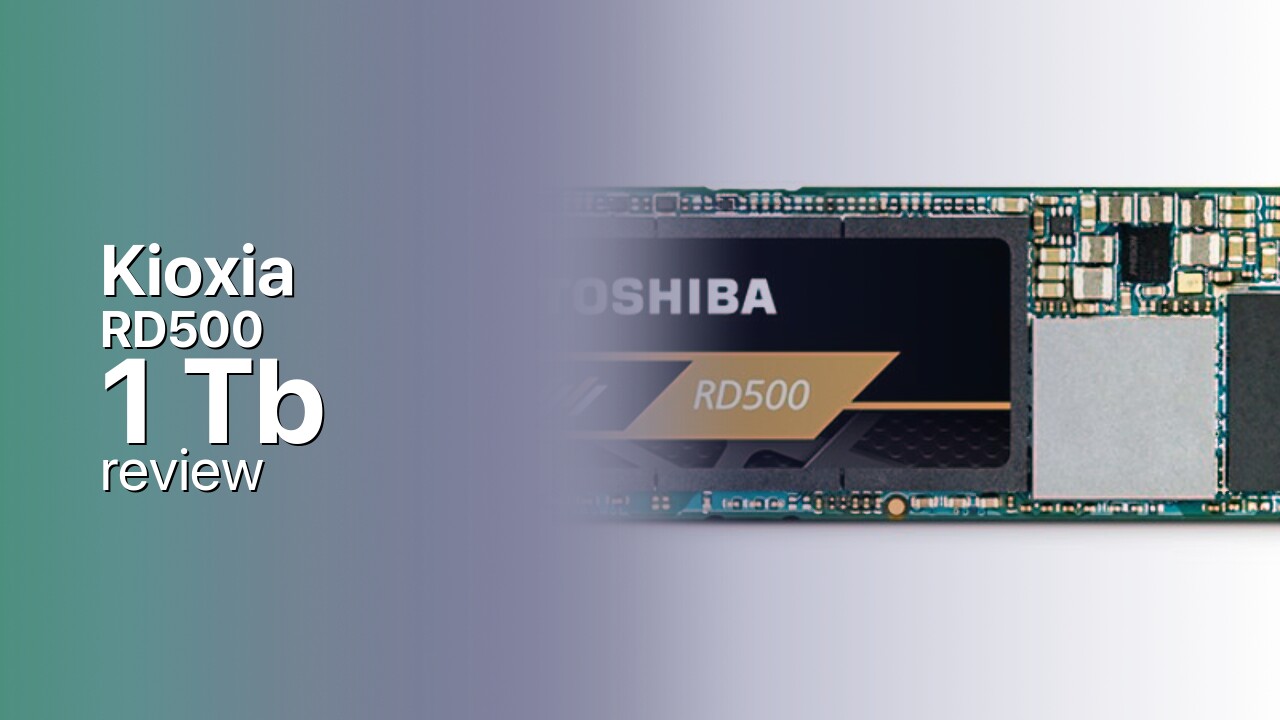
The RD500 dates from Kioxia's rebranding period — the drive launched under the Toshiba name and was later sold as a Kioxia product when Toshiba Memory Corporation spun off and renamed itself in 2019. Internally, it is a Phison PS5012-E12 reference design: an eight-channel PCIe 3.0 x4 controller paired with Toshiba 96-layer BiCS4 3D TLC NAND and 1 GB of DDR4 DRAM. This puts the RD500 in the same platform family as the Sabrent Rocket, Corsair MP510, Silicon Power P34A80, and Seagate FireCuda 510 — all E12-based drives that differ primarily in firmware tuning and warranty terms rather than hardware.
The 1 TB variant delivers the full Phison E12 performance envelope: 3,400 MB/s sequential reads and 3,200 MB/s sequential writes, figures shared with the 512 GB and 2 TB capacities. Unlike some capacity-scaled platforms where the smaller drive is slower, the E12 populates all eight channels at 1 TB, so the throughput ceiling is uniform across the stack. Endurance scales from 200 TBW on the 256 GB to 800 TBW on the 2 TB, with the 1 TB landing at 400 TBW — a conservative rating that reflects Toshiba's warranty approach rather than any NAND limitation, as competing E12 drives at 1 TB often carry 600–800 TBW ratings on the same controller and NAND combination.
As a PCIe 3.0 drive released during the transition to PCIe 4.0, the RD500 occupies an awkward historical position: it launched against the Samsung 970 EVO Plus and WD Black SN750, both Gen3 contemporaries, but arrived just as Gen4 drives like the Phison E16-based Sabrent Rocket 4.0 began appearing. Today, it competes on the used and clearance market against newer DRAM-equipped Gen3 drives and budget Gen4 options. Its value proposition hinges entirely on the Phison E12's mature firmware, the presence of DRAM (which most modern budget drives lack), and pricing well below current-generation PCIe 3.0 flagships.
Storage Comparisons:
RD500 Performance & Benchmarks
Rated at 3,400 MB/s sequential reads and 3,200 MB/s sequential writes, the 1 TB RD500 saturates the PCIe 3.0 x4 bus on reads and comes close on writes. Random performance peaks at 640,000 IOPS read and 600,000 IOPS write — mid-pack for an E12 drive, where firmware tuning and NAND binning can push the ceiling toward 700K IOPS on better-known implementations like the Sabrent Rocket.
Kioxia RD500 1 TB vs M.2 3.0 x 4 peers
Switch between sequential throughput and random IOPS to see how this drive stacks up against other M.2 3.0 x 4 SSDs in our database. The highlighted bar is the drive on this page — click any other bar to open that drive.
- ADATA SX 8800 Pro 512 GB: 3,500 MB/s read, 2,700 MB/s write
- ADATA SX 8800 Pro 1 TB: 3,500 MB/s read, 2,700 MB/s write
- ADATA XPG Spectrix S40G RGB 256 GB: 3,500 MB/s read, 3,000 MB/s write
- ADATA XPG Spectrix S40G RGB 512 GB: 3,500 MB/s read, 3,000 MB/s write
- Kioxia RD500 1 TB (this drive): 3,400 MB/s read, 3,200 MB/s write
The Phison E12's pseudo-SLC cache is generous on the 1 TB model, absorbing tens of gigabytes of burst writes at full speed before transitioning to native TLC speeds around 600–800 MB/s. For an OS and game drive, the cache is effectively never exhausted in normal use — the scenarios that fill it (multi-hundred-gigabyte file dumps) are rare on a consumer desktop. Independent reviewers of the E12 platform consistently note that sustained TLC write speeds on 1 TB variants land in the 600 MB/s range, which is still faster than any SATA SSD and sufficient for all but the most demanding ingest workflows. The RD500 runs warm under sustained load, and Kioxia did not include a heatsink — a point worth noting for ITX builds or laptop installations where airflow is limited.
Kioxia RD500 vs Competitors
See how the RD500 stacks up against other M.2 3.0 x 4 drives in our database:
Compare with rival drives:
Endurance, TBW & Warranty
Kioxia backs the RD500 1 TB with a five-year warranty, limited by a 400 TBW endurance rating. At 20 GB/day, that endurance budget covers approximately 55 years of consumer use. The 400 TBW figure is conservative for a 1 TB Phison E12 drive: competing implementations using the same controller and similar NAND often carry 600 TBW or higher at this capacity, suggesting Kioxia set a cautious warranty ceiling rather than the NAND failing at that threshold. The drive carries a 1.5-million-hour MTBF rating. Warranty service is handled through Kioxia's RMA process, which has been operational since the Toshiba-to-Kioxia rebranding but may have slower turnaround than larger SSD vendors with established retail presence in all regions.
Kioxia RD500 1 TB Specifications
| Category | Value |
|---|---|
| Capacity [?] | 1 TB |
| Interface [?] | M.2 3.0 x 4 |
| Controller [?] | Phison PS5012-E12 |
| Memory type [?] | Toshiba TLC |
| DRAM [?] | 1GB DDR4 |
| Read speed (MB/s) [?] | 3400 |
| Write speed (MB/s) [?] | 3200 |
| Read IOPS [?] | 640000 |
| Write IOPS [?] | 600000 |
| Endurance (TBW) [?] | 400 |
| MTBF (million hours) [?] | 1.5 |
| Warranty (years) [?] | 5 |
Verdict: Is the RD500 Worth It in 2026?
The Kioxia RD500 1 TB is a competent Phison E12 reference drive that does nothing wrong and nothing to stand out from a dozen near-identical competitors. Its DRAM cache and BiCS4 TLC NAND give it a clear advantage over modern DRAM-less budget SSDs, but against other E12 drives like the Sabrent Rocket or Corsair MP510, the RD500's lower 400 TBW endurance rating and now-discontinued status make it a harder sell at anything above clearance pricing. It is a sensible buy if found at a deep discount for a secondary system, an external NVMe enclosure, or as a reliable OS drive in a legacy PCIe 3.0 platform where Gen4 capability would go unused. Buyers building a new system in 2026 should look at the Kioxia Exceria Pro or a budget PCIe 4.0 drive instead — the RD500's era has passed, and even entry-level Gen4 drives now match or exceed its peak throughput at similar pricing.
+ Pros
- 3,400 MB/s sequential reads — saturating PCIe 3.0 x4
- Phison E12 controller with 1 GB DDR4 DRAM cache
- Toshiba BiCS4 96-layer TLC NAND — no QLC endurance penalty
- Single-sided M.2 2280 PCB compatible with thin laptops
- 5-year warranty from a tier-one NAND manufacturer
- Cons
- 400 TBW endurance — conservative vs 600+ TBW on competing E12 drives
- PCIe 3.0 ceiling limits upgrade path on newer platforms
- No factory heatsink — runs warm under sustained write loads
- Discontinued product — limited retail availability, used market only
- Firmware updates require Windows-only Kioxia SSD Utility
Buy this or similar SSD Storage:



Video Review
Toshiba RD500 SSD NVME Unboxing e Review