Lexar NM700 1TB Review — A DRAM-Equipped PCIe 3.0 NVMe SSD (2026)
Quick answer
The Lexar NM700 1 TB makes sense for a specific buyer: someone on a PCIe 3.0 platform who wants a DRAM-equipped NVMe drive at a budget price and is willing to buy used or NOS.
Read: 3500 MB/s Write: 2000 MB/s Endurance: 600 TBW Warranty: 5 years Interface: M.2 3.0 x 4
The Lexar NM700 1 TB is a PCIe 3.0 NVMe drive that earns its keep through a dedicated DRAM cache and strong sequential throughput at a price tier where most competitors have already ditched the buffer.
Controller & Memory
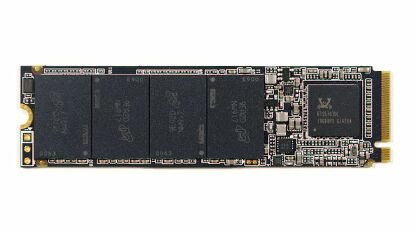
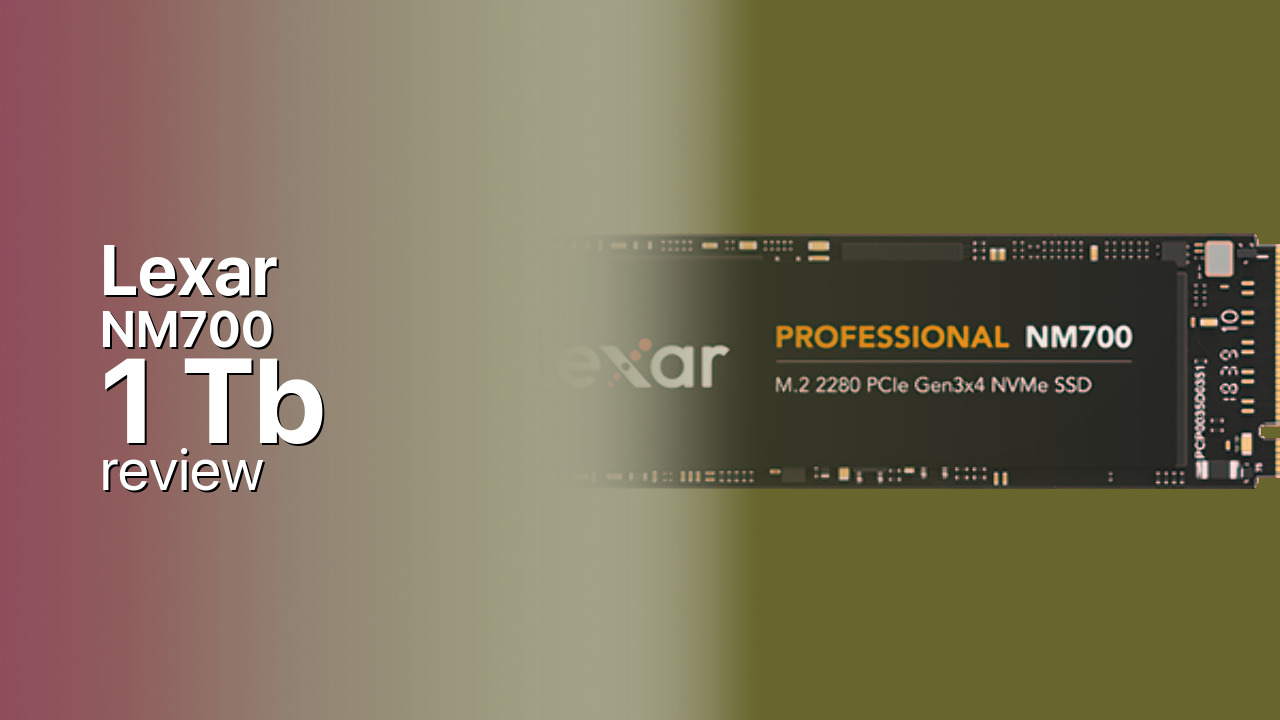
The Lexar NM700 pairs a Marvell 88SS1092 controller with 3D TLC NAND and 1 GB of Nanya LPDDR3-1866 DRAM on a single-sided M.2 2280 PCB. The Marvell 88SS1092 is an older triple-core, eight-channel design that also appeared in the Plextor M8Pe and Toshiba XG5, and while it lacks the power efficiency of newer controllers, the eight-channel architecture gives it decent parallelism when paired with enough NAND dies. The single-sided PCB is a practical advantage — it fits into thin laptops and ultrabooks that cannot accommodate double-sided drives, something several of the NM700's competitors at this price point cannot claim.
Lexar launched the NM700 in mid-2020 as a mid-range PCIe 3.0 drive aimed at system builders who wanted DRAM-backed performance without paying the Samsung tax. The 1 TB variant delivers 3,500 MB/s sequential reads and 2,000 MB/s sequential writes, with a dynamic SLC cache that holds roughly 1,800 MB/s writes for transfers up to about 330 GB before dropping to approximately 400 MB/s in direct-to-TLC mode. That cache is generously sized relative to the drive's total capacity, which keeps real-world write performance snappy for most consumer workloads. The NM700 also benefits from Lexar's status as a subsidiary of Longsys, one of the largest NAND flash distributors, which gives the brand more supply-chain credibility than many smaller SSD vendors.
The NM700 launched at a time when the PCIe 3.0 market was crowded, and it landed somewhere in the middle. It is faster than DRAM-less alternatives like the WD Blue SN550 but cannot match the Samsung 970 EVO Plus in either peak throughput or random I/O — Samsung's in-house Phoenix controller and V-NAND combination simply runs cleaner. The NM700 has been effectively discontinued as Lexar shifted focus to PCIe 4.0 models like the NM760, NM790, and NM800 series, but used and new-old-stock 1 TB units remain available. For anyone building or upgrading a PCIe 3.0 system who wants a DRAM cache without paying for a used 970 EVO Plus, the NM700 is worth a look — provided the price is right.
Storage Comparisons:
NM700 Performance & Benchmarks
The Lexar NM700 1 TB is rated for 3,500 MB/s sequential reads and 2,000 MB/s sequential writes, with random performance of up to 293,000 IOPS reads and 272,000 IOPS writes. These figures are competitive for a PCIe 3.0 x4 drive and reflect the Marvell 88SS1092's eight-channel architecture running at full lane saturation. Independent reviewers found the NM700 hitting its rated sequential numbers consistently, though random I/O performance at low queue depths — the pattern most relevant to boot and application launch — fell noticeably behind the Samsung 970 EVO Plus and even some DRAM-less HMB designs like the WD Blue SN570.
Lexar NM700 1 TB vs M.2 3.0 x 4 peers
Switch between sequential throughput and random IOPS to see how this drive stacks up against other M.2 3.0 x 4 SSDs in our database. The highlighted bar is the drive on this page — click any other bar to open that drive.
- Lexar NM700 1 TB (this drive): 3,500 MB/s read, 2,000 MB/s write
- ADATA SX 8800 Pro 512 GB: 3,500 MB/s read, 2,700 MB/s write
- ADATA SX 8800 Pro 1 TB: 3,500 MB/s read, 2,700 MB/s write
- ADATA XPG Spectrix S40G RGB 256 GB: 3,500 MB/s read, 3,000 MB/s write
- ADATA XPG Spectrix S40G RGB 512 GB: 3,500 MB/s read, 3,000 MB/s write
The NM700's SLC cache behavior is a mixed story. The dynamic cache is large — up to roughly 330 GB when the drive is mostly empty — and sustains writes at around 1,800 MB/s until exhaustion, which covers nearly any real-world consumer transfer. After the cache fills, direct-to-TLC writes settle at approximately 400 MB/s, which is competitive with SATA SSDs but slower than the ~600 MB/s sustained that the 970 EVO Plus manages in its own post-cache regime. Thermally, the NM700 runs hot — reviewers recorded controller temperatures reaching the mid-90s Celsius under sustained sequential load, which triggered thermal throttling in some test scenarios. A motherboard M.2 heatsink or at least passive airflow is recommended, especially in compact cases. For gaming, the NM700 loads titles within a second or two of faster PCIe 4.0 drives, and the DRAM cache keeps Windows responsive during mixed read/write multitasking that would cause DRAM-less drives to stutter.
Lexar NM700 vs Competitors
See how the NM700 stacks up against other M.2 3.0 x 4 drives in our database:
Compare with rival drives:
Endurance, TBW & Warranty
Lexar covers the NM700 1 TB with a 5-year limited warranty and rates the drive for 600 TBW of endurance. At 600 TBW, the NM700 can absorb roughly 328 GB of writes per day for the full five-year warranty period — an endurance envelope that exceeds typical consumer workloads of 20 to 50 GB per day by a wide margin. At a 30 GB/day pace, the drive would last over 50 years before hitting the TBW limit, so write endurance is effectively a non-issue for gaming and general desktop use. The MTBF is rated at 1.5 million hours, a standard population statistic for consumer NVMe SSDs that reflects expected failure rates across a large installed base. The 256 GB and 512 GB variants carry lower endurance ratings of 150 TBW and 300 TBW respectively, making the 1 TB model the clear choice for buyers who plan to keep the drive long-term. Lexar handles warranty claims through its standard RMA channel, and the brand's backing by Longsys provides more stability than some smaller SSD labels.
Lexar NM700 1 TB Specifications
| Category | Value |
|---|---|
| Capacity [?] | 1 TB |
| Interface [?] | M.2 3.0 x 4 |
| Controller [?] | Marvell 88SS1092 |
| Memory type [?] | 3D TLC |
| DRAM [?] | Nanya LPDDR3 |
| Read speed (MB/s) [?] | 3500 |
| Write speed (MB/s) [?] | 2000 |
| Read IOPS [?] | 293000 |
| Write IOPS [?] | 272000 |
| Endurance (TBW) [?] | 600 |
| MTBF (million hours) [?] | 1.5 |
| Warranty (years) [?] | 5 |
Verdict: Is the NM700 Worth It in 2026?
The Lexar NM700 1 TB makes sense for a specific buyer: someone on a PCIe 3.0 platform who wants a DRAM-equipped NVMe drive at a budget price and is willing to buy used or NOS. The dedicated 1 GB LPDDR3 buffer keeps the drive responsive under mixed workloads that would cause DRAM-less alternatives to falter, and the 600 TBW endurance rating on a 5-year warranty is solid for this price class. Gamers, office-PC builders, and anyone cloning an old SATA SSD will find the NM700 a meaningful upgrade. Skip it if you can stretch to a used Samsung 970 EVO Plus, which is faster in every metric and runs cooler, or if your motherboard supports PCIe 4.0 — a new WD Blue SN580 or Lexar's own NM790 costs roughly the same and delivers Gen4 bandwidth with better thermals. The NM700's age shows in its power draw and heat output, but for a DRAM-backed PCIe 3.0 stopgap, it gets the fundamentals right.
+ Pros
- 3,500 MB/s sequential reads at PCIe 3.0 ceiling
- Dedicated 1 GB LPDDR3 DRAM cache for consistent mixed workloads
- Single-sided PCB fits thin laptops and ultrabooks
- 600 TBW endurance with 5-year warranty
- Large dynamic SLC cache holds up to ~330 GB of sustained writes
- Often priced well below the Samsung 970 EVO Plus on the used market
- Cons
- Runs hot — controller can hit 94°C and thermal throttle under sustained load
- Random I/O at low queue depths trails Samsung 970 EVO Plus and some HMB drives
- Post-cache write speed drops to ~400 MB/s
- Effectively discontinued — limited to used and NOS stock
- No PCIe 4.0 support — cannot be used in a PS5
Buy this or similar SSD Storage:



Video Review
Lexar NM700 Gen 3x4 NVMe M.2 - Is It The One to Get?