Gigabyte Aorus 7000S 1TB SSD — Phison E18 NVMe Review (2026)
Quick answer
The Gigabyte Aorus 7000S 1TB is a solid PCIe 4.0 pick for builders who want a bundled heatsink and single-sided compatibility out of the box.
Read: 7000 MB/s Write: 5500 MB/s Endurance: 700 TBW Warranty: 5 years Interface: M.2 4.0 x 4
The Gigabyte Aorus 7000S 1TB pairs Phison's E18 controller with Micron 96L TLC and a nanocarbon heatsink for sustained PCIe 4.0 throughput without throttling.
Controller & Memory
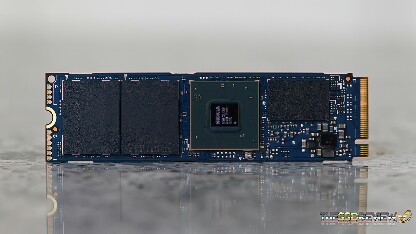
Under the aluminum heatsink sits Phison's PS5018-E18, a triple-core Arm Cortex-R5 controller clocked at 1 GHz with a two-core CoXProcessor 2.0 for NAND management. The 1TB model carries 1 GB of DDR4 DRAM and Micron 96-layer (B27B) TLC NAND across four packages on one side of the PCB. Unlike the 2TB variant, the 1TB is single-sided, which matters for laptop and PS5 compatibility.
Gigabyte rates the 1TB capacity at 7,000 MB/s sequential read and 5,500 MB/s sequential write — the write speed trails the 2TB model's 6,850 MB/s because the smaller capacity has fewer NAND dies to interleave. Random performance is rated at 350,000 read and 700,000 write IOPS, again lower than the 2TB's 650,000 read IOPS. The drive supports AES-256 hardware encryption and NVMe 1.4. The included heatsink adds roughly 7 mm of height and is removable if the motherboard already has an M.2 heatsink.
Competitors in the same PCIe 4.0 tier include the Samsung 980 Pro, WD Black SN850, and Corsair MP600 Pro — all E18 or similar Elpis/SMi controllers. The Aorus 7000S differentiates primarily through its bundled nanocarbon heatsink and the double-sided thermal pad design, which keeps the controller well below throttling temperatures during extended writes.
Storage Comparisons:
Aorus 7000S Performance & Benchmarks
The Aorus 7000S 1TB is manufacturer-rated for 7,000 MB/s sequential read and 5,500 MB/s sequential write. These are SLC-cached burst figures. Independent reviews from Tom's Hardware and Legit Reviews confirm that real-world CrystalDiskMark results closely match the rated read speed, while sustained writes settle to roughly 1,800 MB/s once the SLC cache fills, typically after several hundred gigabytes of continuous writes. For gaming and general desktop use, the cache is more than large enough that the drop-off rarely matters.
Gigabyte Aorus 7000S 1 TB vs M.2 4.0 x 4 peers
Switch between sequential throughput and random IOPS to see how this drive stacks up against other M.2 4.0 x 4 SSDs in our database. The highlighted bar is the drive on this page — click any other bar to open that drive.
- Patriot Viper PV593 1 TB: 14,500 MB/s read, 14,000 MB/s write
- Patriot Viper PV593 2 TB: 14,500 MB/s read, 14,000 MB/s write
- Patriot Viper PV593 4 TB: 14,500 MB/s read, 14,000 MB/s write
- Patriot Viper PV573 2 TB: 14,000 MB/s read, 12,000 MB/s write
- Gigabyte Aorus 7000S 1 TB (this drive): 7,000 MB/s read, 5,500 MB/s write
The 350,000 random read IOPS on the 1TB model is noticeably lower than the 2TB's 650,000 figure, reflecting the fewer parallel NAND channels available at this capacity. In practice, this shows up in QD1 random read latency more than in typical desktop workloads. Game load times, OS boot, and application launches are largely indistinguishable from competing Phison E18 drives at the same capacity. The 700,000 random write IOPS rating matches the 2TB, so write-heavy workloads like video scratch disks hold up well within the SLC cache.
Gigabyte Aorus 7000S vs Competitors
See how the Aorus 7000S stacks up against other M.2 4.0 x 4 drives in our database:
Compare with rival drives:
Endurance, TBW & Warranty
Gigabyte rates the Aorus 7000S 1TB at 700 TBW (terabytes written) endurance with a 5-year warranty, whichever comes first. At a typical consumer write workload of 20 GB per day, the drive would take roughly 96 years to exhaust its endurance rating — effectively a non-issue for any desktop user. Even a heavier 100 GB/day workflow would take over 19 years. The 5-year warranty period is standard for this tier. The drive is backed by Gigabyte's SSD Toolbox utility, which provides S.M.A.R.T. health monitoring and secure erase functionality, though it lacks the cloning tools bundled by some competitors.
Gigabyte Aorus 7000S 1 TB Specifications
| Category | Value |
|---|---|
| Capacity [?] | 1 TB |
| Interface [?] | M.2 4.0 x 4 |
| Controller [?] | Phison E18 |
| Memory type [?] | Micron TLC |
| DRAM [?] | 1GB or 2GB DDR4 |
| Read speed (MB/s) [?] | 7000 |
| Write speed (MB/s) [?] | 5500 |
| Read IOPS [?] | 350000 |
| Write IOPS [?] | 700000 |
| Endurance (TBW) [?] | 700 |
| MTBF (million hours) [?] | 1.6 |
| Warranty (years) [?] | 5 |
Verdict: Is the Aorus 7000S Worth It in 2026?
The Gigabyte Aorus 7000S 1TB is a solid PCIe 4.0 pick for builders who want a bundled heatsink and single-sided compatibility out of the box. The 5,500 MB/s write speed and 350K random read IOPS are measurably lower than the 2TB variant, so users chasing maximum Gen4 throughput should step up to the larger capacity. For gaming builds, PS5 upgrades, or a fast OS drive where the heatsink saves buying a separate cooler, the 1TB holds its own against the Samsung 980 Pro and WD Black SN850. Those who prefer a bare drive with no heatsink height penalty should look at the Sabrent Rocket 4 Plus or the Corsair MP600 Pro instead.
+ Pros
- 7,000 MB/s sequential reads
- Included nanocarbon heatsink
- Single-sided PCB fits laptops and PS5
- 700 TBW endurance with 5-year warranty
- AES-256 hardware encryption
- Cons
- 5,500 MB/s writes trail the 2TB model
- 350K random read IOPS at 1TB capacity
- SLC cache slow to recover after heavy writes
- SSD Toolbox lacks cloning software
Buy this or similar SSD Storage:



Video Review
The Next Generation Of SSDs - Aorus 7000s