Intel SSD 670P 1TB QLC NVMe Review (2026)
Quick answer
The Intel 670P 1TB is a solid budget QLC NVMe SSD that delivers competitive read speeds and generous capacity at a low cost per GB.
Read: 3500 MB/s Write: 2500 MB/s Endurance: 370 TBW Warranty: 5 years Interface: M.2 3.0 x 4
The Intel 670P 1TB is the mid-capacity option in Intel's third-generation QLC NVMe line, offering a strong price-to-capacity ratio with the newer SM2265G controller and 144-layer QLC flash.
Controller & Memory
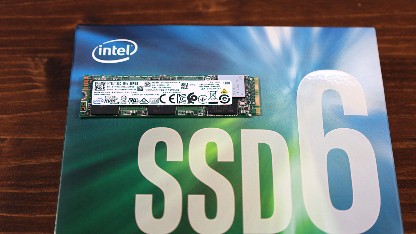
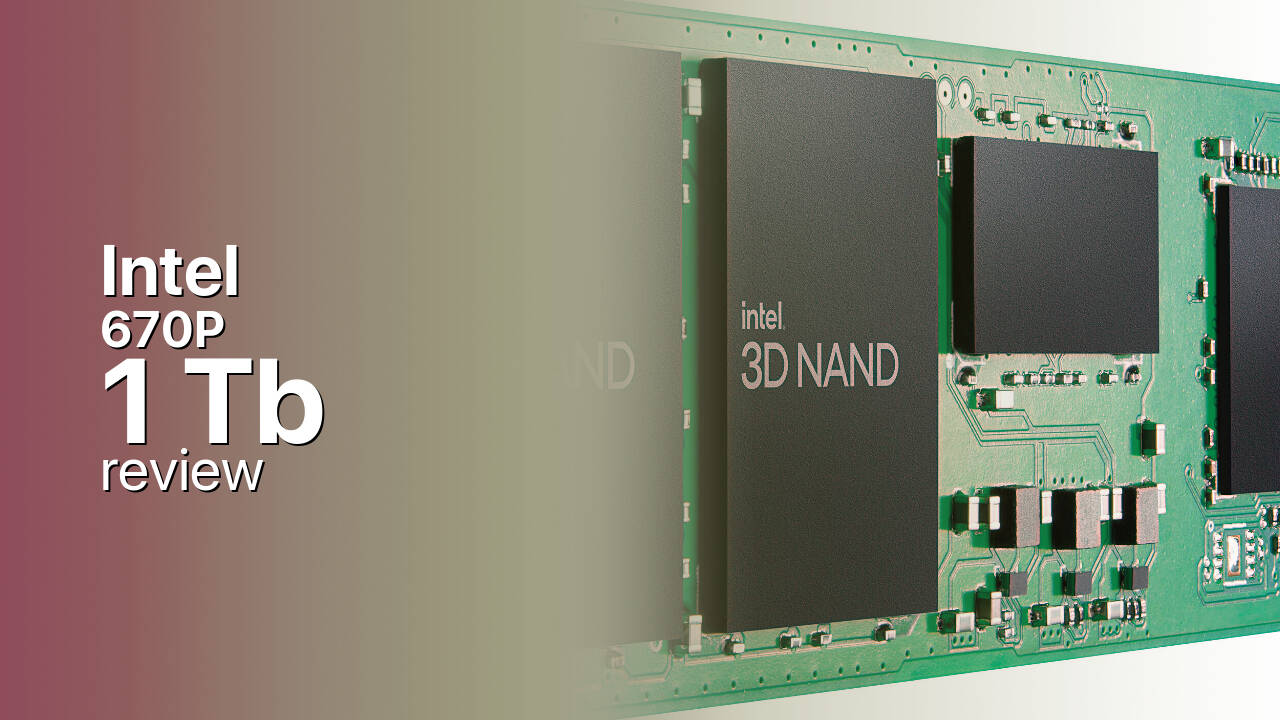
Under the hood, the 670P 1 TB pairs the Silicon Motion SM2265G controller with Intel's 144-layer 1 Tbit 3D QLC NAND. A 256 MB Nanya DDR3L DRAM chip handles the flash translation layer. The single-sided M.2 2280 form factor makes it compatible with thin laptops and compact desktop builds.
The 1 TB model hits 3,500 MB/s sequential reads and 2,500 MB/s writes -- a significant step up from the 512 GB model's 3,000 / 1,600 MB/s. Random performance scales to 220,000 read IOPS and 330,000 write IOPS. Endurance is rated at 370 TBW with a 5-year warranty, and the SLC cache ranges from 12 GB minimum up to 140 GB when the drive is mostly empty.
The 670P 1 TB competes with QLC drives like the Crucial P3 1 TB and Samsung 870 QVO 1 TB, as well as budget TLC NVMe drives. Its strength is high read speed at a low cost per GB; the weakness is QLC's inherent write slowdown after the SLC cache fills.
Storage Comparisons:
670P Performance & Benchmarks
At 3,500 MB/s sequential reads and 2,500 MB/s writes, the 1 TB 670P comes close to saturating the PCIe 3.0 x4 interface -- an impressive showing for a QLC drive. The read speed matches many mainstream TLC competitors, and the write speed is competitive with entry-level TLC NVMe drives as long as writes stay within the SLC cache.
Intel 670P 1 TB vs M.2 3.0 x 4 peers
Switch between sequential throughput and random IOPS to see how this drive stacks up against other M.2 3.0 x 4 SSDs in our database. The highlighted bar is the drive on this page — click any other bar to open that drive.
- Intel 670P 1 TB (this drive): 3,500 MB/s read, 2,500 MB/s write
- ADATA SX 8800 Pro 512 GB: 3,500 MB/s read, 2,700 MB/s write
- ADATA SX 8800 Pro 1 TB: 3,500 MB/s read, 2,700 MB/s write
- ADATA XPG Spectrix S40G RGB 256 GB: 3,500 MB/s read, 3,000 MB/s write
- ADATA XPG Spectrix S40G RGB 512 GB: 3,500 MB/s read, 3,000 MB/s write
Random IOPS land at 220,000 reads and 330,000 writes. The write IOPS figure is strong and reflects the SM2265G controller's improved handling of QLC flash. Read IOPS, while decent, trail TLC drives like the Samsung 970 EVO by a notable margin.
The QLC caveat: once the SLC cache is exhausted, write performance drops to the native QLC write speed, which is substantially slower than TLC. AnandTech's testing of the 2 TB model showed the 670P performed well in real-world traces where idle time allowed the cache to flush, but struggled under sustained heavy write workloads. The 1 TB model, with its 12 GB minimum cache, is more vulnerable to cache exhaustion than the 2 TB.
Intel 670P vs Competitors
See how the 670P stacks up against other M.2 3.0 x 4 drives in our database:
Compare with rival drives:
Endurance, TBW & Warranty
Intel rates the 670P 1 TB at 370 TBW over its 5-year warranty, equating to roughly 203 GB of writes per day. At 0.2 drive writes per day, this endurance is 85% higher than the older 660P at the same capacity (200 TBW) and close to the 0.3 DWPD typical of mainstream TLC drives. For consumers writing 20 to 50 GB daily, the endurance limit is far out of reach. Warranty service is through Intel's standard RMA process, limited by whichever comes first: the 5-year term or the TBW threshold.
Intel 670P 1 TB Specifications
| Category | Value |
|---|---|
| Capacity [?] | 1 TB |
| Interface [?] | M.2 3.0 x 4 |
| Controller [?] | Silicon Motion SM2265G |
| Memory type [?] | Intel 144L 3D QLC |
| DRAM [?] | Nanya 256MB DDR3L |
| Read speed (MB/s) [?] | 3500 |
| Write speed (MB/s) [?] | 2500 |
| Read IOPS [?] | 220000 |
| Write IOPS [?] | 330000 |
| Endurance (TBW) [?] | 370 |
| MTBF (million hours) [?] | 1200000 |
| Warranty (years) [?] | 5 |
Verdict: Is the 670P Worth It in 2026?
The Intel 670P 1TB is a solid budget QLC NVMe SSD that delivers competitive read speeds and generous capacity at a low cost per GB. It is best suited for users who primarily read data -- game libraries, media consumption, OS drives -- rather than those who frequently write large files. For sustained write workloads, a TLC NVMe drive like the Kingston KC2500 or WD Blue SN570 is a better investment. At this capacity the 670P offers strong value, and the 370 TBW endurance provides peace of mind for typical consumer use.
+ Pros
- 3,500 MB/s sequential reads
- 2,500 MB/s sequential writes
- 370 TBW endurance, improved over 660P
- DRAM cache (256 MB Nanya DDR3L)
- Single-sided M.2 2280 fits thin laptops
- 5-year warranty
- Cons
- QLC write speed drops after SLC cache fills
- 220,000 random read IOPS, below TLC competitors
- 0.2 DWPD endurance lower than TLC drives
- 12 GB minimum SLC cache is modest
- PCIe 3.0 only
Buy this or similar SSD Storage:



Video Review
The Intel 670p NVMe is here! Yes, this is a budget NVMe SSD that you should be excited about.