What Is DRAM Cache in an SSD? Does It Matter?
DRAM cache is a small memory chip on some SSDs that stores the drive's mapping table. It helps the controller find data faster and can improve responsiveness, sustained performance, and efficiency.
What DRAM cache actually does
An SSD needs a map that tells the controller where data lives on the NAND flash. DRAM stores that map in fast memory so the controller does not need to keep checking the flash itself.
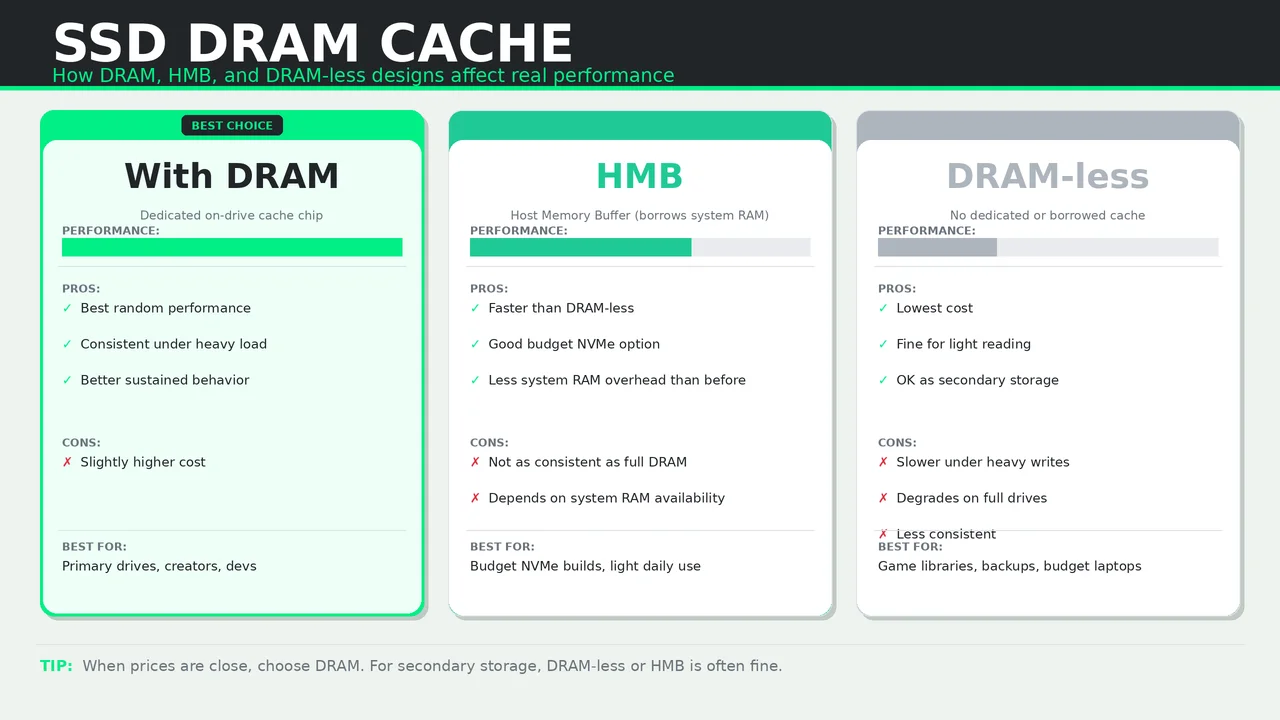
SSDs with DRAM vs DRAM-less SSDs
SSDs with dedicated DRAM
- Better random performance
- Better sustained behavior during heavy use
- Less overhead on the NAND
- More consistent performance over time
DRAM-less SSDs
- Lower purchase cost
- Can still feel fast for light daily use
- Often slow down more under heavy writes or when the drive is nearly full
What is HMB?
Many NVMe DRAM-less drives use Host Memory Buffer (HMB). This lets the SSD borrow a small amount of system RAM instead of having dedicated DRAM on the drive.
HMB has improved with newer standards and is a good middle ground for budget NVMe drives. It is not quite as good as full DRAM, but it is much better than early DRAM-less designs.
How much does DRAM cache matter for gaming?
For game loading and general desktop use, the difference is often small. DRAM becomes more important for:
- Heavy multitasking
- Content creation and large file workloads
- Drives that are nearly full
- Sustained write performance
Buying advice
- If prices are close, choose a DRAM drive.
- For secondary storage or game libraries, DRAM-less or HMB is often fine.
- Check real-world benchmarks for the specific drive — controller and firmware matter as much as DRAM itself.