SSD NAND Types: TLC vs QLC vs MLC vs SLC Explained
Posted on
by
Raymond Chen
NAND type refers to how many bits are stored per memory cell. It affects price, endurance, speed, and write behavior. Most modern consumer SSDs use TLC or QLC NAND.
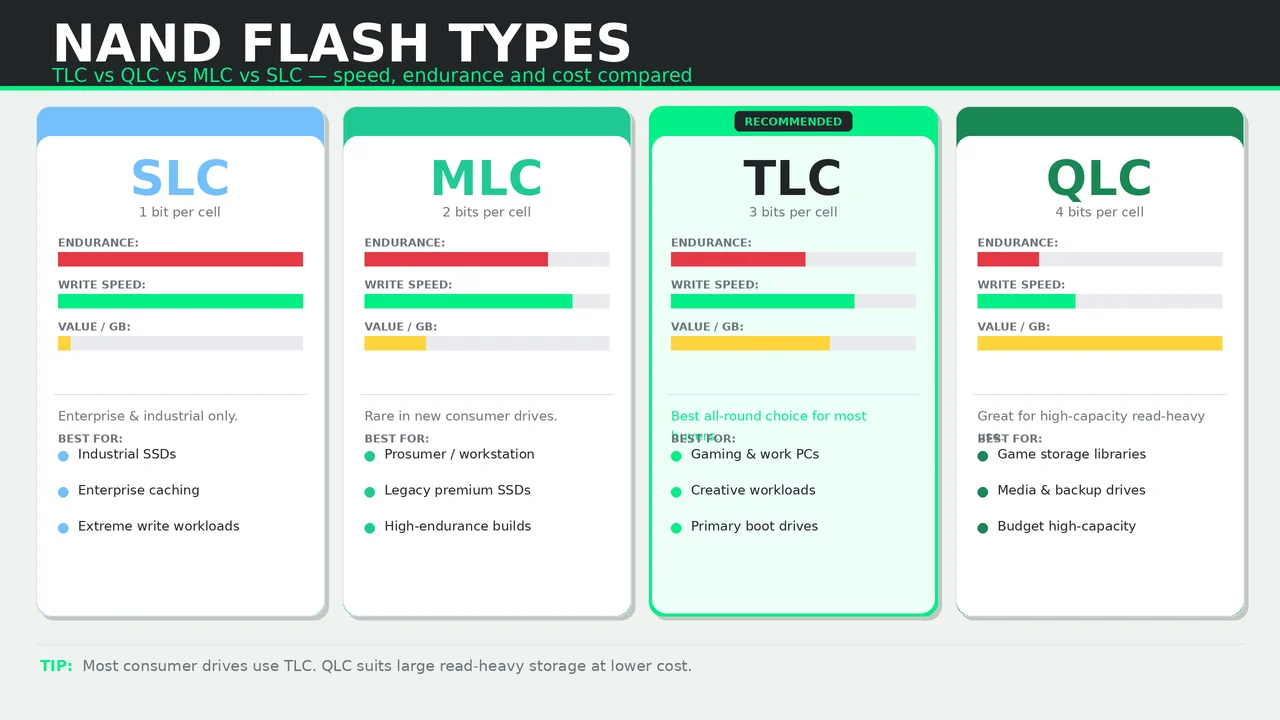
Common NAND types in consumer SSDs
- TLC (Triple-Level Cell) — 3 bits per cell. Best balance of speed, endurance, and price. Used in most current drives.
- QLC (Quad-Level Cell) — 4 bits per cell. Cheaper per gigabyte but lower endurance and slower under heavy writes. Good for game libraries and read-heavy storage.
- MLC (Multi-Level Cell) — 2 bits per cell. Higher endurance but rare in new consumer drives. Mostly enterprise or legacy prosumer.
- SLC (Single-Level Cell) — 1 bit per cell. Highest endurance and speed but very expensive per gigabyte. Enterprise and industrial only.
How does NAND type affect SSD lifespan?
More bits per cell means lower endurance. TLC handles more write cycles than QLC. MLC and SLC last even longer but cost more and are uncommon in consumer gear.
For most home users, even QLC endurance is plenty. It becomes relevant for heavy write workloads such as video editing, VMs, or database servers.
How does NAND type affect speed?
- Read speed — TLC and QLC are similar for sequential reads. Random reads can favor TLC slightly.
- Write speed — TLC is faster, especially sustained writes after the SLC cache fills. QLC can slow down more noticeably.
- SLC caching — Both TLC and QLC use SLC caching for fast burst writes. QLC drives tend to have smaller caches and drop to native speed sooner.
Which NAND type should you choose?
- Choose TLC for primary drives, gaming, creative work, and general use.
- Choose QLC when you need affordable high capacity and your workload is mostly read-heavy.
- Do not judge by NAND type alone — firmware, controller quality, DRAM cache, and warranty all matter too.