What Is SSD MTBF and Does It Matter?
MTBF stands for Mean Time Between Failures. It is a statistical model for large populations of drives, not a prediction for your specific SSD.
What MTBF really means
MTBF is calculated from accelerated lab testing and failure statistics. A 2 million hour MTBF does not mean your drive will last 2 million hours. It means that across a large population, the average time between failures is projected to be that high.
For individual users, MTBF is not a guarantee. It is more useful as a signal of component quality and manufacturer confidence.
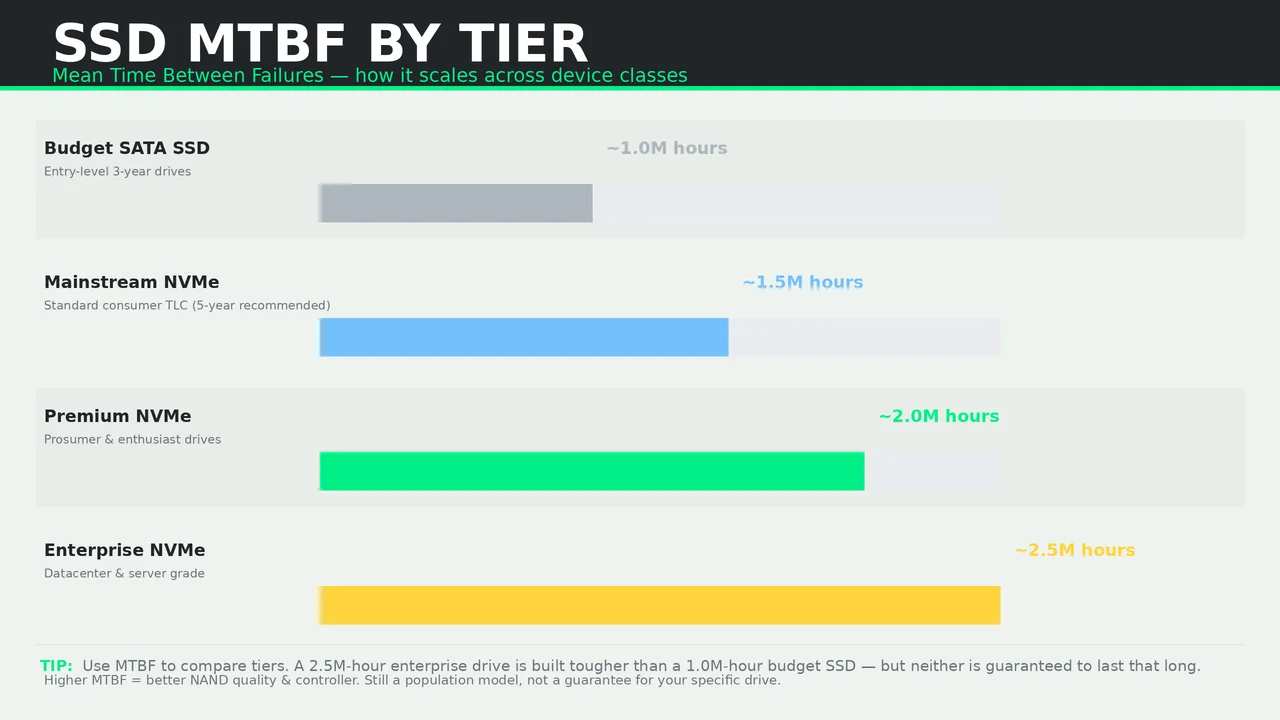
Typical MTBF by drive tier
- Budget SATA SSD — around 1.0 million hours
- Mainstream NVMe — around 1.5 to 2.0 million hours
- Premium NVMe — around 2.0 to 2.5 million hours
- Enterprise drives — 2.5 million hours or more
Higher MTBF usually correlates with better NAND, better controller, and more conservative firmware tuning.
Why MTBF is overrated
Real-world reliability is affected by power quality, temperature, usage patterns, and manufacturing variance. Two drives with identical MTBF can have very different failure rates in practice.
Better reliability signals to use instead
- Warranty length — 5-year coverage shows more confidence than 3-year.
- TBW rating — Higher TBW means better NAND endurance.
- Controller quality — Proven brands with mature firmware.
- Real-world reviews — Long-term failure reports and user experiences.
- Thermal behavior — Excessive heat shortens drive life.