Does the SSD Controller Matter for Performance?
Posted on
by
Raymond Chen
The SSD controller is the brain of the drive. It manages all NAND reads and writes, error correction, wear leveling, garbage collection, and caching. Two SSDs with identical NAND can perform very differently if they use different controllers.
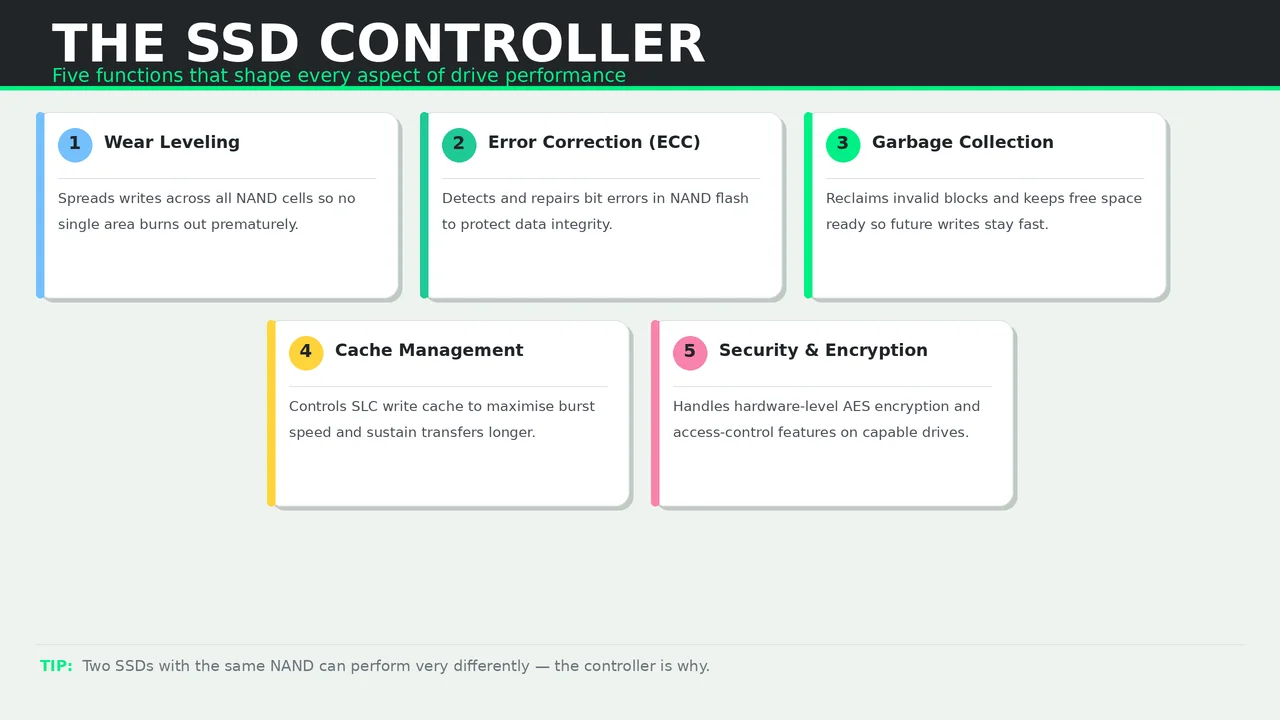
What does the SSD controller actually do?
- Translates system commands into NAND operations
- Performs wear leveling to spread writes evenly
- Runs error correction (ECC) to protect data integrity
- Manages SLC caching and DRAM usage
- Handles garbage collection in the background
- Executes firmware for power management and features
Does the controller matter for everyday buyers?
Yes. A good controller can make budget NAND perform well, and a bad controller can waste high-end NAND. Real-world tests of sustained performance, multitasking, and drive responsiveness often reflect controller quality more than NAND type or specs on paper.
How to judge controller quality
- Brand reputation — Phison, Samsung, WD, SK Hynix, and Micron have strong track records.
- Firmware maturity — Avoid very new controllers with unproven firmware unless reviews are excellent.
- Real-world benchmarks — Check sustained write tests, not just peak numbers.
- Thermal behavior — Good controllers manage heat without aggressive throttling.
Controller and NAND pairing
Manufacturers pair controllers and NAND carefully. A TLC drive with a premium controller often outperforms a similar QLC drive with a budget controller. When comparing SSDs, look at full reviews, not just the NAND type or the controller name.