Crucial P3 Plus 2TB PCIe 4.0 NVMe SSD Review (2026)
Quick answer
Buy the Crucial P3 Plus 2TB if you want PCIe 4.0 performance on a budget and your workload is mostly gaming, general productivity, and media consumption.
Read: 4800 MB/s Write: 4100 MB/s Endurance: 800 TBW Warranty: 5 years Interface: M.2 4.0 x 4
The Crucial P3 Plus 2TB is a budget-friendly PCIe 4.0 NVMe SSD that trades premium performance for aggressive pricing, making it a solid choice for gamers and general users who want Gen 4 speeds without paying flagship prices.
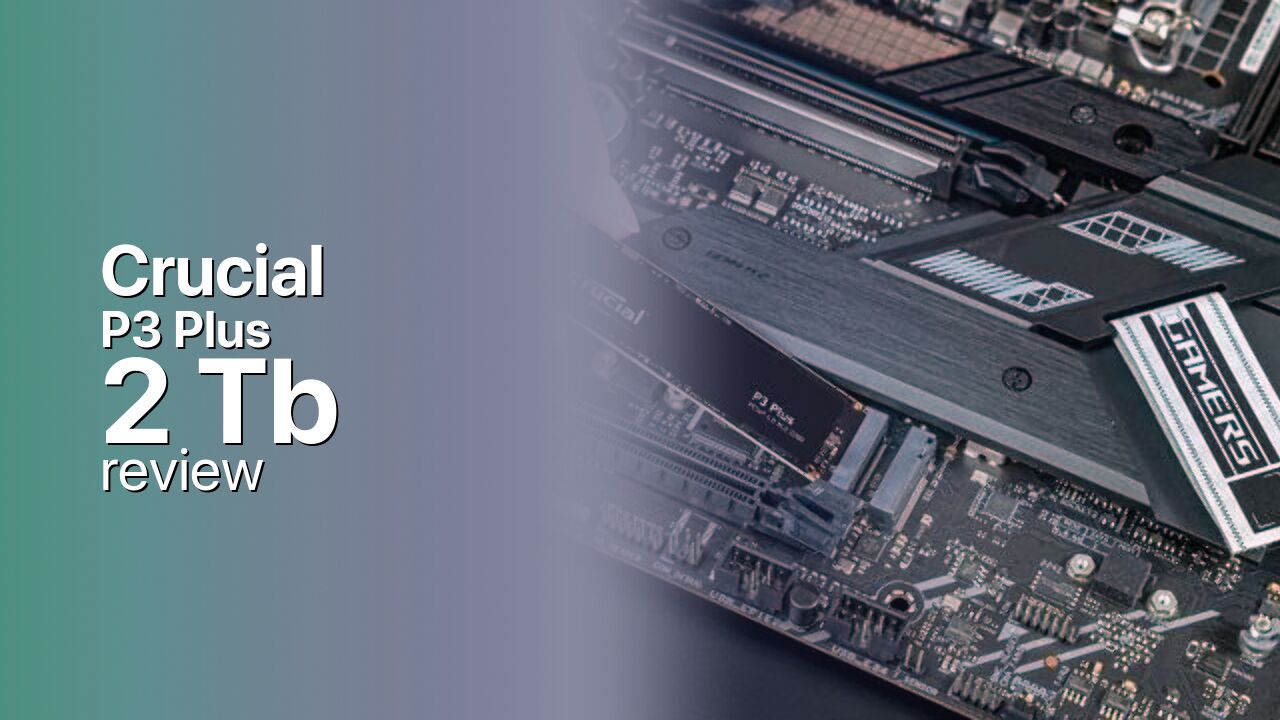
Controller & Memory
Under the hood, the P3 Plus uses Micron's own 176-layer QLC NAND paired with a Phison E21T controller. This is a DRAM-less design that relies on Host Memory Buffer (HMB) technology, borrowing a small portion of system RAM to handle the NAND mapping table that a dedicated DRAM chip would normally manage. The drive ships on a standard M.2 2280 form factor and is available in capacities ranging from 500 GB up to 4 TB.
The 2 TB variant sits in the sweet spot of the lineup, offering 4,800 MB/s sequential reads and 4,100 MB/s sequential writes. Smaller capacities take a performance hit on writes, while the 4 TB model pushes slightly higher numbers. Because this is a QLC-based drive, sustained write performance drops after the SLC cache exhausts, but for typical gaming and productivity workloads that rarely becomes noticeable. No heatsink is included, so if you are installing this in a PS5 or a motherboard with poor M.2 airflow, plan to add a third-party cooler.
Competition in this budget PCIe 4.0 segment includes the WD Blue SN580, Kingston NV2, and Crucial's own P5 Plus. The P3 Plus distinguishes itself with a higher endurance rating (800 TBW on this 2 TB model) and a full 5-year warranty, which is uncommon at this price point. It is not the fastest Gen 4 drive, and QLC NAND makes it less ideal for heavy sustained write workloads like 4K video editing, but as a game library drive or OS boot volume, it hits the right notes.
Storage Comparisons:
P3 Plus Performance & Benchmarks
Rated at 4,800 MB/s sequential reads and 4,100 MB/s sequential writes, the P3 Plus delivers roughly three times the throughput of SATA SSDs and enough headroom for current PCIe 4.0 gaming loads. Random performance comes in at up to 680,000 IOPS reads and 800,000 IOPS writes, which translates to snappy OS responsiveness and quick game load times. Independent testing shows real-world gaming load times that are within striking distance of more expensive TLC-based drives, thanks in part to the Phison E21T controller's efficient caching algorithms.
Crucial P3 Plus 2 TB vs M.2 4.0 x 4 peers
Switch between sequential throughput and random IOPS to see how this drive stacks up against other M.2 4.0 x 4 SSDs in our database. The highlighted bar is the drive on this page — click any other bar to open that drive.
- Patriot Viper PV593 1 TB: 14,500 MB/s read, 14,000 MB/s write
- Patriot Viper PV593 2 TB: 14,500 MB/s read, 14,000 MB/s write
- Patriot Viper PV593 4 TB: 14,500 MB/s read, 14,000 MB/s write
- Patriot Viper PV573 2 TB: 14,000 MB/s read, 12,000 MB/s write
- Crucial P3 Plus 2 TB (this drive): 4,800 MB/s read, 4,100 MB/s write
The SLC cache strategy here is typical for QLC drives: a small portion of the NAND operates in faster SLC mode to absorb burst writes, after which write speeds drop to NAND native levels. For day-to-day use—copying a few gigabytes of files, installing games, or booting Windows—you will mostly stay within that cached window. Large file transfers north of 50 GB will trigger the slowdown. If your workflow involves regularly moving hundreds of gigabytes, a TLC-based drive like the WD Black SN850X or Samsung 980 Pro is worth the extra cost.
Crucial P3 Plus vs Competitors
See how the P3 Plus stacks up against other M.2 4.0 x 4 drives in our database:
Compare with rival drives:
Endurance, TBW & Warranty
Crucial backs the P3 Plus 2TB with a 5-year warranty and 800 TBW endurance rating. That endurance figure means you can write 800 terabytes to the drive before the warranty expires; at a heavy 50 GB per day write workload, that would take nearly 44 years to exhaust. Typical users write far less—around 10–20 GB per day—so the TBW headroom is effectively a non-issue. MTBF is not officially published for this consumer series, which is standard for budget-focused drives. The warranty is handled directly through Micron/Crucial, and the company provides a solid warranty claim process with online tools for checking drive health and RMA status.
Crucial P3 Plus 2 TB Specifications
| Category | Value |
|---|---|
| Capacity [?] | 2 TB |
| Interface [?] | M.2 4.0 x 4 |
| Controller [?] | Phison E21T |
| Memory type [?] | Micron QLC |
| DRAM [?] | (HMB) |
| Read speed (MB/s) [?] | 4800 |
| Write speed (MB/s) [?] | 4100 |
| Read IOPS [?] | 680000 |
| Write IOPS [?] | 800000 |
| Endurance (TBW) [?] | 800 |
| MTBF (million hours) [?] | 1500000 |
| Warranty (years) [?] | 5 |
Verdict: Is the P3 Plus Worth It in 2026?
Buy the Crucial P3 Plus 2TB if you want PCIe 4.0 performance on a budget and your workload is mostly gaming, general productivity, and media consumption. The 800 TBW endurance and 5-year warranty are standout features at this price point. Skip it if you regularly transfer very large files or run sustained write workloads like professional video editing, where a TLC-based drive with dedicated DRAM will maintain performance better. For most users looking to add fast storage without breaking the bank, this is a sensible pick.
+ Pros
- 4,800 MB/s sequential reads on PCIe 4.0
- 800 TBW endurance rating above class average
- 5-year warranty uncommon for budget QLC drives
- Phison E21T controller proven and reliable
- Available up to 4 TB capacity
- Competitively priced against Gen 4 competition
- Cons
- QLC NAND slower after SLC cache fills
- DRAM-less HMB design affects sustained writes
- No included heatsink for PS5 or hot systems
- Write speeds lag behind flagship PCIe 4.0 drives
Buy this or similar SSD Storage:
Video Review
Crucial P3 2TB PCIe 3.0 NVMe M.2 SSD Review