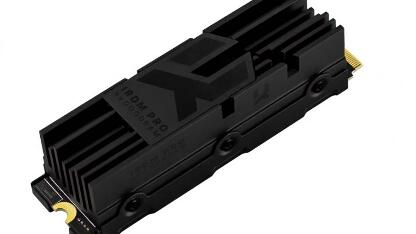
Gigabyte Aorus 7000S 2TB NVMe SSD — Full Review (2026)
Quick answer
The Gigabyte Aorus 7000S 2TB is one of the more complete PCIe 4.0 SSD packages at this capacity: a well-designed heatsink, strong endurance, and competitive performance across synthetic and real-world benchmarks.
Read: 7000 MB/s Write: 6850 MB/s Endurance: 1400 TBW Warranty: 5 years Interface: M.2 4.0 x 4
The Gigabyte Aorus 7000S 2TB is the full-fat variant of Gigabyte's Phison E18 lineup, delivering 6,850 MB/s writes and 1,400 TBW endurance behind a nanocarbon-coated heatsink designed for throttle-free operation.
Controller & Memory
The Aorus 7000S 2TB uses the same Phison PS5018-E18 controller as the 1TB model — a triple-core Arm Cortex-R5 running at 1 GHz with two auxiliary CoXProcessor 2.0 cores for background NAND management. Where the 2TB differs is density: it carries 2 GB of SK Hynix DDR4 DRAM (split across both sides of the PCB) and Micron B27B 96-layer TLC across eight NAND packages with 32 total dies. This higher die count is what enables the faster write speed and higher random read IOPS versus the 1TB.
Gigabyte rates the 2TB at 7,000 MB/s sequential read, 6,850 MB/s sequential write, 650,000 random read IOPS, and 700,000 random write IOPS. The drive is double-sided, meaning components sit on both faces of the PCB, which adds roughly 11.5 mm of total height with the included heatsink. The nanocarbon coating on the aluminum heatsink is claimed to reduce temperatures by 20 percent, and independent reviews confirm the drive stays well below throttling under sustained workloads.
Direct competitors at 2TB include the Samsung 980 Pro 2TB, WD Black SN850 2TB, Corsair MP600 Pro 2TB, and Sabrent Rocket 4 Plus 2TB. All leverage the same generation of PCIe 4.0 controllers and deliver similar peak throughput; the Aorus 7000S differentiates on its included heatsink design and AES-256 hardware encryption.
Storage Comparisons:
Aorus 7000S Performance & Benchmarks
At 2TB, the Aorus 7000S hits its full stride: 7,000 MB/s sequential read and 6,850 MB/s sequential write as rated by Gigabyte. Independent testing from Tom's Hardware and Legit Reviews confirms the drive meets or slightly exceeds these numbers in CrystalDiskMark on a fresh drive. The 650,000 random read IOPS and 700,000 random write IOPS represent the full E18 platform capability unlocked by the higher NAND die count.
Gigabyte Aorus 7000S 2 TB vs M.2 4.0 x 4 peers
Switch between sequential throughput and random IOPS to see how this drive stacks up against other M.2 4.0 x 4 SSDs in our database. The highlighted bar is the drive on this page — click any other bar to open that drive.
- Patriot Viper PV593 1 TB: 14,500 MB/s read, 14,000 MB/s write
- Patriot Viper PV593 2 TB: 14,500 MB/s read, 14,000 MB/s write
- Patriot Viper PV593 4 TB: 14,500 MB/s read, 14,000 MB/s write
- Patriot Viper PV573 2 TB: 14,000 MB/s read, 12,000 MB/s write
- Gigabyte Aorus 7000S 2 TB (this drive): 7,000 MB/s read, 6,850 MB/s write
Sustained write behavior follows the standard Phison E18 pattern: a large SLC cache delivers peak write speed for several hundred gigabytes, after which writes settle to around 1,800 MB/s on a drive that is 50 percent full. Tom's Hardware noted the cache recovery can be slow, which means back-to-back large file transfers may see reduced speeds on the second pass. For gaming, OS use, and typical content creation, this is unlikely to matter — the cache is generous enough for most real-world workloads. Gaming benchmarks from TweakTown showed the Aorus 7000S 2TB setting lab records on their Intel test platform, outperforming other E18 drives in game load times.
Gigabyte Aorus 7000S vs Competitors
See how the Aorus 7000S stacks up against other M.2 4.0 x 4 drives in our database:
Compare with rival drives:
Endurance, TBW & Warranty
The 2TB model carries a 1,400 TBW endurance rating — double the 1TB's 700 TBW — backed by a 5-year limited warranty. Writing 767 GB every single day for five years would exhaust the rated endurance, a workload that virtually no consumer approaches. Even heavy content creators writing 200 GB daily would take nearly 20 years to reach the limit. The MTBF is rated at 1.6 million hours. Gigabyte's SSD Toolbox provides S.M.A.R.T. health data and secure erase, but lacks the cloning and migration tools that competitors like Samsung (Magician) and Sabrent bundle with their drives.
Gigabyte Aorus 7000S 2 TB Specifications
| Category | Value |
|---|---|
| Capacity [?] | 2 TB |
| Interface [?] | M.2 4.0 x 4 |
| Controller [?] | Phison E18 |
| Memory type [?] | Micron TLC |
| DRAM [?] | 1GB or 2GB DDR4 |
| Read speed (MB/s) [?] | 7000 |
| Write speed (MB/s) [?] | 6850 |
| Read IOPS [?] | 650000 |
| Write IOPS [?] | 700000 |
| Endurance (TBW) [?] | 1400 |
| MTBF (million hours) [?] | 1.6 |
| Warranty (years) [?] | 5 |
Verdict: Is the Aorus 7000S Worth It in 2026?
The Gigabyte Aorus 7000S 2TB is one of the more complete PCIe 4.0 SSD packages at this capacity: a well-designed heatsink, strong endurance, and competitive performance across synthetic and real-world benchmarks. Builders who want a drive that works out of the box without sourcing a separate heatsink will appreciate the design. The double-sided PCB rules out some slim laptop slots, and the SLC cache recovery time is slower than some E18 competitors. For a PS5 upgrade, the Samsung 980 Pro 2TB or Sabrent Rocket 4 Plus 2TB are worth considering as alternatives that offer similar performance with different thermal and software trade-offs.
+ Pros
- 7,000 MB/s read, 6,850 MB/s write
- 1,400 TBW endurance with 5-year warranty
- Effective nanocarbon heatsink included
- 650K random read IOPS
- AES-256 hardware encryption
- Strong gaming performance per independent reviews
- Cons
- Double-sided PCB limits laptop compatibility
- SLC cache slow to recover after heavy writes
- SSD Toolbox lacks cloning and migration tools
- Heatsink adds height incompatible with some motherboards
Buy this or similar SSD Storage:



Video Review
Read With No Throttling! The Brand New AORUS Gen4 7000s SSD