SSD Endurance and TBW Ratings Explained
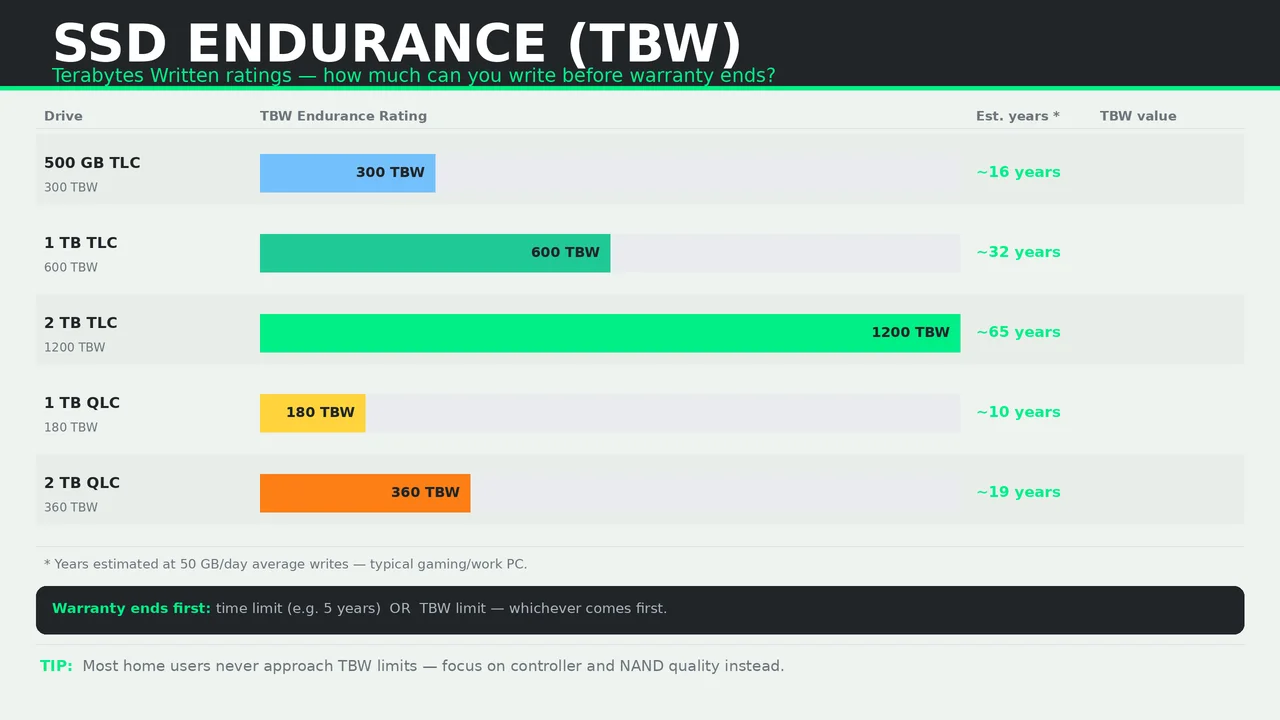
SSD endurance is rated in TBW (Terabytes Written). It tells you how much data the manufacturer expects the drive to write over its warranty period.
What is TBW?
TBW stands for Terabytes Written. It is the total amount of data the drive is rated to write before the warranty ends.
For example, a 1 TB TLC drive with 600 TBW rating is rated to write 600 terabytes over its warranty. If you write 50 GB per day, that would take about 32 years.
How much TBW do you need?
Typical home use
Around 20 to 50 GB per day of writes is normal for gaming and desktop use. Even 600 TBW lasts decades at that rate.
Heavy content creation
Video editing, large asset libraries, and compiling can push 100 GB or more per day. A higher TBW rating or a 2 TB model gives more headroom.
Professional workloads
Servers, databases, and cache drives may write hundreds of GB per day. Enterprise drives with high TBW ratings are designed for this.
TBW vs warranty period
Warranty ends when EITHER time runs out OR TBW is reached — whichever comes first.
A 5-year warranty with 600 TBW is more reassuring than a 3-year warranty with 200 TBW, but for most home users, time will run out long before you hit the TBW limit.
Does higher TBW mean better NAND?
Often, yes. Higher TBW usually means better NAND quality and more conservative controller tuning. It is a useful signal when comparing drives, but most users never approach the limit.