SSD Write Speed: Peak vs Sustained and Why It Matters
SSD write speed determines how fast the drive can save data. Many drives quote huge peak numbers thanks to SLC caching, but sustained write speed after the cache fills is what matters for large transfers.
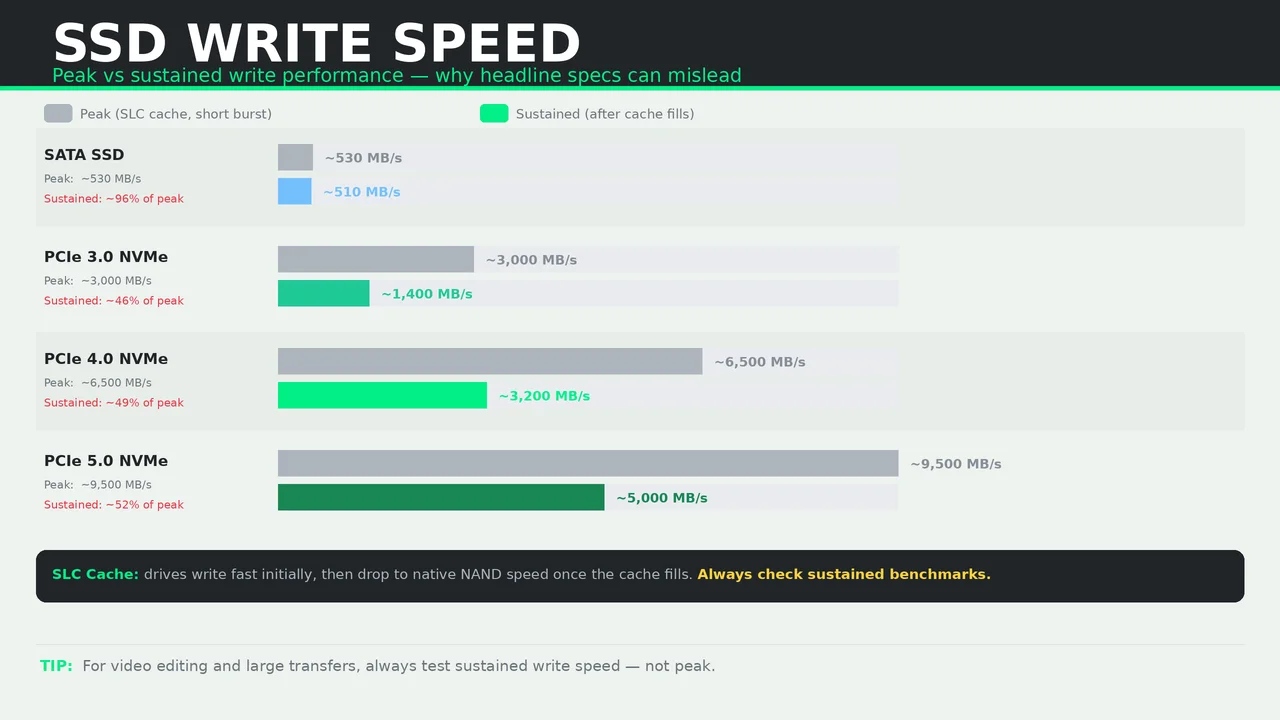
Peak vs sustained write speed
- Peak write — short burst speed using the SLC cache. This is the number on the box.
- Sustained write — speed after the cache is full. This reflects real NAND performance.
A drive with 6,000 MB/s peak might drop to 1,500 MB/s sustained after writing 100 GB or so. For large file workloads, sustained speed is more important.
What is SLC cache?
SLC caching treats a portion of the NAND like faster single-bit SLC memory. The drive writes quickly into this cache, then quietly copies data to the slower native NAND in the background.
Once the SLC cache is full, write speed drops to the native NAND speed. This can be a dramatic falloff on QLC drives and on smaller capacities.
Typical write speeds by interface
- SATA SSD — up to about 530 MB/s
- PCIe 3.0 NVMe — peak around 3,000 MB/s, sustained often 1,000 to 1,500 MB/s
- PCIe 4.0 NVMe — peak around 6,500 MB/s, sustained often 2,000 to 3,500 MB/s
- PCIe 5.0 NVMe — peak can exceed 9,000 MB/s, sustained varies widely by model
Does faster write speed matter?
For everyday use, even SATA write speed is plenty. Faster writes help with:
- Large video or photo imports
- Game install times
- File backups and cloning
- Video editing and rendering
For sustained write-heavy workloads, always check benchmarks, not just peak specs.