Corsair MP600 Core 1TB — PCIe 4.0 QLC NVMe SSD Review (2026)
Quick answer
The Corsair MP600 Core 1 TB occupies a specific niche that still matters several years after its launch: it is one of the cheapest PCIe 4.0 drives with a genuine DRAM cache, and for read-heavy workloads it delivers responsiveness that punches above its QLC class.
Read: 4950 MB/s Write: 3950 MB/s Endurance: 225 TBW Warranty: 5 years Interface: M.2 4.0 x 4
The Corsair MP600 Core 1TB pairs Micron 96L QLC NAND with the eight-channel Phison E16 controller and dedicated DRAM cache, bringing PCIe 4.0 to a budget price point.
Controller & Memory
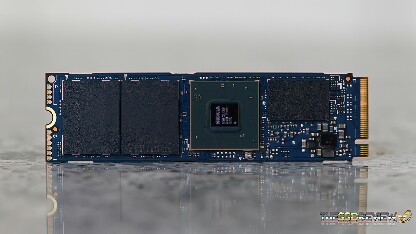
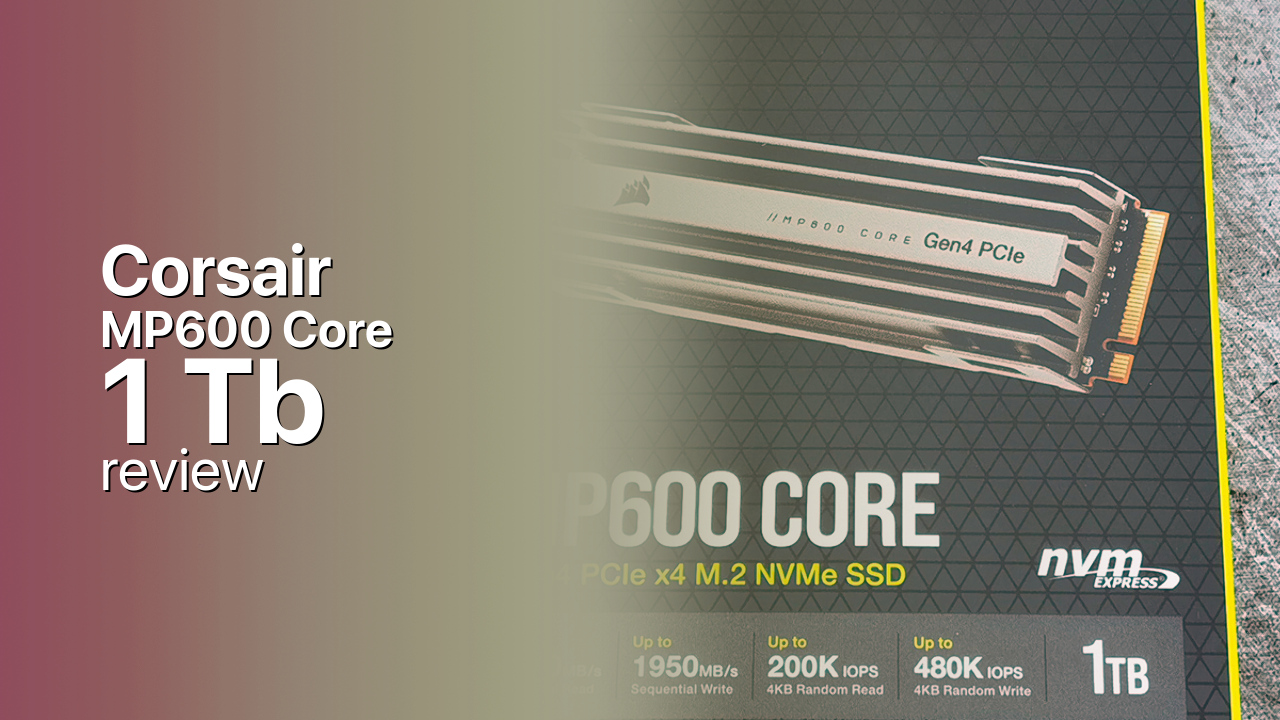
The MP600 Core was Corsair's first QLC-based NVMe SSD — a deliberate move to bring PCIe 4.0 within reach of buyers who could not justify the premium that early TLC-based Gen 4 drives commanded. At its heart is the same Phison PS5016-E16 controller found in the original MP600 and virtually every first-generation PCIe 4.0 consumer drive, but the NAND is Micron's 96-layer QLC (quad-level cell) flash rather than the TLC used in the standard MP600. The 1 TB model couples this with a 1 GB LPDDR4 DRAM cache, giving it the full mapping-table buffer that budget DRAM-less designs forgo. Corsair rates the drive at up to 4,950 MB/s sequential read and 3,950 MB/s sequential write, with random performance of 200,000 IOPS read and 480,000 IOPS write.
The QLC trade-off shows up most clearly in endurance and sustained write behaviour. Corsair warranties the 1 TB MP600 Core for 225 TBW over five years — roughly one-third of what a comparable TLC Phison E16 drive like the regular MP600 carries, and well below the ~600 TBW typical of 1 TB TLC drives. The low endurance figure reflects the fundamental physics of QLC: each cell stores four bits and the tighter voltage margins mean fewer program/erase cycles before the cell wears out. Under bursty consumer workloads — game installs, OS updates, file copies under ~50 GB — the drive operates entirely within its pseudo-SLC write cache and delivers TLC-like responsiveness. Push past that cache boundary with a sustained write exceeding roughly 60–80 GB on the 1 TB model, however, and the controller folds into direct-to-QLC programming at approximately 150–200 MB/s — slower than a mechanical hard drive.
Despite the endurance ceiling, the MP600 Core makes sense for its intended audience. At launch it carried a significant discount over TLC PCIe 4.0 alternatives, and used prices have kept it among the cheapest ways to get a DRAM-backed PCIe 4.0 drive. The single-sided M.2 2280 form factor fits any slot, and Corsair includes a low-profile aluminium heatspreader that keeps the E16 controller within its operating envelope during typical workloads. For a read-heavy use case — a dedicated game library, a secondary media scratch disk, or a boot drive in a system that does not hammer storage with continuous writes — the MP600 Core 1 TB delivers the headline PCIe 4.0 numbers its TLC-badged sibling promises, just with a shorter endurance leash.
Storage Comparisons:
MP600 Core Performance & Benchmarks
The MP600 Core 1 TB benchmarks close to the Phison E16 reference design in read-centric tests but diverges sharply under sustained write loads. In CrystalDiskMark and ATTO, sequential reads land between 4,800 and 4,950 MB/s — effectively saturating the interface for sequential transfers — while QD1 4K random reads hover around 65–70 MB/s, which is within the typical range for an eight-channel, DRAM-backed controller. Sequential cached writes reach 3,800–3,950 MB/s, matching Corsair's marketing claims and holding steady for transfers up to the pSLC cache budget. The 200,000/480,000 IOPS random rating is adequate for mixed consumer use but trails the ~700,000+ IOPS figures that TLC E16 drives manage, since QLC's slower program time constrains the random write ceiling even within the cache.
Corsair MP600 Core 1 TB vs M.2 4.0 x 4 peers
Switch between sequential throughput and random IOPS to see how this drive stacks up against other M.2 4.0 x 4 SSDs in our database. The highlighted bar is the drive on this page — click any other bar to open that drive.
- Patriot Viper PV593 1 TB: 14,500 MB/s read, 14,000 MB/s write
- Patriot Viper PV593 2 TB: 14,500 MB/s read, 14,000 MB/s write
- Patriot Viper PV593 4 TB: 14,500 MB/s read, 14,000 MB/s write
- Patriot Viper PV573 2 TB: 14,000 MB/s read, 12,000 MB/s write
- Corsair MP600 Core 1 TB (this drive): 4,950 MB/s read, 3,950 MB/s write
Where the Core separates from its TLC siblings is the sustained-write cliff. Independent reviews consistently measure a cache capacity of roughly 55–65 GB on a fresh 1 TB drive, after which the direct-to-QLC write speed collapses to 150–200 MB/s. This behaviour is inherent to all consumer QLC drives, not a defect, but it means the MP600 Core is a poor choice for large continuous writes — video ingest, database bulk loads, or cloning a full 500 GB drive in one pass. Thermally the drive behaves identically to other E16 products: the 28 nm controller reaches the mid-70s °C under sustained load in still air, with a mild throttle engaging near 75 °C. Corsair's included aluminium heatspreader is sufficient to keep temperatures in the 60s °C under typical gaming and desktop loads, eliminating throttling in most real-world scenarios.
Corsair MP600 Core vs Competitors
See how the MP600 Core stacks up against other M.2 4.0 x 4 drives in our database:
Compare with rival drives:
Endurance, TBW & Warranty
Corsair backs the MP600 Core 1 TB with a 5-year limited warranty — notably longer than the 3-year coverage that some QLC competitors offer, and matching the warranty length of premium TLC drives. The endurance budget is 225 TBW, equivalent to approximately 125 GB of host writes per day over the warranty term, or about 0.12 drive writes per day (DWPD). This is a low endurance ceiling by TLC standards but is typical for QLC drives of this generation: the competing Crucial P3 Plus 1 TB carries 220 TBW, and the Sabrent Rocket Q4 1 TB is rated at 200 TBW. For context, 225 TBW is enough for roughly 40–50 full-drive rewrites — sufficient for a decade of gaming and general productivity, but potentially limiting for users who frequently write large media projects, run video surveillance recording, or use the drive as a scratch disk for 4K editing. Corsair's SSD Toolbox software and the standard NVMe SMART attributes report the host-write counter, so monitoring remaining endurance is straightforward.
Corsair MP600 Core 1 TB Specifications
| Category | Value |
|---|---|
| Capacity [?] | 1 TB |
| Interface [?] | M.2 4.0 x 4 |
| Controller [?] | Phison PS5016-E16 |
| Memory type [?] | Micron 3D QLC |
| DRAM [?] | SK Hynix DRAM Cache |
| Read speed (MB/s) [?] | 4950 |
| Write speed (MB/s) [?] | 3950 |
| Read IOPS [?] | 200000 |
| Write IOPS [?] | 480000 |
| Endurance (TBW) [?] | 225 |
| MTBF (million hours) [?] | 1.7 |
| Warranty (years) [?] | 5 |
Verdict: Is the MP600 Core Worth It in 2026?
The Corsair MP600 Core 1 TB occupies a specific niche that still matters several years after its launch: it is one of the cheapest PCIe 4.0 drives with a genuine DRAM cache, and for read-heavy workloads it delivers responsiveness that punches above its QLC class. The Phison E16 controller is a mature, well-understood platform with broad platform compatibility, and the five-year warranty provides peace of mind that the 225 TBW endurance ceiling is unlikely to be reached by the typical buyer. The downsides are unambiguous: sustained write performance to QLC is abysmal by SSD standards, the endurance rating is one-third of what a similarly priced TLC drive offers, and newer DRAM-less TLC drives like the WD Blue SN580 now deliver higher real-world throughput without the QLC write cliff. If your storage needs are biased toward reads — game library, media playback, OS boot with light productivity — the MP600 Core 1 TB remains a defensible value pick. If you regularly move large files or want headroom for years of heavy writes, skip the Core and look at any TLC-based PCIe 4.0 alternative.
+ Pros
- Genuine DRAM cache at a QLC price point
- 4,950 MB/s reads saturate PCIe 4.0 for gaming
- 5-year warranty matches premium TLC drives
- Mature Phison E16 controller with wide compatibility
- Included aluminium heatspreader works well
- Strong cached write speed of 3,950 MB/s
- Cons
- Direct-to-QLC writes crash to ~150–200 MB/s
- Only 225 TBW endurance — a third of TLC peers
- QLC NAND limits drive lifespan under heavy writes
- Random write IOPS trail TLC-based E16 drives
- Newer DRAM-less TLC drives now outperform it
Buy this or similar SSD Storage:



Video Review
Corsair MP600 Core PCIe 4.0 M.2 NVMe SSD Unboxing & Overview