Corsair MP600 1TB Review — PCIe 4.0 NVMe SSD (2026)
Quick answer
Gamers and general-purpose desktop builders with an AMD X570 or B550 board who want a reliable PCIe 4.0 boot drive will find the Corsair MP600 1TB still gets the job done, even in 2026.
Read: 4950 MB/s Write: 4250 MB/s Endurance: 1800 TBW Warranty: 5 years Interface: M.2 4.0 x 4
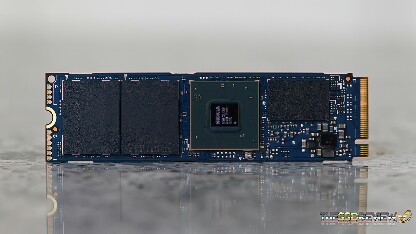
The Corsair MP600 1TB was one of the first PCIe 4.0 NVMe drives to market, pairing Phison's PS5016-E16 controller with Toshiba 96-layer BiCS4 TLC NAND behind an included aluminium heatsink.
Controller & Memory
Corsair launched the MP600 in mid-2019 as its opening move into the PCIe 4.0 generation, exclusively tied to AMD's X570 platform at the time. The Corsair MP600 1TB is built around the Phison PS5016-E16, an 8-channel, 28 nm controller powered by a dual-core ARM Cortex-R5 with a co-processor. It was the industry's first consumer PCIe 4.0 x4 NVMe controller, and the MP600 rode that wave alongside the Ryzen 3000 launch.
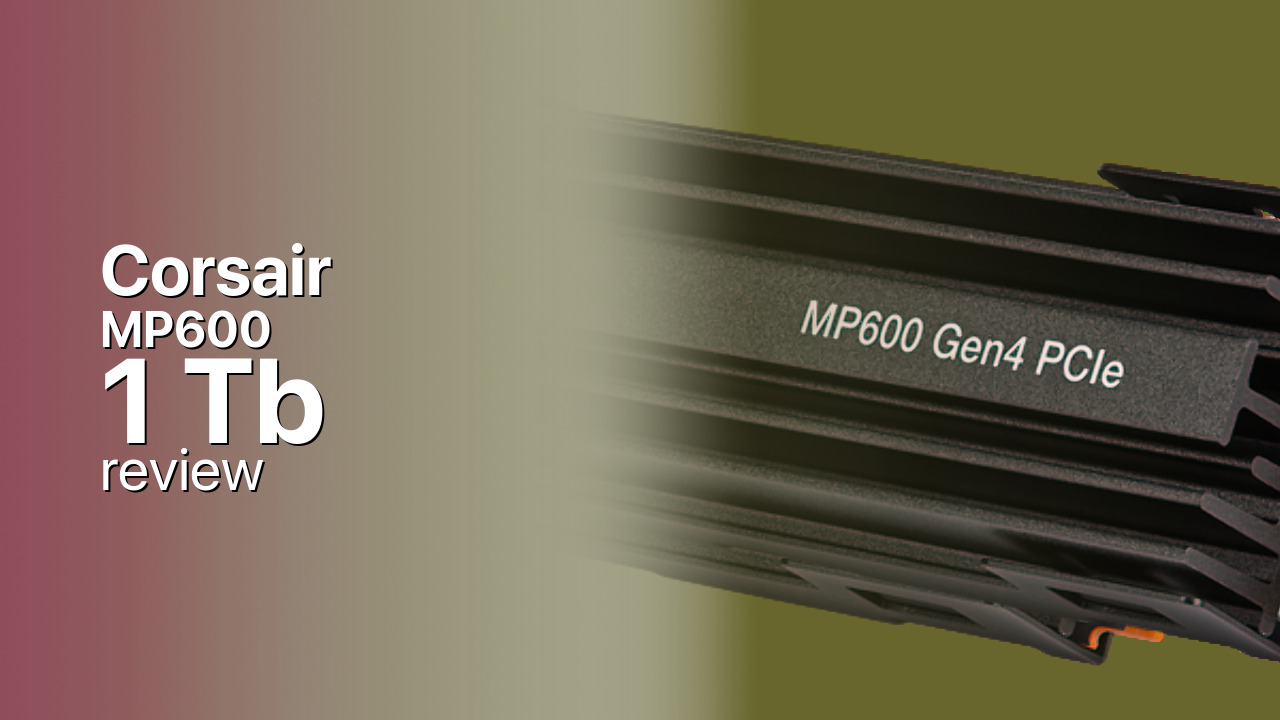
Inside the 1TB variant, the E16 is paired with Toshiba BiCS4 96-layer 3D TLC NAND and 1 GB of SK Hynix DDR4-2400 DRAM acting as the Flash Translation Layer cache. The drive ships on a double-sided M.2 2280 PCB underneath a pre-mounted, high-surface-area aluminium heatsink that adds roughly 7 mm of height. That heatsink is removable if the motherboard already has its own M.2 thermal solution, but it is worth planning for the extra clearance on compact ITX builds.
The MP600 family also comes in 500 GB and 2 TB capacities. Sequential speeds are identical across the 1 TB and 2 TB models at 4,950 MB/s read and 4,250 MB/s write, though the 500 GB variant drops to lower write throughput. Endurance scales linearly: 1,800 TBW on the 1 TB model versus 3,600 TBW on the 2 TB. Direct rivals from the same era include the Gigabyte Aorus NVMe Gen4 and Sabrent Rocket 4.0, both of which also use the Phison E16 reference platform. The Samsung 980 Pro and WD Black SN850 arrived later with faster second-generation controllers, but at launch the MP600 had no real Gen4 competition.
Storage Comparisons:
MP600 Performance & Benchmarks
Corsair rates the MP600 1TB at up to 4,950 MB/s sequential read and 4,250 MB/s sequential write, with random performance of up to 680K IOPS read and 600K IOPS write at queue depth 32. These numbers represent the practical ceiling of the PCIe 3.0 x4 interface doubled, and the drive genuinely reaches them on an AMD X570 or B550 platform with PCIe 4.0 lanes enabled.
Corsair MP600 1 TB vs M.2 4.0 x 4 peers
Switch between sequential throughput and random IOPS to see how this drive stacks up against other M.2 4.0 x 4 SSDs in our database. The highlighted bar is the drive on this page — click any other bar to open that drive.
- Patriot Viper PV593 1 TB: 14,500 MB/s read, 14,000 MB/s write
- Patriot Viper PV593 2 TB: 14,500 MB/s read, 14,000 MB/s write
- Patriot Viper PV593 4 TB: 14,500 MB/s read, 14,000 MB/s write
- Patriot Viper PV573 2 TB: 14,000 MB/s read, 12,000 MB/s write
- Corsair MP600 1 TB (this drive): 4,950 MB/s read, 4,250 MB/s write
On Intel platforms or any PCIe 3.0 slot, the MP600 caps out around 3,500 MB/s — still fast, but no different from a good PCIe 3.0 drive. Independent reviewers consistently found the MP600 meeting or slightly exceeding its rated sequential numbers in CrystalDiskMark, with real-world large-file transfers sitting in the 3.8 to 4.2 GB/s range depending on the workload. Sustained random write performance holds up reasonably well, though the E16's SLC caching strategy means that extended writes beyond roughly 100 GB can drop to native TLC speeds in the 1.5 to 2.0 GB/s range. For a boot drive or gaming workload that rarely fills the cache, this is not a practical concern.
Corsair MP600 vs Competitors
See how the MP600 stacks up against other M.2 4.0 x 4 drives in our database:
Compare with rival drives:
Endurance, TBW & Warranty
Corsair backs the MP600 1TB with a 5-year limited warranty that is tied to the drive's 1,800 TBW endurance rating — whichever limit is reached first ends the coverage. At a typical consumer write workload of 20 to 50 GB per day, the 1,800 TBW figure translates to roughly 100 years on the low end and 36 years on the high end, meaning the warranty period will expire long before the endurance ceiling is hit for the vast majority of users. Corsair quotes an MTBF of 1.7 million hours for the MP600 family. Like all MTBF figures, this is a statistical projection across a population of drives under controlled test conditions, not a guarantee that any individual unit will run for 194 years without fault. Warranty service is handled directly through Corsair's RMA portal.
Corsair MP600 1 TB Specifications
| Category | Value |
|---|---|
| Capacity [?] | 1 TB |
| Interface [?] | M.2 4.0 x 4 |
| Controller [?] | Phison PS5016-E16 |
| Memory type [?] | Toshiba 3D TLC |
| DRAM [?] | SK Hynix 1GB - 2GB DDR4 |
| Read speed (MB/s) [?] | 4950 |
| Write speed (MB/s) [?] | 4250 |
| Read IOPS [?] | 680000 |
| Write IOPS [?] | 600000 |
| Endurance (TBW) [?] | 1800 |
| MTBF (million hours) [?] | 1700000 |
| Warranty (years) [?] | 5 |
Verdict: Is the MP600 Worth It in 2026?
Gamers and general-purpose desktop builders with an AMD X570 or B550 board who want a reliable PCIe 4.0 boot drive will find the Corsair MP600 1TB still gets the job done, even in 2026. Anyone building on a newer Intel 12th-gen or later platform, or someone chasing the highest possible sequential throughput, should skip the MP600 in favour of a Samsung 990 Pro or WD Black SN850X, both of which leverage later-generation controllers that push past 7,000 MB/s on PCIe 4.0. The MP600 was a strong first-generation Gen4 drive in 2019, and it remains competent for everyday workloads — but the PCIe 4.0 field has moved on, and newer drives deliver meaningfully better performance at similar or lower cost.
+ Pros
- Included aluminium heatsink in the box
- 4,950 MB/s sequential reads on PCIe 4.0
- 1,800 TBW endurance on the 1TB model
- 5-year warranty with direct RMA support
- DRAM cache (1 GB SK Hynix DDR4)
- Backwards compatible with PCIe 3.0 slots
- Cons
- First-gen Phison E16 controller outpaced by newer drives
- Double-sided PCB may not fit some slim laptop slots
- Caps at PCIe 3.0 speeds on non-Gen4 platforms
- No hardware AES 256-bit encryption
- Heatsink adds height that can conflict with GPU backplates
Buy this or similar SSD Storage:



Video Review
How Much Faster Is PCIe 4.0 vs 3.0 - Corsair MP600 Review