Corsair Force MP400 8TB NVMe SSD Review (2026)
Quick answer
The Corsair Force MP400 8 TB is a niche product for users who need the maximum possible NVMe capacity in a single M.2 slot and are willing to pay a premium for it.
Read: 3480 MB/s Write: 3000 MB/s Endurance: 1600 TBW Warranty: 5 years Interface: M.2 3.0 x 4
The Corsair Force MP400 8 TB is one of the highest-capacity M.2 NVMe SSDs available, using the Phison E12S controller and Micron 96-layer QLC NAND to deliver 8 TB in a double-sided M.2 2280 form factor.
Controller & Memory
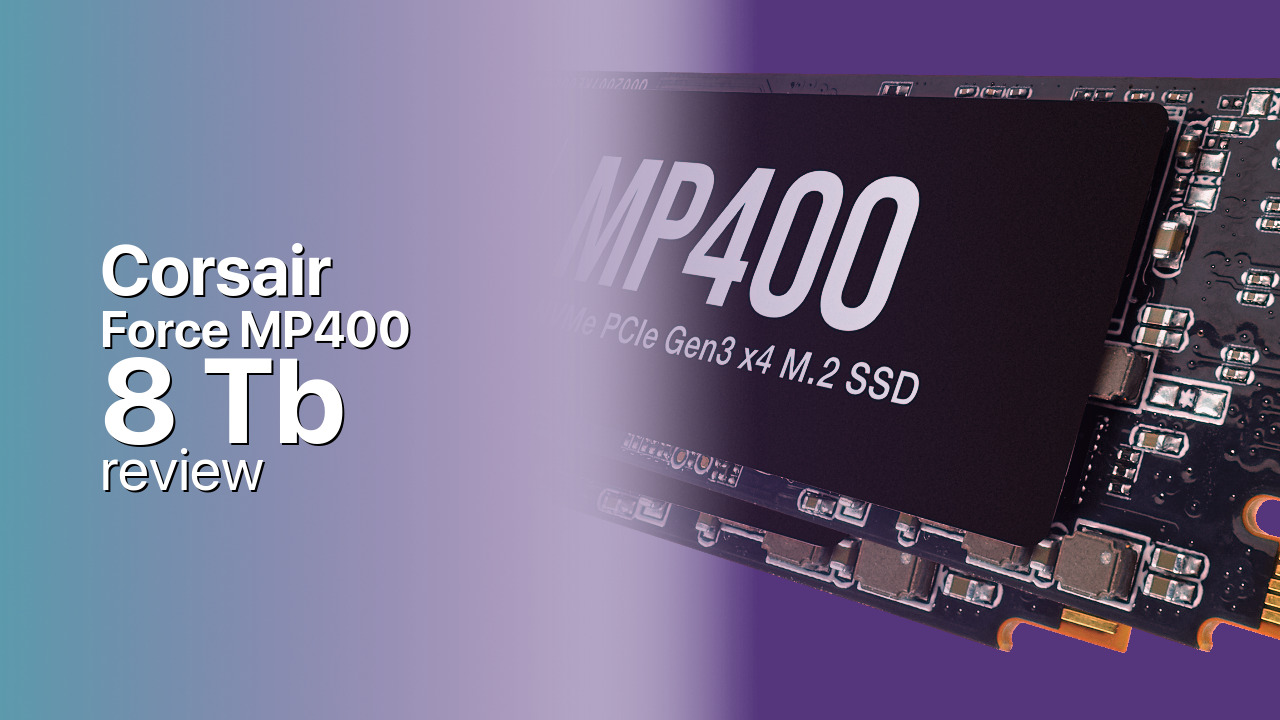
The 8 TB MP400 uses the same Phison PS5012-E12S PCIe 3.0 x4 controller as the 4 TB model, paired with Micron's 96-layer 3D QLC NAND. The E12S is an eight-channel NVMe 1.3 design built on TSMC's 12nm process, featuring two Arm Cortex R5 cores and dual CoXProcessor 2.0 co-processors. A Nanya DDR3L DRAM chip handles the flash translation layer at a reduced DRAM-to-NAND ratio compared to the typical 1 MB per 1 GB standard. The 8 TB model is double-sided, with NAND packages populated on both sides of the PCB.
The 8 TB is the flagship of the MP400 series, which also spans 1 TB and 2 TB (using the Phison E16 on PCIe 4.0) and 4 TB (same E12S as this model). The 8 TB carries identical speed ratings to the 4 TB at 3,480/3,000 MB/s and 610K/710K IOPS, but with double the endurance at 1,600 TBW. The large NAND array means the dynamic SLC cache spans roughly 2 TB, providing an enormous burst write buffer.
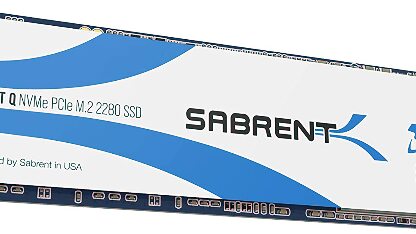
At this capacity, the MP400 8 TB competes in a small field. The Sabrent Rocket Q 8TB uses the same platform, and most TLC NVMe drives max out at 4 TB. For bulk storage and archiving, the MP400 8 TB also competes with SATA SSDs and hard drives on cost per GB, though at far higher performance. Corsair's own MP600 Pro Gen4 tops out at 2 TB, leaving the MP400 as Corsair's highest-capacity NVMe option.
Storage Comparisons:
Force MP400 Performance & Benchmarks
Corsair rates the Force MP400 8 TB at 3,480 MB/s sequential read and 3,000 MB/s sequential write, with up to 610,000 random read IOPS and 710,000 random write IOPS. These match the 4 TB model exactly, as both share the same Phison E12S controller and NAND configuration.
Corsair Force MP400 8 TB vs M.2 3.0 x 4 peers
Switch between sequential throughput and random IOPS to see how this drive stacks up against other M.2 3.0 x 4 SSDs in our database. The highlighted bar is the drive on this page — click any other bar to open that drive.
- ADATA SX 8800 Pro 512 GB: 3,500 MB/s read, 2,700 MB/s write
- ADATA SX 8800 Pro 1 TB: 3,500 MB/s read, 2,700 MB/s write
- ADATA XPG Spectrix S40G RGB 256 GB: 3,500 MB/s read, 3,000 MB/s write
- ADATA XPG Spectrix S40G RGB 512 GB: 3,500 MB/s read, 3,000 MB/s write
- Corsair Force MP400 8 TB (this drive): 3,480 MB/s read, 3,000 MB/s write
The dynamic SLC cache spans approximately one-quarter of the 8 TB NAND array, translating to roughly 2 TB of cached write capacity. This is the largest SLC cache in the MP400 family, and for most consumer workloads it means the drive will never hit the native QLC write speed during normal use. Once the cache fills after approximately 2 TB of sustained writes, the drive falls back to native QLC throughput of around 80 to 160 MB/s depending on workload. Independent reviewers note that the E12S controller thermal management keeps the drive running cool even under heavy load, helped by the 12nm process node and active state power management features. Power draw peaks at 7.1 W during active reads, within most desktop M.2 slot budgets.
Corsair Force MP400 vs Competitors
See how the Force MP400 stacks up against other M.2 3.0 x 4 drives in our database:
Compare with rival drives:
Endurance, TBW & Warranty
Corsair backs the Force MP400 8 TB with a five-year limited warranty, ending at 1,600 TBW of writes or the warranty period, whichever comes first. At a typical 20 GB per day workload, the 1,600 TBW budget translates to roughly 219 years of use. Even at an exceptionally heavy 200 GB per day, the endurance ceiling is over 21 years. The drive includes Phison's SmartECC third-generation LDPC error correction, SmartRefresh for periodic block refresh, and end-to-end data protection. Factory overprovisioning of approximately 9 percent of the raw NAND capacity provides an additional reliability buffer. The absolute endurance figure of 1,600 TBW is competitive with many enterprise-grade SSDs, though the per-GB endurance rating remains lower than TLC consumer drives due to QLC's inherently fewer program-erase cycles.
Corsair Force MP400 8 TB Specifications
| Category | Value |
|---|---|
| Capacity [?] | 8 TB |
| Interface [?] | M.2 3.0 x 4 |
| Controller [?] | Phison PS5012-E12S |
| Memory type [?] | Micron 96L QLC |
| DRAM [?] | DDR3L |
| Read speed (MB/s) [?] | 3480 |
| Write speed (MB/s) [?] | 3000 |
| Read IOPS [?] | 610000 |
| Write IOPS [?] | 710000 |
| Endurance (TBW) [?] | 1600 |
| MTBF (million hours) [?] | 1.8 |
| Warranty (years) [?] | 5 |
Verdict: Is the Force MP400 Worth It in 2026?
The Corsair Force MP400 8 TB is a niche product for users who need the maximum possible NVMe capacity in a single M.2 slot and are willing to pay a premium for it. Archivists, NAS builders, and content creators with massive media libraries will appreciate the 8 TB of fast storage. Anyone who regularly writes more than 2 TB in sustained transfers should know the QLC penalty will kick in, and a TLC alternative would be more consistent under those conditions. For sheer capacity on a single M.2 drive, the MP400 8 TB is difficult to beat, provided the double-sided PCB fits the target system.
+ Pros
- 8 TB capacity in a single M.2 2280 slot
- Massive 2 TB dynamic SLC cache
- 1,600 TBW endurance rating
- 610K/710K random IOPS
- 3,480/3,000 MB/s sequential throughput
- 5-year warranty included
- Cons
- Double-sided PCB limits compatibility
- PCIe 3.0 x4, not PCIe 4.0
- QLC post-cache writes drop to 80-160 MB/s
- No AES 256 hardware encryption
- Premium price for the 8 TB capacity
Buy this or similar SSD Storage:



Video Review
Corsair MP400 Review - Up to 8TB of FAST SSD - TechteamGB