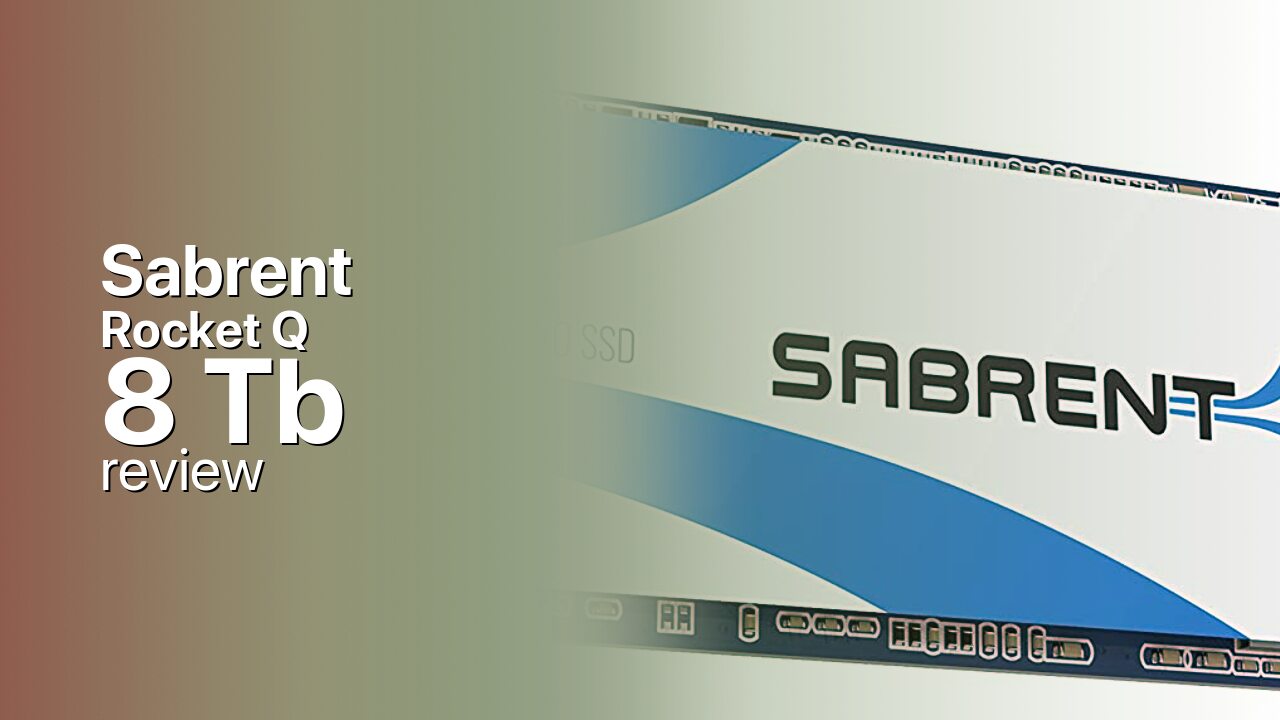
Sabrent Rocket Q 8TB Review (2026)
Quick answer
The Sabrent Rocket Q 8TB is a capacity champion that delivers an unmatched 8TB in a single M.2 NVMe slot.
Read: 3400 MB/s Write: 3000 MB/s Endurance: 4916 TBW Warranty: 5 years Interface: M.2 3.0 x 4
The Sabrent Rocket Q 8TB is one of the highest-capacity consumer M.2 NVMe SSDs available, using QLC NAND to pack massive storage into a standard form factor.
Controller & Memory
Sabrent pushed QLC NAND to its limit with the Rocket Q 8TB, delivering the highest capacity available in a consumer M.2 2280 NVMe drive at launch. The drive uses the Phison E12S controller with DDR4 DRAM and QLC NAND, rated at 3,400 MB/s sequential reads and 3,000 MB/s writes. These peak speeds are competitive with many TLC drives.
The 8TB capacity eliminates storage constraints for virtually any consumer use case. It can hold an entire game library, media collection, and professional project files without needing a secondary drive. The trade-off is QLC NAND, which provides this density at the cost of slower sustained writes after the SLC cache is exhausted and lower per-cell endurance than TLC.
The drive carries a massive 4,916 TBW endurance rating with a 5-year warranty. The M.2 2280 form factor fits standard NVMe slots. The Rocket Q 8TB competes with few direct competitors at this capacity, as most manufacturers top out at 4TB in the consumer NVMe space.
Storage Comparisons:
Rocket Q Performance & Benchmarks
The Sabrent Rocket Q 8TB is rated at 3,400 MB/s sequential reads and 3,000 MB/s sequential writes with 650,000 IOPS for both random reads and writes. These peak speeds are impressive for a QLC drive and match many TLC-based PCIe 3.0 competitors. The 8TB model maintains the same speed ratings as smaller Rocket Q capacities, which is notable given the massive NAND density.
Sabrent Rocket Q 8 TB vs M.2 3.0 x 4 peers
Switch between sequential throughput and random IOPS to see how this drive stacks up against other M.2 3.0 x 4 SSDs in our database. The highlighted bar is the drive on this page — click any other bar to open that drive.
- ADATA SX 8800 Pro 512 GB: 3,500 MB/s read, 2,700 MB/s write
- ADATA SX 8800 Pro 1 TB: 3,500 MB/s read, 2,700 MB/s write
- ADATA XPG Spectrix S40G RGB 256 GB: 3,500 MB/s read, 3,000 MB/s write
- ADATA XPG Spectrix S40G RGB 512 GB: 3,500 MB/s read, 3,000 MB/s write
- Sabrent Rocket Q 8 TB (this drive): 3,400 MB/s read, 3,000 MB/s write
The 8TB capacity provides a very large pseudo-SLC cache, typically 80-120 GB of cached write capacity before transitioning to native QLC speeds. This is the largest SLC cache in the Rocket Q lineup, and for many consumer tasks the entire write operation will complete within the cached region. Once the cache is exhausted, native QLC write speeds drop to roughly 100-300 MB/s, which is the fundamental QLC limitation regardless of capacity.
For read-heavy workloads like gaming, media playback, and file access, the Rocket Q 8TB performs similarly to TLC drives. The 3,400 MB/s read speed delivers fast game loading and media streaming. The DDR4 DRAM cache maintains consistent random I/O for mixed workloads. The drive is best suited as a massive storage pool for systems where bulk capacity is the priority and sustained write speed is secondary.
Sabrent Rocket Q vs Competitors
See how the Rocket Q stacks up against other M.2 3.0 x 4 drives in our database:
Compare with rival drives:
Endurance, TBW & Warranty
Sabrent backs the Rocket Q 8TB with a 5-year warranty and a massive 4,916 TBW endurance rating. This is among the highest endurance ratings on any consumer SSD, enabled by the enormous NAND capacity that distributes writes across thousands of memory cells. Writing 100 GB per day would take over 134 years to reach 4,916 TBW.
Sabrent requires product registration on their website for full warranty coverage. The 1.8 million hour MTBF rating reflects enterprise-grade reliability targets. For any realistic consumer workload, the endurance will never be a concern. The 8TB capacity means the drive will be replaced for technology reasons long before NAND wear becomes relevant.
Sabrent Rocket Q 8 TB Specifications
| Category | Value |
|---|---|
| Capacity [?] | 8 TB |
| Interface [?] | M.2 3.0 x 4 |
| Controller [?] | Phison E12S |
| Memory type [?] | QLC |
| DRAM [?] | DDR4 |
| Read speed (MB/s) [?] | 3400 |
| Write speed (MB/s) [?] | 3000 |
| Read IOPS [?] | 650000 |
| Write IOPS [?] | 650000 |
| Endurance (TBW) [?] | 4916 |
| MTBF (million hours) [?] | 1.8 |
| Warranty (years) [?] | 5 |
Verdict: Is the Rocket Q Worth It in 2026?
The Sabrent Rocket Q 8TB is a capacity champion that delivers an unmatched 8TB in a single M.2 NVMe slot. The 3,400/3,000 MB/s peak speeds are strong, and the DDR4 DRAM provides consistent random I/O. Buy it if you need the maximum possible storage in a single M.2 slot and your workloads are primarily reads.
Skip it if you do not need 8TB in a single slot, because multiple smaller TLC drives offer better sustained write performance and lower total cost. Also consider that 8TB QLC drives command a significant price premium, and two 4TB TLC drives may offer better value and performance. The Rocket Q 8TB is a niche product for users who specifically need maximum single-drive capacity.
+ Pros
- 8TB capacity — highest available in consumer M.2 NVMe
- 3,400/3,000 MB/s peak speeds match TLC drives
- DDR4 DRAM for consistent random I/O
- 4,916 TBW endurance — essentially unlimited for consumer use
- 5-year warranty with 1.8M hour MTBF
- Cons
- QLC NAND — slow sustained writes after SLC cache
- Premium price for the 8TB capacity
- Single-point-of-failure for 8TB of data
- QLC native writes drop to 100-300 MB/s
- Niche product with few direct competitors
Buy this or similar SSD Storage:



Video Review
The 8TB NVMe SSD! Sabrent Rocket Q 8TB Review