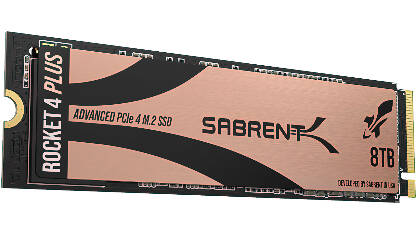
Anacomda i4-X Fiery Serpent 8 TB: The Announced Top of the Line (2026)
Quick answer
The Anacomda i4-X Fiery Serpent 8 TB is the announced capacity flagship of the line, and on paper it is an attractive one, carrying the same Phison E18, Kioxia TLC, discrete DRAM, and aluminium heatsink platform as the verified smaller capacities, the same 7,000 MB/s sequential ceiling, and what would be the family's highest endurance rating.
Read: 7000 MB/s Write: 7000 MB/s Endurance: 5600 TBW Warranty: 5 years Interface: M.2 4.0 x 4
The Anacomda i4-X Fiery Serpent 8 TB is the announced capacity flagship of the line, on the same E18, Kioxia TLC, and DRAM platform as the verified capacities, but with unconfirmed availability.
Controller & Memory
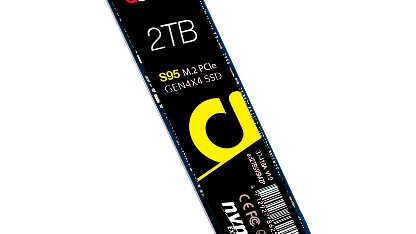
The Anacomda i4-X Fiery Serpent line is Anacomda's flagship PCIe 4.0 family, running Phison's PS5018-E18 tri-core controller with Kioxia 112-layer BiCS5 3D TLC NAND and a discrete DDR4L DRAM cache that holds the full flash translation layer mapping table on-drive. The verified capacities, the 1 TB, 2 TB, and 4 TB, reach the E18 platform's 7,000 MB/s sequential ceiling, carry five-year warranties, and ship with an aluminium heat spreader plus graphite thermal pad. The 8 TB sits at the top of the lineup on Anacomda's product packaging and in the johnnylucky database, which lists the i4-X Firery Serpent family as spanning 1 TB to 8 TB, but it is the one capacity buyers should approach with eyes open.
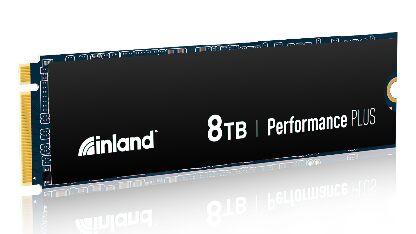
The honest status of the 8 TB is that it is an announced flagship rather than a widely shipping product. Anacomda's i4-X packaging indicates the lineup extends to 8 TB, and the johnnylucky database entry reflects that, but a search for the 8 TB turns up no confirmed retail availability, no independent review, and no official Anacomda spec sheet for this specific capacity. That is not unusual for a capacity maximum, drive makers routinely list a top capacity on packaging before it reaches retailers in volume, and the 8 TB i4-X fits the pattern of announced-but-late or region-limited flagship capacities seen across the SSD market. What can be said with confidence is the platform: because the 8 TB shares the E18 controller, Kioxia TLC, DRAM cache, heatsink, and firmware of the verified capacities, it plausibly delivers the same 7,000 MB/s sequential reads and writes, the same roughly 1,000,000 random IOPS, and the same five-year warranty.
Endurance is the one figure that cannot be stated precisely for the 8 TB. The verified line scales at roughly 700 TBW per terabyte, 700 TBW at 1 TB, 1,550 TBW at 2 TB, and 2,800 TBW at 4 TB, so an 8 TB model would carry the family's highest rating, estimated in the 5,000-plus TBW range by that scaling, but Anacomda has not published an official 8 TB endurance number. For buyers who can actually source one, the 8 TB would serve as a single-drive solution for very large media libraries, substantial game collections, and heavy sustained-write workloads, competing with other 8 TB-class Gen4 flagships. For most buyers, the 4 TB remains the highest verified capacity and the safer choice.
Storage Comparisons:
i4-X Firery Serpent Performance & Benchmarks
On the shared E18 platform, the 8 TB i4-X would be expected to reach the same 7,000 MB/s sequential reads and 7,000 MB/s sequential writes as the verified 2 TB and 4 TB models, both of which saturate the E18's eight channels at the platform ceiling. The 1 TB is the only capacity that writes slower, at 5,000 MB/s, because it populates fewer NAND dies; the 8 TB, with the most dies of any capacity in the line, would have no such constraint. Random I/O is rated at roughly 1,000,000 read and write IOPS across the E18 platform.
ANACOMDA i4-X Firery Serpent 8 TB vs M.2 4.0 x 4 peers
Switch between sequential throughput and random IOPS to see how this drive stacks up against other M.2 4.0 x 4 SSDs in our database. The highlighted bar is the drive on this page — click any other bar to open that drive.
- Patriot Viper PV593 1 TB: 14,500 MB/s read, 14,000 MB/s write
- Patriot Viper PV593 2 TB: 14,500 MB/s read, 14,000 MB/s write
- Patriot Viper PV593 4 TB: 14,500 MB/s read, 14,000 MB/s write
- Patriot Viper PV573 2 TB: 14,000 MB/s read, 12,000 MB/s write
- ANACOMDA i4-X Firery Serpent 8 TB (this drive): 7,000 MB/s read, 7,000 MB/s write
NiKKTech's review of the 2 TB i4-X characterised the platform as a very good Gen4 design, confirming the headline speeds and highlighting the dynamic-range SLC cache, SmartECC RAID-style error correction, and fourth-generation LDPC engine. The discrete DRAM cache is the E18's defining strength, keeping random I/O latency consistent under sustained mixed workloads and heavy writes where DRAM-less HMB designs eventually slow. The 8 TB's larger SLC cache, carved from the largest NAND pool in the line, would extend the window of peak-speed sustained writes the furthest, which matters for large file transfers and content-creation workloads. These are platform-level expectations rather than measured results for the 8 TB, since no independent review of this specific capacity exists, and buyers should treat performance claims accordingly until the drive ships in volume and is tested.
ANACOMDA i4-X Firery Serpent vs Competitors
See how the i4-X Firery Serpent stacks up against other M.2 4.0 x 4 drives in our database:
Compare with rival drives:
Endurance, TBW & Warranty
Anacomda covers the i4-X Fiery Serpent line with a five-year limited warranty, terminated at whichever arrives first between the term and the drive's TBW endurance rating, and the 8 TB would carry the family's highest endurance figure. The verified capacities scale at roughly 700 TBW per terabyte, 700 TBW at 1 TB, 1,550 TBW at 2 TB, and 2,800 TBW at 4 TB, so an 8 TB model would land in the 5,000-plus TBW range by that scaling, but Anacomda has not published an official 8 TB rating and the figure should be treated as an estimate until confirmed. At a typical consumer write load of 20 GB per day, even a conservative 5,000 TBW rating translates to roughly 684 years before the write budget is exhausted, so the five-year term would expire long before the NAND approaches its limit. NiKKTech's review confirmed Anacomda's 1.6 million hour MTBF rating across the i4-X line, a fleet-reliability statistic describing expected failure rates across a population of drives rather than a lifespan promise for any individual unit, and it would apply to the 8 TB on the same platform. The practical warranty question for the 8 TB is availability, since a drive that is not widely shipping cannot be replaced under warranty if it cannot be purchased in the first place; buyers considering the 8 TB should confirm it is actually in stock and supported in their region before relying on the coverage.
ANACOMDA i4-X Firery Serpent 8 TB Specifications
| Category | Value |
|---|---|
| Capacity [?] | 8 TB |
| Interface [?] | M.2 4.0 x 4 |
| Controller [?] | Phison PS5018 E18 8 Channel |
| Memory type [?] | Kioxia 112-L TLC |
| DRAM [?] | Yes |
| Read speed (MB/s) [?] | 7000 |
| Write speed (MB/s) [?] | 7000 |
| Read IOPS [?] | 1000000 |
| Write IOPS [?] | 1000000 |
| Endurance (TBW) [?] | 5600 |
| MTBF (million hours) [?] | 2000000 |
| Warranty (years) [?] | 5 |
Verdict: Is the i4-X Firery Serpent Worth It in 2026?
The Anacomda i4-X Fiery Serpent 8 TB is the announced capacity flagship of the line, and on paper it is an attractive one, carrying the same Phison E18, Kioxia TLC, discrete DRAM, and aluminium heatsink platform as the verified smaller capacities, the same 7,000 MB/s sequential ceiling, and what would be the family's highest endurance rating. The honest caveat is that the 8 TB is an announced rather than a widely shipping capacity: it appears on Anacomda's packaging and in the johnnylucky database, but confirmed retail availability, independent review, and official detailed specifications for this specific capacity are absent, so buyers should treat its performance and endurance figures as platform-derived estimates until the drive ships and is tested. For most buyers, the 4 TB remains the highest verified i4-X capacity and the safer choice, delivering the same 7,000 MB/s ceiling with a confirmed 2,800 TBW rating. Buyers who genuinely need 8 TB on a single Gen4 M.2 card and can confirm the i4-X 8 TB is available and warrantied in their region get the line's maximum capacity and endurance, but they should verify availability first rather than assume the drive is purchasable.
+ Pros
- E18 platform with discrete DRAM cache, same as verified capacities
- Full 7,000 MB/s sequential read and write ceiling expected
- Highest endurance in the line, estimated 5,000-plus TBW
- Bundled aluminium heatsink with graphite pad
- Five-year warranty and 1.6 million hour MTBF
- Cons
- Announced capacity, not confirmed as widely shipping
- No independent review or official detailed spec sheet for the 8 TB
- Endurance rating estimated from line scaling, not officially published
- 8 TB carries a premium and single-drive Gen4 capacity is niche
- Availability and region-specific warranty support unconfirmed
Buy this or similar SSD Storage:
Video Review
GRANNY 4 AMBULANCE ESCAPE 😨 - Escaped From Granny's Mortuary Using Ambulance !!