Pioneer APS-SE20Q 500GB — Budget PCIe 3.0 NVMe SSD (2026)
Quick answer
The Pioneer APS-SE20Q 500GB is a competent budget NVMe for users who want DRAM-equipped PCIe 3.0 storage without paying a premium.
Read: 3400 MB/s Write: 3000 MB/s Endurance: 200 TBW Warranty: 3 years Interface: M.2 3.0 x 4
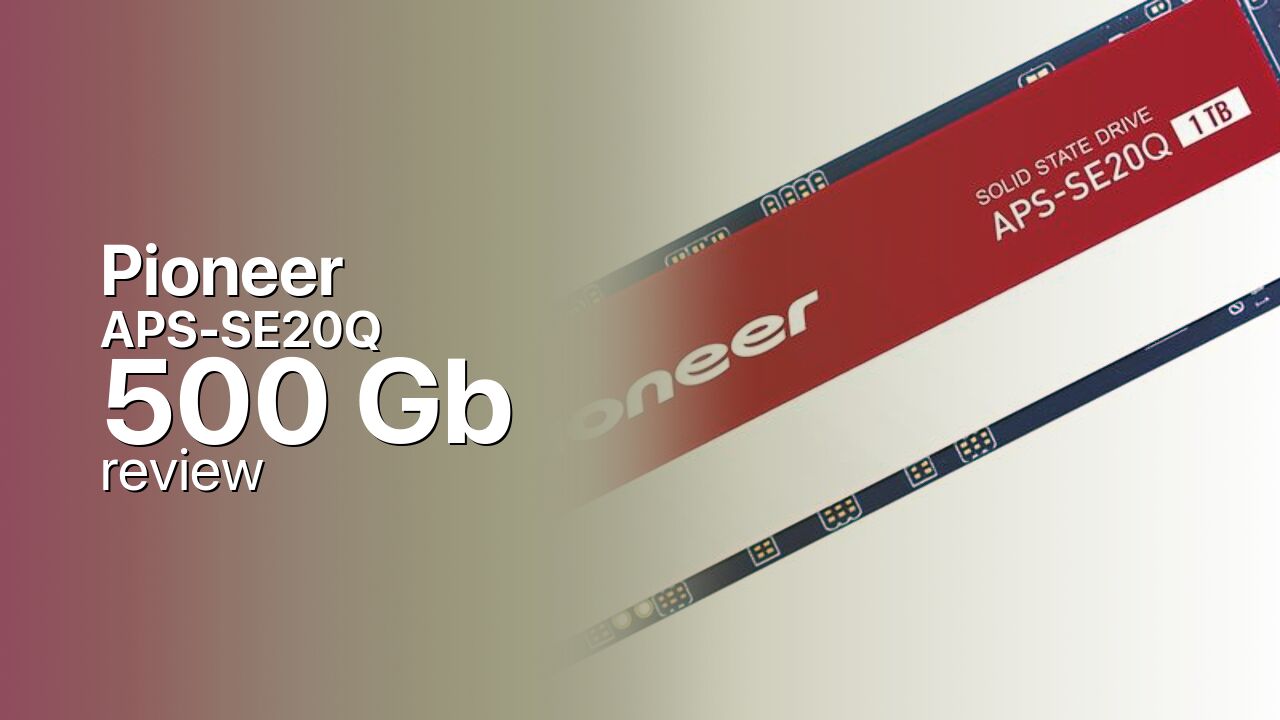
The Pioneer APS-SE20Q 500GB is a budget-oriented PCIe 3.0 NVMe SSD that pairs a Phison E12S controller with Micron 96-layer QLC NAND and a dedicated 512 MB DRAM cache.
Controller & Memory
Pioneer is better known for audio and home-entertainment gear, but the Japanese company has been quietly building out its SSD lineup under the IoT division. The APS-SE20Q is their first QLC drive, arriving in 500GB, 1TB, and 2TB capacities. All three share the same Phison PS5012-E12S-32 controller — an 8-channel, dual-core design that has proven reliable across multiple brands — paired with 512 MB of DDR3 DRAM for mapping-table caching.
The NAND is Micron 3D QLC with 96 cell layers. QLC stores 4 bits per cell, which increases density and lowers cost per gigabyte but comes with lower write endurance and slower sustained-write performance compared to TLC. Pioneer compensates with a dynamic SLC cache that borrows a portion of the QLC pool to absorb burst writes at SLC speeds. The drive is single-sided at just 1.35 mm thick, making it a natural fit for ultrabooks and compact builds where dual-sided modules can cause clearance issues.
At the 500GB capacity, the APS-SE20Q sits at the entry point of the lineup. The 1TB and 2TB models offer more spare area for the SLC cache and garbage collection, which generally translates to better sustained-write consistency under heavy workloads. For a boot drive or game library that sees mostly reads, the 500GB variant is serviceable, but power users should consider the larger capacities.
Direct competitors in the budget PCIe 3.0 QLC space include the Intel 660p and Crucial P1. Both use the same Phison E12 platform with QLC NAND and offer similar sequential speeds, but they carry double the TBW endurance at 400 TB. The WD Blue SN550 is another alternative, though it uses TLC NAND and a DRAM-less HMB design instead of dedicated DRAM.
Storage Comparisons:
APS-SE20Q Performance & Benchmarks
Pioneer rates the APS-SE20Q 500GB at up to 3,400 MB/s sequential reads and 3,000 MB/s sequential writes, with random read throughput up to 650,000 IOPS. These are the same ratings across all capacities, though independent testing on the 2TB model by Allround-PC confirmed the drive hits its advertised numbers — sequential reads landed at 3,462 MB/s and writes at 3,052 MB/s, slightly above spec.
Pioneer APS-SE20Q 500 GB vs M.2 3.0 x 4 peers
Switch between sequential throughput and random IOPS to see how this drive stacks up against other M.2 3.0 x 4 SSDs in our database. The highlighted bar is the drive on this page — click any other bar to open that drive.
- ADATA SX 8800 Pro 512 GB: 3,500 MB/s read, 2,700 MB/s write
- ADATA SX 8800 Pro 1 TB: 3,500 MB/s read, 2,700 MB/s write
- ADATA XPG Spectrix S40G RGB 256 GB: 3,500 MB/s read, 3,000 MB/s write
- ADATA XPG Spectrix S40G RGB 512 GB: 3,500 MB/s read, 3,000 MB/s write
- Pioneer APS-SE20Q 500 GB (this drive): 3,400 MB/s read, 3,000 MB/s write
The SLC cache handles burst writes well. In synthetic benchmarks, the drive delivers strong random-write numbers that approach sequential-write levels, a sign of a well-tuned cache implementation. However, once the SLC cache fills during sustained large-file transfers, write speeds drop significantly as data lands directly on QLC cells. For a typical consumer workload — OS boot, game loads, photo imports — the cache rarely exhausts and performance feels snappy. For sustained writes of tens of gigabytes, expect a noticeable step-down.
Thermal throttling is a consideration under prolonged heavy loads. Allround-PC measured peak temperatures of 80°C above the controller without a heatsink, at which point the drive throttles to protect itself. A motherboard M.2 heatsink or thermal pad is recommended for sustained-write scenarios. For light desktop and laptop use, thermals are generally manageable.
Pioneer APS-SE20Q vs Competitors
See how the APS-SE20Q stacks up against other M.2 3.0 x 4 drives in our database:
Compare with rival drives:
Endurance, TBW & Warranty
Pioneer backs the APS-SE20Q with a 3-year limited warranty capped at 200 TBW total bytes written. That endurance figure is on the low side — competitors like the Intel 660p and Crucial P1 offer 400 TBW at similar capacities. At 200 TBW, a user writing 20 GB per day would take roughly 27 years to exhaust the rating, so for typical consumer workloads the endurance is more than adequate. But for write-heavy use cases like video scratch disks or frequent large dataset transfers, the lower TBW is a genuine limitation. The warranty is direct through Pioneer, though availability and RMA support may vary by region.
Pioneer APS-SE20Q 500 GB Specifications
| Category | Value |
|---|---|
| Capacity [?] | 500 GB |
| Interface [?] | M.2 3.0 x 4 |
| Controller [?] | Phison PS5012-E12S-32 |
| Memory type [?] | Micron 3D QLC |
| DRAM [?] | 512 MB DDR3 |
| Read speed (MB/s) [?] | 3400 |
| Write speed (MB/s) [?] | 3000 |
| Read IOPS [?] | 650000 |
| Write IOPS [?] | 350000 |
| Endurance (TBW) [?] | 200 |
| MTBF (million hours) [?] | 1500000 |
| Warranty (years) [?] | 3 |
Verdict: Is the APS-SE20Q Worth It in 2026?
The Pioneer APS-SE20Q 500GB is a competent budget NVMe for users who want DRAM-equipped PCIe 3.0 storage without paying a premium. It makes sense as a boot drive or secondary game library for budget builders who prioritize upfront cost over long-term endurance. If you write more than 30 GB daily or need the extra headroom, step up to the 1TB or 2TB model — or consider the Intel 660p or Crucial P1, which offer double the TBW at competitive prices.
+ Pros
- 3,400 MB/s sequential reads
- Dedicated 512 MB DDR3 DRAM cache
- Single-sided 1.35 mm PCB fits ultrabooks
- Dynamic SLC cache for burst writes
- Phison E12S controller (proven platform)
- Cons
- 200 TBW — half the endurance of Intel 660p
- 3-year warranty (competitors offer 5)
- QLC NAND limits sustained write speeds
- Thermal throttling at 80°C without heatsink
- Limited regional availability and support
Buy this or similar SSD Storage:



Video Review
Pioneer APS-SE20Q-500 Internal SSD Review