PNY XLR8 CS3250 4TB — PCIe 5.0 NVMe SSD Review (2026)
Quick answer
The PNY XLR8 CS3250 4TB is the right drive for users who need both PCIe 5.0 throughput and genuinely large capacity in a single M.2 slot — a combination that eliminates the need to juggle data between a fast boot drive and a bulky SATA or HDD storage drive.
Read: 14900 MB/s Write: 14000 MB/s Endurance: 2800 TBW Warranty: 5 years Interface: M.2 5.0 x 4
The PNY XLR8 CS3250 4TB is the highest-capacity model in PNY's PCIe 5.0 NVMe lineup, pairing Phison's E28 controller with 4TB of SanDisk BiCS8 TLC NAND to deliver up to 14,900 MB/s sequential reads and a 2,800 TBW endurance rating.

Controller & Memory
PNY's CS3250 is the first retail drive to launch on Phison's PS5028-E28 controller, a 6nm chip that doubles the bandwidth ceiling compared to PCIe 4.0 predecessors. The 4TB model is the top SKU in the three-drive lineup (1TB, 2TB, 4TB) and pairs the E28 with SanDisk BiCS8 218-layer 3D TLC NAND and an expected 4GB LPDDR4 DRAM cache — 1GB per terabyte of storage, matching the allocation pattern established on the 1TB and 2TB models. The additional DRAM keeps the controller's address-translation table entirely in on-board memory, which sustains high throughput during long sequential transfers without the lookup-penalty degradation that affects HMB-only designs.
The CS3250 ships in the standard M.2 2280 form factor with a PCIe Gen 5 x4 interface running NVMe 2.0. PNY coats the Phison E28 controller with a thermal compound layer to reduce peak temperatures without requiring a bulky integrated heatsink, making the drive suitable for compact ITX builds and laptops that expose an M.2 2280 Gen5 slot. The 4TB variant matches the 2TB model's sequential write speed at 14,000 MB/s — 500 MB/s faster than the 1TB's 13,500 MB/s — because higher capacities spread writes across more NAND dies in parallel, improving sustained throughput. With 4TB of usable space, the drive is large enough to hold an extensive game library, a working video project cache, or a professional content-creation scratch disk without the capacity anxiety that accompanies 1TB and 2TB drives.
For buyers comparing PCIe 5.0 options at this capacity, the CS3250 4TB competes against the Crucial T705 4TB, Corsair MP700 Pro 4TB, Samsung 9100 Pro 4TB, and the WD Black SN8100 4TB. The T705 uses the older Phison E26 controller and has a longer retail review history; the Samsung 9100 Pro and WD Black SN8100 are newer entrants in the Gen5 4TB space. The CS3250 differentiates itself with the newer E28 silicon (6nm vs E26's 12nm), competitive rated sequential speeds, and PNY's 5-year warranty backed by direct support.
Storage Comparisons:
XLR8 CS3250 Performance & Benchmarks
The PNY XLR8 CS3250 4TB is rated at 14,900 MB/s sequential reads and 14,000 MB/s sequential writes under PCIe Gen 5 x4 — figures that sit at the current consumer NVMe ceiling. The 4TB model's write speed matches the 2TB SKU (14,000 MB/s) and is 500 MB/s higher than the 1TB (13,500 MB/s), reflecting the greater NAND die parallelism available at higher capacities. PNY does not publish official random IOPS specifications for the CS3250; independent reviewers testing the 2TB model report figures in the 1.4-1.5 million IOPS range at 4K QD32, and the 4TB's additional NAND channels should sustain or slightly improve those numbers.
PNY XLR8 CS3250 4 TB vs M.2 5.0 x 4 peers
Switch between sequential throughput and random IOPS to see how this drive stacks up against other M.2 5.0 x 4 SSDs in our database. The highlighted bar is the drive on this page — click any other bar to open that drive.
- PNY XLR8 CS3250 4 TB (this drive): 14,900 MB/s read, 14,000 MB/s write
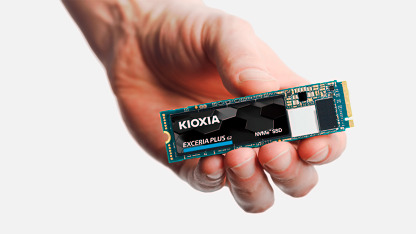
- Kioxia Exceria Pro G2 2 TB: 14,900 MB/s read, 13,400 MB/s write
- Kioxia Exceria Pro G2 4 TB: 14,900 MB/s read, 13,700 MB/s write
- PNY XLR8 CS3250 1 TB: 14,900 MB/s read, 13,500 MB/s write
- PNY XLR8 CS3250 2 TB: 14,900 MB/s read, 14,000 MB/s write
In practical terms, PCIe 5.0 throughput is most visible in large sequential workloads: 4K and 8K video ingest, DaVinci Resolve project caches, multi-layer Premiere Pro timelines, and game loading on titles that implement DirectStorage. The doubled sequential bandwidth over PCIe 4.0 condenses multi-gigabyte file transfers to seconds rather than tens of seconds. At 4TB, the drive has enough capacity to store several large game installations, a full video project, and a working OS simultaneously — a real advantage over 2TB drives that force users to shuffle data between drives.
The 4GB DRAM cache (expected, per the standard 1GB-per-1TB E28 allocation confirmed on lower capacities) means the SLC write buffer is backed by genuine address-translation memory, allowing the drive to maintain high throughput through the buffer without the degradation that affects HMB-only designs. The Phison E28's thermal coating helps prevent controller throttling under sustained writes, and independent reviewers noted only marginal throttling during extended sequential write runs on the 2TB model — the 4TB, with its larger NAND array distributing writes across more dies, should fare similarly or better in sustained-write thermal scenarios.
PNY XLR8 CS3250 vs Competitors
See how the XLR8 CS3250 stacks up against other M.2 5.0 x 4 drives in our database:
Compare with rival drives:
Endurance, TBW & Warranty
PNY covers the CS3250 with a five-year limited warranty, subject to TBW limits. The 4TB model carries a 2,800 TBW endurance rating — the highest in the CS3250 lineup, scaling proportionally from 600 TBW on the 1TB and 1,200 TBW on the 2TB. At a typical desktop write workload of 30 GB per day, the 4TB model's endurance budget translates to roughly 255 years of use before the TBW limit is reached, which means the five-year warranty clock will expire long before endurance becomes a practical concern for almost any consumer. Even at a heavy professional workload of 300 GB per day — sustained video production, database writes, or backup operations — the drive would take over 25 years to exhaust its rated write endurance.
PNY lists MTBF at 1.5 million hours across the CS3250 lineup. MTBF is a population-level reliability statistic derived from component stress testing; it reflects the average failure rate across a large fleet of drives, not a per-unit lifespan guarantee. PNY does not publish the TBW figure on its official product page — only the warranty clause '5-Year Limited Warranty or TBW' — but the 2,800 TBW rating is documented in independent review spec tables. Warranty service is handled through PNY's standard RMA process, and PNY provides free Acronis True Image cloning software and its SSD Toolbox utility for S.M.A.R.T. monitoring, secure erase, and firmware updates.
PNY XLR8 CS3250 4 TB Specifications
| Category | Value |
|---|---|
| Capacity [?] | 4 TB |
| Interface [?] | M.2 5.0 x 4 |
| Controller [?] | Phison E28 |
| Memory type [?] | SanDisk BiCS8 3D TLC |
| DRAM [?] | Yes |
| Read speed (MB/s) [?] | 14900 |
| Write speed (MB/s) [?] | 14000 |
| Read IOPS [?] | 1500000 |
| Write IOPS [?] | 1500000 |
| Endurance (TBW) [?] | 2800 |
| MTBF (million hours) [?] | 1.5 |
| Warranty (years) [?] | 5 |
Verdict: Is the XLR8 CS3250 Worth It in 2026?
The PNY XLR8 CS3250 4TB is the right drive for users who need both PCIe 5.0 throughput and genuinely large capacity in a single M.2 slot — a combination that eliminates the need to juggle data between a fast boot drive and a bulky SATA or HDD storage drive. The 2,800 TBW endurance rating is substantial and gives professionals room to write heavily for years without approaching the warranty ceiling. Buyers running a PCIe 4.0 or 3.0 platform should skip this drive — it requires a PCIe 5.0 x4 slot to reach rated speeds and will fall back to PCIe 4.0 bandwidth on older motherboards. For those with the right hardware, the Samsung 9100 Pro 4TB and Crucial T705 4TB are the natural alternatives worth comparing on current street pricing; the T705 has a longer review track record and the Samsung carries a strong brand warranty, but the CS3250's newer E28 controller and competitive pricing make it a strong value proposition in the Gen5 4TB tier. The drive ships without a heatsink, so budget for motherboard-integrated cooling or a thin aftermarket heatsink if the slot lacks thermal padding.
+ Pros
- 14,900 MB/s sequential reads on PCIe 5.0 x4
- 14,000 MB/s sequential writes (matches 2TB SKU, 500 MB/s above 1TB)
- 4GB LPDDR4 DRAM cache — no HMB compromise
- 2,800 TBW endurance with 5-year limited warranty
- 4TB capacity — enough for game library, OS, and working projects on one drive
- MTBF rated at 1.5 million hours
- Thermal-coated controller — usable without aftermarket heatsink
- Cons
- Requires PCIe 5.0 x4 slot — no benefit on PCIe 4.0 or 3.0 platforms
- PNY does not publish official IOPS specs or TBW on its product page
- No included heatsink in retail box
- Runs warmer than PCIe 4.0 drives under sustained load
- 4TB Gen5 SSD pricing is premium compared to equivalent PCIe 4.0 drives
Buy this or similar SSD Storage:
Video Review
The Cheat Code for Choosing an SSD for Your Build