Apacer AS2280F4 2 TB: full-speed Gen5 NVMe with active cooling (2026)
Quick answer
The Apacer AS2280F4 2 TB is the performance sweet spot of the lineup: the first capacity to hit the full 12,000 MB/s read and 11,800 MB/s write rated speeds, combined with 1,400 TBW endurance, LPDDR4 DRAM, and the active-cooling heatsink that ships with every unit.
Read: 12000 MB/s Write: 11800 MB/s Endurance: 1400 TBW Warranty: 5 years Interface: M.2 5.0
The Apacer AS2280F4 2 TB is a PCIe 5.0 x4 NVMe SSD built on the Phison PS5026-E26 controller with LPDDR4 DRAM, rated 12,000 MB/s reads, 11,800 MB/s writes, and 1,400 TBW on the 2 TB model.
Controller & Memory
The AS2280F4 runs on Phison's PS5026-E26, an eight-channel PCIe 5.0 NVMe controller fabricated on TSMC's 12nm process. The E26 is the most widely deployed Gen5 controller in the consumer market, found inside drives from Crucial, Corsair, Seagate, and Sabrent as well. In the AS2280F4, Phison pairs the E26 with Micron 232-layer TLC NAND (the B58R die) and an LPDDR4 DRAM chip that holds the logical-to-physical address mapping table in dedicated on-board memory. This distinguishes it from DRAM-less HMB designs that borrow system RAM across the PCIe bus for the same purpose. The drive connects via PCIe 5.0 x4 with NVMe 2.0 and uses the standard M.2 2280 form factor, requiring a Gen5-capable M.2 slot — typically found on current-generation Z790, X670E, or Z890 motherboards.
The 2 TB model is the performance sweet spot of the AS2280F4 lineup. The 1 TB sits below it with lower speeds (11,500 MB/s reads, 9,000 MB/s writes) because its smaller NAND die count constrains parallelism; the 2 TB is the first capacity to unlock the full 12,000/11,800 MB/s rated throughput. The 4 TB steps slightly higher still at 12,400/12,000 MB/s, but at a significant price premium. The 2 TB also delivers double the TBW endurance of the 1 TB (1,400 versus 700) and a larger dynamic SLC write cache for better sustained write performance. For creators, backup pipelines, and workstation users handling large files regularly, the 2 TB capacity is the practical entry point in this lineup.
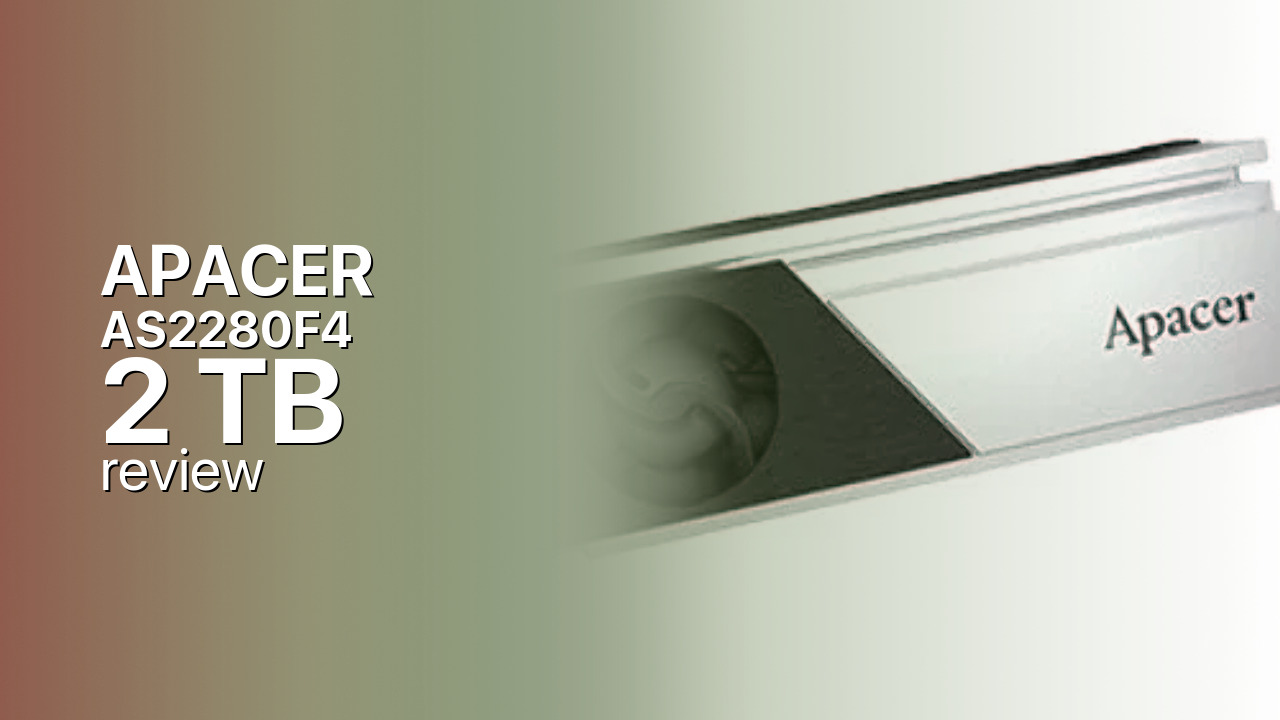
All AS2280F4 variants ship with an active-cooling heatsink: an aluminium fin array combined with an integrated mini-fan that Apacer rates at up to 25% lower operating temperature than passive heatsink designs. This matters with the E26 controller, which runs warmer than its PCIe 4.0 predecessors due to the higher signalling rates of Gen5. The Crucial T705 2 TB, Corsair MP700 Pro 2 TB, and Seagate FireCuda 540 2 TB share the same E26 controller, but most rely on passive aluminium heatsinks — the AS2280F4's active cooling is a genuine differentiator for builds where M.2 slot airflow is constrained.
Storage Comparisons:
AS2280F4 Performance & Benchmarks
The Apacer AS2280F4 2 TB is rated at 12,000 MB/s sequential reads and 11,800 MB/s sequential writes on PCIe 5.0 x4 — figures that put it ahead of every PCIe 4.0 NVMe drive and roughly double the bandwidth ceiling of a fast Gen4 SSD. Random performance is rated at 1,400,000 read IOPS and 1,400,000 write IOPS under 4K workloads. Notably, the 1 TB model only reaches 1,300,000 read IOPS; the 2 TB's additional NAND die parallelism closes that gap.
APACER AS2280F4 2 TB vs M.2 5.0 peers
Switch between sequential throughput and random IOPS to see how this drive stacks up against other M.2 5.0 SSDs in our database. The highlighted bar is the drive on this page — click any other bar to open that drive.
- Corsair MP700 Pro XT 1 TB: 14,900 MB/s read, 14,200 MB/s write
- Corsair MP700 Pro XT 2 TB: 14,900 MB/s read, 14,500 MB/s write
- Corsair MP700 Pro XT 4 TB: 14,900 MB/s read, 14,400 MB/s write
- Crucial T710 1 TB: 14,900 MB/s read, 13,800 MB/s write
- APACER AS2280F4 2 TB (this drive): 12,000 MB/s read, 11,800 MB/s write
Practical sequential throughput on any TLC NVMe drive is divided into two phases: an initial SLC write cache burst, and sustained out-of-cache writes once the buffer fills. On the 2 TB AS2280F4, the dynamic SLC cache is substantially larger than on the 1 TB — the additional NAND dies provide more capacity to partition off as fast pseudo-SLC storage. For everyday workloads — OS boot, application data, game asset streaming — the drive operates almost entirely within this SLC window, and the full 11,800 MB/s write speed is representative of what you will see. For large sequential writes that exhaust the cache — transferring tens or hundreds of gigabytes in a single session — sustained throughput drops to the direct TLC write rate, which is still competitive with top-tier PCIe 4.0 drives.
The included active-cooling heatsink is directly relevant to sustained performance. The Phison E26 controller throttles under thermal pressure, and fan-assisted cooling keeps the controller below its throttle threshold more reliably than a passive solution does, preserving the rated speeds for longer sequential runs. For gaming, the 12,000 MB/s read bandwidth supports DirectStorage-enabled titles that stream compressed assets from storage to the GPU without CPU decompression. In conventional titles without DirectStorage, game load times are constrained by random small-block read performance rather than peak sequential bandwidth, and the 1,400,000 IOPS rating handles those workloads without friction.
APACER AS2280F4 vs Competitors
See how the AS2280F4 stacks up against other M.2 5.0 drives in our database:
Compare with rival drives:
Endurance, TBW & Warranty
Apacer covers the AS2280F4 with a 5-year global warranty across all capacities. The 2 TB model carries a rated endurance of 1,400 TBW (terabytes written) — the total cumulative write budget covered under warranty. Coverage expires at whichever threshold arrives first: five years from purchase or 1,400 TBW of cumulative writes.
At a typical consumer write rate of 30 GB per day, reaching 1,400 TBW on the 2 TB model would take approximately 128 years — far beyond any realistic use scenario. Even at an intensive 200 GB per day — heavy video editing or large dataset management — the drive would take roughly 19 years to exhaust its endurance rating. Only a small number of continuously writing workloads, such as ongoing database write pipelines exceeding 1 TB per day, would approach the 1,400 TBW boundary within any practical timeframe. For those edge cases, the 4 TB model with 3,000 TBW is the better choice. The 5-year time limit will be the binding constraint for nearly every buyer. Warranty service is handled through Apacer's regional authorised support network.
APACER AS2280F4 2 TB Specifications
| Category | Value |
|---|---|
| Capacity [?] | 2 TB |
| Interface [?] | M.2 5.0 |
| Controller [?] | Phison PS5026-E26 8 Channel |
| Memory type [?] | Micron 232-L TLC |
| DRAM [?] | Yes |
| Read speed (MB/s) [?] | 12000 |
| Write speed (MB/s) [?] | 11800 |
| Read IOPS [?] | 1400000 |
| Write IOPS [?] | 1400000 |
| Endurance (TBW) [?] | 1400 |
| MTBF (million hours) [?] | 1600000 |
| Warranty (years) [?] | 5 |
Verdict: Is the AS2280F4 Worth It in 2026?
The Apacer AS2280F4 2 TB is the performance sweet spot of the lineup: the first capacity to hit the full 12,000 MB/s read and 11,800 MB/s write rated speeds, combined with 1,400 TBW endurance, LPDDR4 DRAM, and the active-cooling heatsink that ships with every unit. The 5-year warranty is competitive at this tier.
Buy it if you have a PCIe 5.0 platform and want the full E26 performance without stepping up to the 4 TB's price. The larger SLC cache over the 1 TB makes a real difference for users moving large files, and 1,400 TBW covers any mainstream workload comfortably.
Skip it if your board tops out at PCIe 4.0 — a Crucial T705 or Samsung 9100 Pro on Gen4 delivers equivalent real-world performance at lower cost on those platforms. Users with lighter workloads who want Gen5 at a lower entry price may find the 1 TB sufficient, noting its lower sustained write speeds.
+ Pros
- 12,000 MB/s sequential reads on PCIe 5.0 x4 — full-speed for the E26 controller
- 11,800 MB/s sequential writes, higher than the 1 TB model (9,000 MB/s)
- 1,400,000 read and write IOPS — matched across both random dimensions at 2 TB
- 1,400 TBW endurance — double the 1 TB model's budget
- Bundled active-cooling heatsink with integrated fan
- LPDDR4 DRAM cache on the Phison PS5026-E26 controller
- 5-year global warranty, NVMe 2.0, M.2 2280 form factor
- Cons
- Requires a PCIe 5.0 x4 M.2 slot — no speed benefit on Gen4 or Gen3 platforms
- Phison E26 runs warm; sustained performance depends on active cooling functioning correctly
- Integrated fan adds noise compared to passive heatsink designs
- Gen5 pricing premium over equivalent PCIe 4.0 drives
- 4TB variant hits higher speeds (12,400/12,000 MB/s) and 3,000 TBW for workstation users who need more
Buy this or similar SSD Storage:
Video Review
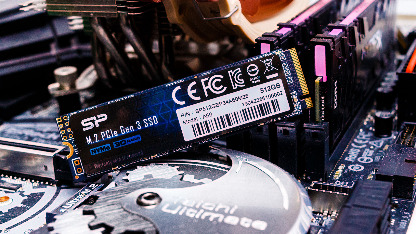
Experience Mind-blowing Speed With The Gen 5 Apacer As2280f4 Nvme Drive!