GOODRAM IRDM Pro Gen 5 2TB PCIe 5.0 NVMe Review (2026)
Quick answer
The GOODRAM IRDM Pro Gen 5 2 TB is the right pick for a PCIe 5.0-capable desktop owner who wants a single high-capacity drive that does not give up Gen5 throughput, and who values a 5-year EU-backed warranty over the absolute fastest sustained-write scores.
Read: 12000 MB/s Write: 11000 MB/s Endurance: 1400 TBW Warranty: 5 years Interface: M.2 5.0
The GOODRAM IRDM Pro Gen 5 2 TB is the mainstream capacity of Wilk Elektronik's flagship PCIe 5.0 line, hitting the platform's full 12,000 MB/s read and 11,000 MB/s write with a 1,400 TBW rating.
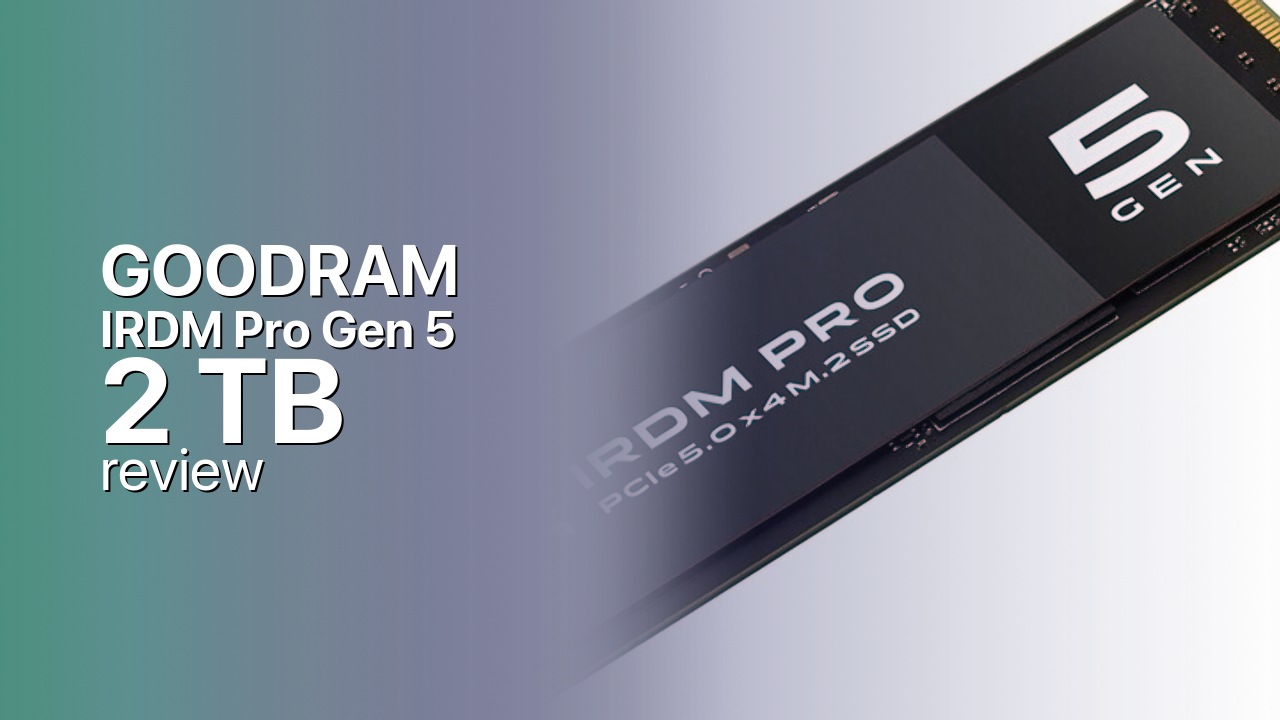
Controller & Memory
The 2 TB IRDM Pro Gen 5 is the middle of three capacities GOODRAM ships on this platform (1 TB, 2 TB, 4 TB) and it is the one that lands at the platform's full rated speed, unlike the 1 TB which trades some write throughput for fewer NAND dies. Inside is the standard Gen5 recipe: Phison's PS5026-E26 controller, an eight-channel 5-core part built on TSMC's 12 nm process, paired with Micron B58R 232-layer TLC running at 2,400 MT/s. A 4 GB LPDDR4 DRAM buffer holds the flash translation layer, and a pseudo-SLC write cache absorbs short bursts before flushing to native TLC. GOODRAM ships the stick double-sided in the M.2 2280 form factor with its Graphreeze graphene coating in place of a metal heatsink.
Capacity-specific, the 2 TB variant is rated for 12,000 MB/s sequential read, 11,000 MB/s sequential write, up to 1,400,000 random read IOPS and 1,400,000 random write IOPS, with a 1,400 TBW endurance rating. These are the same headline numbers GOODRAM quotes on the 4 TB and they match what TechPowerUp's independent database reports for the 2 TB part. Compared to the 1 TB, the jump to full-speed writes is the main reason to pay for the larger capacity if your workload pushes sustained transfers; for read-mostly use the gap is negligible. Endurance scales linearly with capacity on this family, so the 2 TB doubles the 700 TBW of the 1 TB.
The buyer profile is a PCIe 5.0-capable desktop owner (AMD 600-series or Intel 700-series onward) who wants a single high-capacity drive for OS, games library, and working files without compromising on Gen5 throughput. Double-sided PCB rules out some single-sided-only laptop slots and tight PS5 installations, though the drive meets Sony's read-speed requirement comfortably. No metal heatsink ships in the box; budget for the motherboard's integrated M.2 cooler or a third-party Gen5 heatsink, since the graphene layer alone is not enough to keep an E26 controller at peak under sustained load. Direct rivals include the Crucial T700 2TB and Crucial T705 2TB on the same Phison E26 platform, the Corsair MP700 PRO 2TB, and on PCIe 4.0 for value-led buyers the Samsung 990 Pro 2TB.
Storage Comparisons:
IRDM Pro Gen 5 Performance & Benchmarks
On the 2 TB capacity GOODRAM rates the IRDM Pro Gen 5 for 12,000 MB/s sequential read and 11,000 MB/s sequential write over its PCIe 5.0 x4 link, with random performance quoted at up to 1,400,000 read IOPS and 1,400,000 write IOPS. These are essentially the platform ceiling for a Phison E26 drive on Micron 232-layer TLC; TechPowerUp's independent database reports the same numbers for the 2 TB variant. In real terms that is roughly double the sequential throughput of the fastest PCIe 4.0 parts, which matters most for moving large files, capturing 4K and 8K video to a scratch disk, and for DirectStorage-enabled games that can stream assets directly to the GPU.
GOODRAM IRDM Pro Gen 5 2 TB vs M.2 5.0 peers
Switch between sequential throughput and random IOPS to see how this drive stacks up against other M.2 5.0 SSDs in our database. The highlighted bar is the drive on this page — click any other bar to open that drive.
- Corsair MP700 Pro XT 1 TB: 14,900 MB/s read, 14,200 MB/s write
- Corsair MP700 Pro XT 2 TB: 14,900 MB/s read, 14,500 MB/s write
- Corsair MP700 Pro XT 4 TB: 14,900 MB/s read, 14,400 MB/s write
- Crucial T710 1 TB: 14,900 MB/s read, 13,800 MB/s write
- GOODRAM IRDM Pro Gen 5 2 TB (this drive): 12,000 MB/s read, 11,000 MB/s write
As with every E26 drive, the headline sequential figures are burst numbers measured against the pseudo-SLC cache in a fresh-out-of-box state. Once the cache fills (its size scales with free space and is not published by GOODRAM), writes drop to the native TLC rate, which on the 2 TB is markedly better than on the 1 TB because there are more NAND dies to interleave. Independent reviews of E26 drives on this Micron NAND consistently find the platform hits its rated peak on reads in CrystalDiskMark-style benchmarks, but that real-world game load times and OS responsiveness are nearly indistinguishable from a good PCIe 4.0 drive. Treat the 11,000 MB/s sequential write as a best-case burst; sustained writes land lower, and under heavy load the controller will throttle if cooling is inadequate.
GOODRAM IRDM Pro Gen 5 vs Competitors
See how the IRDM Pro Gen 5 stacks up against other M.2 5.0 drives in our database:
Compare with rival drives:
Endurance, TBW & Warranty
GOODRAM rates the 2 TB IRDM Pro Gen 5 at 1,400 TBW (Terabytes Written) over the lifetime of the drive and backs it with a 5-year limited warranty, whichever comes first. The 1,400 TBW figure scales linearly with capacity across the family (700 TBW on the 1 TB, 3,000 TBW on the 4 TB) and reflects the 3,000 P/E-cycle endurance of the underlying Micron 232-layer TLC. In practical use, 1,400 TBW allows roughly 766 GB of writes every single day for the full five-year warranty term, which is well beyond what any gaming or general-purpose workload generates. A heavy video-editing rig writing 200 GB of footage a day would take around 19 years to exhaust the endurance rating, so the warranty term rather than the TBW is the effective limit. GOODRAM (Wilk Elektronik SA, based in Poland) services the warranty through its European distribution network; buyers outside the EU should confirm RMA handling with the retailer. The drive's rated MTBF is 1.6 million hours, a population-reliability statistic consistent with other Phison E26 drives on the same Micron NAND.
GOODRAM IRDM Pro Gen 5 2 TB Specifications
| Category | Value |
|---|---|
| Capacity [?] | 2 TB |
| Interface [?] | M.2 5.0 |
| Controller [?] | Phison PS5026-E26 8 Channel |
| Memory type [?] | Micron 232-L |
| DRAM [?] | Yes |
| Read speed (MB/s) [?] | 12000 |
| Write speed (MB/s) [?] | 11000 |
| Read IOPS [?] | 1400000 |
| Write IOPS [?] | 1400000 |
| Endurance (TBW) [?] | 1400 |
| MTBF (million hours) [?] | 1600000 |
| Warranty (years) [?] | 5 |
Verdict: Is the IRDM Pro Gen 5 Worth It in 2026?
The GOODRAM IRDM Pro Gen 5 2 TB is the right pick for a PCIe 5.0-capable desktop owner who wants a single high-capacity drive that does not give up Gen5 throughput, and who values a 5-year EU-backed warranty over the absolute fastest sustained-write scores. Skip it if you are on a PCIe 4.0-only board (the drive runs but you waste the Gen5 premium) or if you need a single-sided stick for a laptop or PS5 slot, since this is a double-sided PCB. The direct alternative is the Crucial T705 2TB, which pushes the E26 platform slightly further on write speed and ships in a heatsink variant, though it runs hotter and typically commands a price premium. As a balanced, full-speed Gen5 part with Micron 232-layer TLC and Graphreeze cooling, the IRDM Pro Gen 5 2 TB is the most broadly useful capacity in the lineup.
+ Pros
- Full 12,000 MB/s read at 2 TB
- 11,000 MB/s sequential write
- 1.4M random read and write IOPS
- 1,400 TBW endurance rating
- Phison E26 with 4 GB LPDDR4 DRAM
- 5-year limited warranty
- Cons
- No metal heatsink included
- Double-sided PCB limits laptop fitment
- Phison E26 runs hot under sustained load
- Graphreeze coating alone is not enough cooling
- Write speed drops once SLC cache fills
Buy this or similar SSD Storage:



Video Review
GOODRAM IRDM PRO GEN.2 1TB | SSD Review