BIWIN Black Opal X570 Pro 4TB: Maximum Capacity on Gen5 (2026)
Quick answer
The BIWIN Black Opal X570 Pro 4TB is the strongest configuration in the lineup: the SM2508's 8-channel architecture operates at full parallelism, the write speed reaches its 13,000 MB/s ceiling on par with the 2TB model, the DRAM cache grows to 4GB, and the TBW endurance reaches 3,000 TBW under a 5-year warranty.
Read: 14000 MB/s Write: 13000 MB/s Endurance: 3000 TBW Warranty: 5 years Interface: M.2 5.0
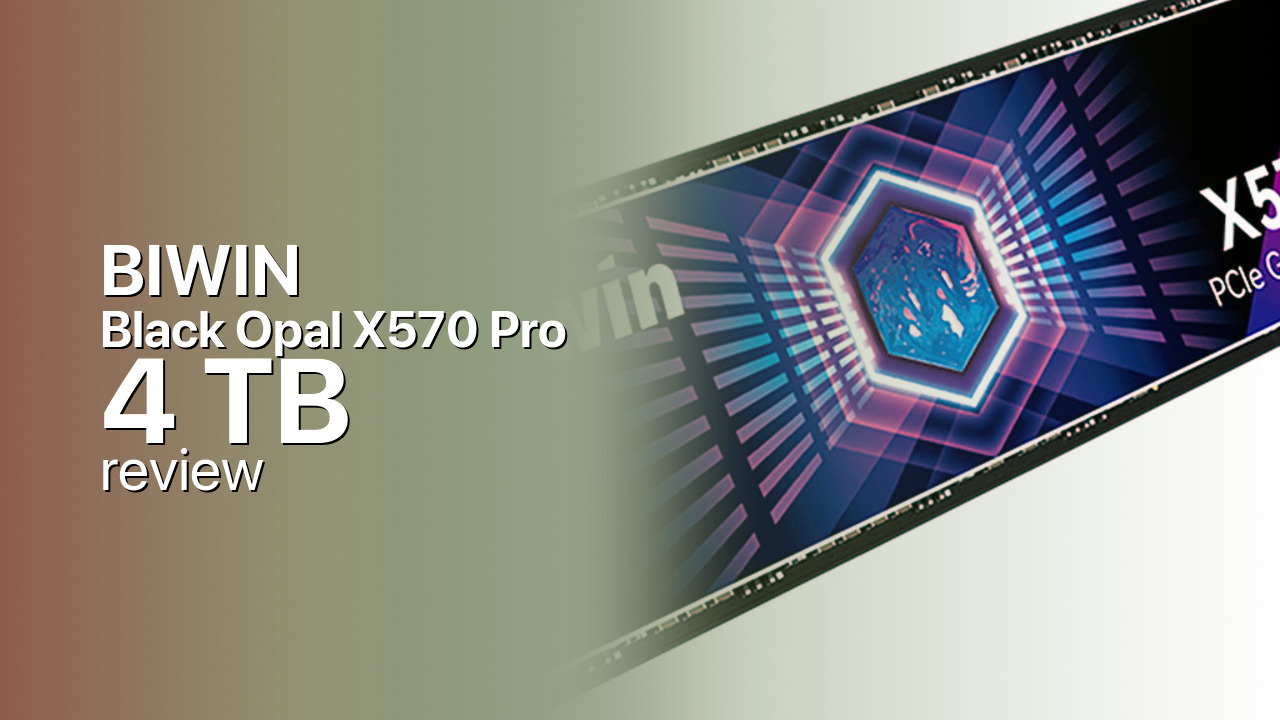
The BIWIN Black Opal X570 Pro 4TB is a PCIe 5.0 NVMe SSD rated at 14,000 MB/s sequential reads and 13,000 MB/s writes, pairing Silicon Motion's SM2508 controller with Micron 232-layer TLC NAND and 4GB of LPDDR4 DRAM in a single-sided M.2 2280 format.
Controller & Memory
The X570 Pro 4TB occupies the top of BIWIN's consumer SSD lineup by capacity — the point in the range where the SM2508 controller can fully exploit its 8-channel architecture. With four terabytes of Micron 232-layer TLC NAND spread across eight channels and 4GB of dedicated LPDDR4 DRAM backing the logical-to-physical address table, the 4TB model reaches write performance parity with the 2TB variant at 13,000 MB/s — a figure the smaller 1TB model cannot match. That write ceiling matters for buyers moving large media libraries, maintaining game collections, or running sustained backup and capture workflows.
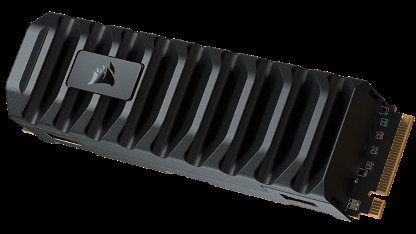
The SM2508 is a 6nm controller, which distinguishes it from the 12nm Phison E26 that dominates competing Gen5 SSDs such as the Crucial T705 and Corsair MP700 Pro. The more advanced node translates to lower idle and active power draw and reduced heat output — factors that become relevant at 4TB capacity where more active NAND die are present and thermal accumulation under sustained writes is higher. The drive ships without a traditional aluminium heatsink, using instead a graphene thermal film bonded to the NAND for passive heat spreading. KitGuru's testing of this exact unit recorded a peak of 57°C during CrystalDiskMark's write phase without any external cooler — a result that compares favourably with Phison E26 drives under equivalent test conditions.
The 4TB X570 Pro is single-sided M.2 2280 — a meaningful specification at this capacity, where some competing designs move to double-sided PCBs that exceed the height clearance for PS5 expansion slots and certain laptop M.2 sockets. The 8TB variant moves to a double-sided layout, making the 4TB the maximum single-sided capacity in the lineup. For buyers building content-creation workstations, NAS-adjacent desktop setups, or large game libraries on a single NVMe slot, 4TB on a single-sided 2280 module removes layout constraints that would otherwise force a secondary drive.
BIWIN (BIWIN Storage Technology Co., Ltd.) is a Shenzhen-based manufacturer with a background in embedded NAND and OEM memory supply. The Black Opal retail brand is a more recent consumer push. Independent reviews from KitGuru, igorslab, and tech4gamers have covered the X570 Pro across its capacity range, and the 4TB unit specifically received KitGuru's Worth Buying Award at an 8.5/10 rating, citing overall performance and endurance as its strongest points.
Storage Comparisons:
Black Opal X570 Pro Performance & Benchmarks
The BIWIN Black Opal X570 Pro 4TB is rated at 14,000 MB/s sequential reads and 13,000 MB/s sequential writes on PCIe 5.0 x4. KitGuru's CrystalDiskMark 8 test of this exact unit measured 14,371 MB/s reads and 13,408 MB/s writes — matching the rated figures closely and confirming that the 13,000 MB/s write spec is not conservative padding. ATTO benchmark results from the same review returned 13,900 MB/s reads and 12,500 MB/s writes, which reflects typical slight divergence between synthetic tools at this performance tier.
BIWIN Black Opal X570 Pro 4 TB vs M.2 5.0 peers
Switch between sequential throughput and random IOPS to see how this drive stacks up against other M.2 5.0 SSDs in our database. The highlighted bar is the drive on this page — click any other bar to open that drive.
- Corsair MP700 Pro XT 1 TB: 14,900 MB/s read, 14,200 MB/s write
- Corsair MP700 Pro XT 2 TB: 14,900 MB/s read, 14,500 MB/s write
- Corsair MP700 Pro XT 4 TB: 14,900 MB/s read, 14,400 MB/s write
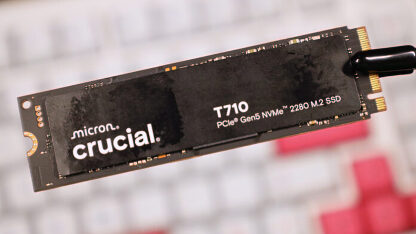
- Crucial T710 1 TB: 14,900 MB/s read, 13,800 MB/s write
- BIWIN Black Opal X570 Pro 4 TB (this drive): 14,000 MB/s read, 13,000 MB/s write
For random access the 4TB model is rated at 2,000,000 read IOPS and 1,600,000 write IOPS. These figures benefit from the 4TB model's higher NAND die count relative to the 1TB variant, where more parallel die allow more simultaneous random operations. The 4GB LPDDR4 DRAM cache — the largest in the lineup — keeps the address-translation table fully resident in low-latency memory, avoiding the HMB round-trips that affect DRAMless designs under heavy random workloads.
The drive carries approximately 208 GB of dynamic pSLC write cache, which absorbs burst writes at SLC speeds before the controller begins writing directly to TLC cells. For sustained sequential writes above that threshold — full 4TB imaging jobs, very large video capture sessions — throughput settles to native TLC write rates, which is normal behaviour for consumer drives at any capacity. The SM2508's 6nm process gives the controller a thermal envelope advantage over the 12nm Phison E26: KitGuru recorded a 57°C peak during write-heavy testing with no external heatsink, which is a controlled result for a Gen5 drive pushing 13,000 MB/s.
BIWIN Black Opal X570 Pro vs Competitors
See how the Black Opal X570 Pro stacks up against other M.2 5.0 drives in our database:
Compare with rival drives:
Endurance, TBW & Warranty
BIWIN backs the Black Opal X570 Pro with a 5-year limited warranty across all capacities. The 4TB model carries a TBW (terabytes written) endurance rating of 3,000 TBW — the highest in the lineup and one of the largest endurance budgets available on a consumer PCIe 5.0 drive at this form factor. At a sustained write rate of 100 GB per day, a workload consistent with regular video editing and content creation, 3,000 TBW equates to over 80 years of operation before the endurance threshold is reached. Even at an intensive 500 GB per day — representative of professional capture and archiving workflows — the rated limit would take over 16 years to approach. The 5-year warranty clock will expire long before TBW becomes the binding constraint for any realistic workload. BIWIN's support structure is headquartered in Shenzhen; buyers outside Asia should confirm that their retail channel provides regional warranty service before purchasing through import or grey-market listings, as coverage terms can vary by distributor.
BIWIN Black Opal X570 Pro 4 TB Specifications
| Category | Value |
|---|---|
| Capacity [?] | 4 TB |
| Interface [?] | M.2 5.0 |
| Controller [?] | Silicon Motion SM2508 8 Channel |
| Memory type [?] | Micron 232-L TLC |
| DRAM [?] | Yes |
| Read speed (MB/s) [?] | 14000 |
| Write speed (MB/s) [?] | 13000 |
| Read IOPS [?] | 2000000 |
| Write IOPS [?] | 1600000 |
| Endurance (TBW) [?] | 3000 |
| MTBF (million hours) [?] | 1500000 |
| Warranty (years) [?] | 5 |
Verdict: Is the Black Opal X570 Pro Worth It in 2026?
The BIWIN Black Opal X570 Pro 4TB is the strongest configuration in the lineup: the SM2508's 8-channel architecture operates at full parallelism, the write speed reaches its 13,000 MB/s ceiling on par with the 2TB model, the DRAM cache grows to 4GB, and the TBW endurance reaches 3,000 TBW under a 5-year warranty. For buyers who need a single-drive solution for large media libraries, game collections exceeding 2TB, or content-creation workstations where repeated large-file transfers are routine, the 4TB X570 Pro consolidates that storage onto one PCIe 5.0 slot without moving to a double-sided PCB.
The honest considerations are brand maturity and retail availability. BIWIN does not yet have the established Western retail footprint, RMA network, or independent benchmark depth of Samsung, WD, or Crucial. KitGuru's Worth Buying Award and tech4gamers' positive testing provide reasonable third-party validation, but the review library is still narrower than the established names at this capacity. Buyers who prioritise proven brand support should compare the Crucial T705 4TB or Seagate FireCuda 540 4TB. Those comfortable with a newer brand offering strong hardware for the price will find the X570 Pro 4TB a technically well-rounded choice.
+ Pros
- 14,000 MB/s sequential reads and 13,000 MB/s writes — full-speed 4TB write performance
- Silicon Motion SM2508 on 6nm: runs cooler than competing Phison E26 Gen5 drives
- 4GB LPDDR4 DRAM cache — largest in the X570 Pro lineup
- 3,000 TBW endurance with 5-year warranty — among the highest on a consumer PCIe 5.0 drive
- Single-sided M.2 2280 — fits PS5 and laptops that reject double-sided modules
- KitGuru measured 14,371 / 13,408 MB/s in CrystalDiskMark — specs match real-world testing
- Cons
- Limited brand recognition and retail presence in Western markets vs Samsung, WD, or Crucial
- No bundled heatsink — relies on graphene thermal film; sustained workloads need motherboard thermal contact
- Regional warranty support may be unclear for units purchased via import or grey-market channels
- Narrower independent benchmark and long-term reliability data than established Gen5 competitors
- Premium pricing over the 2TB model without a write-speed increase — the step-up is capacity and endurance only
Buy this or similar SSD Storage:



Video Review
CRAZY FAST Biwin X570 Pro 2TB 14000MBPS PCIe Gen5 NVME m2 with DRAM cache