High-Capacity PCIe Gen 5 Storage for Large Libraries and Professional Workflows (2026)
Quick answer
The Crucial T710 4TB resolves the speed-versus-capacity trade-off that PCIe 4.0 drives at this capacity could not.
Read: 14500 MB/s Write: 13800 MB/s Endurance: 2400 TBW Warranty: 5 years Interface: M.2 5.0
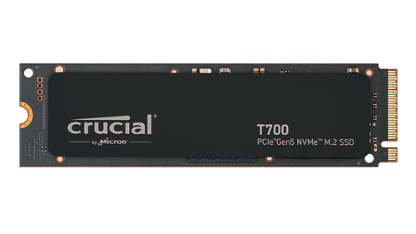
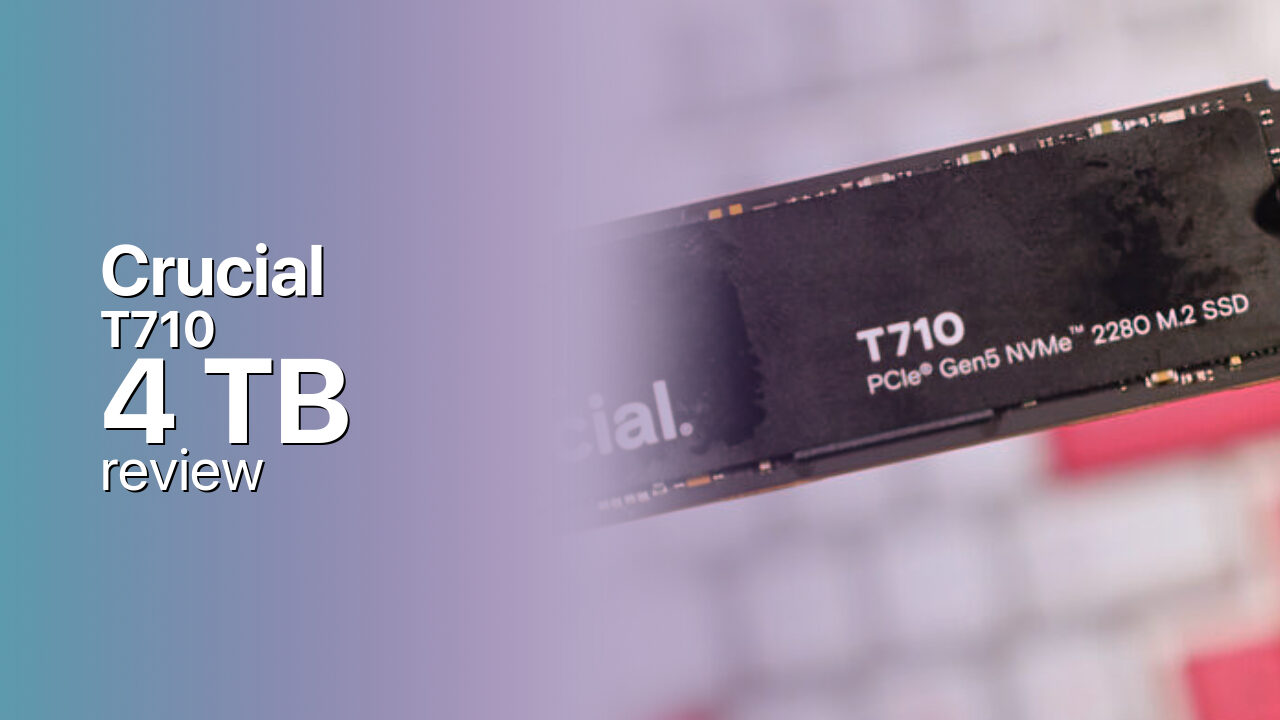
The Crucial T710 4TB brings Micron's 276-layer G9 TLC NAND and the Silicon Motion SM2508 controller to their highest single-drive capacity, with 14,500 MB/s sequential reads, 2.2 million IOPS, and 2,400 TBW in an M.2 2280 form factor.
Controller & Memory
The Crucial T710 4TB targets the builder who wants high-speed primary storage and enough capacity to keep the entire active library on one drive. For a content creator managing raw video project files, 4TB of PCIe 5.0 NVMe eliminates the compromise between speed and capacity. For a gamer who keeps a large installed library, 4TB handles dozens of modern AAA titles without requiring secondary drives or constant uninstall cycles.
The drive is built on Micron's G9 276-layer 3D TLC NAND, the same flash generation as the 1TB and 2TB models. The extra layers give each die a 3.6 GT/s IO speed — roughly 50% faster than the 232-layer B58R NAND in the T705 and Corsair MP700 Pro XT — and the SM2508 controller's eight channels are matched to fully exploit that speed. At 4TB, the die count is at its maximum for the platform, which is why IOPS remain identical to the 2TB at 2.2 million read and 2.2 million write rather than increasing further. Sequential speeds also hold at 14,500 MB/s read and 13,800 MB/s write, matching the 2TB exactly.
The 4TB model carries 4GB of LPDDR4-4266 DRAM, scaling linearly at 1GB per terabyte. The larger DRAM allocation allows a more complete mapping table to reside in cache, which matters most under sustained mixed workloads where the drive is handling simultaneous random and sequential access patterns — common during active video editing or large game asset streaming.
Power consumption remains 8.25 watts across all T710 capacities — a meaningful efficiency advantage over the T705's 11.25 watts. At 4TB, where drive temperatures can be more sensitive to sustained load, the lower power envelope reduces thermal management demands.
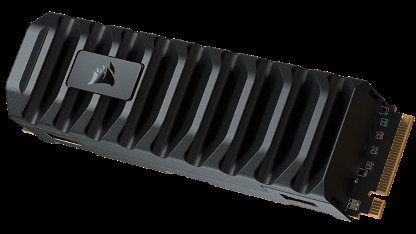
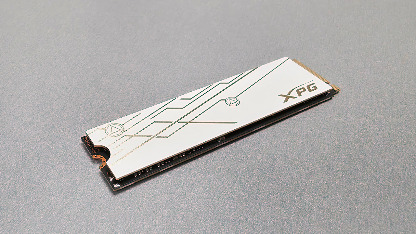
On the competitive side, the Corsair MP700 Pro XT 4TB reaches 14,000 MB/s reads and 11,800 MB/s writes, trailing the T710 by 500 MB/s and 2,000 MB/s respectively. The ADATA XPG Legend 970 Pro 4TB matches the T710 on sequential read at 14,500 MB/s but trails on write at 13,000 MB/s. The T705 4TB reaches the same 14,500 MB/s read as the T710 but writes at only 12,700 MB/s. The T710's 13,800 MB/s write speed is the fastest in the 4TB PCIe 5.0 class at launch.
Storage Comparisons:
T710 Performance & Benchmarks
Crucial rates the T710 4TB at 14,500 MB/s sequential read and 13,800 MB/s sequential write. Random performance reaches 2.2 million read IOPS and 2.2 million write IOPS at QD32, matching the 2TB model exactly. Sequential performance is also identical to the 2TB, as both reach the SM2508 platform's peak throughput with sufficient die parallelism.
Crucial T710 4 TB vs M.2 5.0 peers
Switch between sequential throughput and random IOPS to see how this drive stacks up against other M.2 5.0 SSDs in our database. The highlighted bar is the drive on this page — click any other bar to open that drive.
- Corsair MP700 Pro XT 1 TB: 14,900 MB/s read, 14,200 MB/s write
- Corsair MP700 Pro XT 2 TB: 14,900 MB/s read, 14,500 MB/s write
- Corsair MP700 Pro XT 4 TB: 14,900 MB/s read, 14,400 MB/s write
- Crucial T710 1 TB: 14,900 MB/s read, 13,800 MB/s write
- Crucial T710 4 TB (this drive): 14,500 MB/s read, 13,800 MB/s write
For content creation workflows, 13,800 MB/s sequential write is the most relevant figure: capturing high-bitrate video, exporting rendered project files, and moving large media libraries are all write-bound operations. That 2,000 MB/s write advantage over the Corsair MP700 Pro XT 4TB (11,800 MB/s) is tangible in large export and transfer operations.
The 4GB LPDDR4-4266 DRAM cache provides a larger mapping table than the 1TB and 2TB models, which supports consistent random access latency across the full 4TB span. The SLC write cache is proportionally larger at 4TB than on lower-capacity models, meaning cache exhaustion under continuous write workloads is less frequent. Under the extreme sustained write loads of long-form video capture or large backup operations, sustained write performance will eventually drop to NAND native speed, which is standard behaviour for all TLC drives.
Crucial T710 vs Competitors
See how the T710 stacks up against other M.2 5.0 drives in our database:
Compare with rival drives:
Endurance, TBW & Warranty
Crucial covers the T710 4TB with a five-year limited warranty and an endurance rating of 2,400 TBW on the 4TB model. At a demanding content creator's daily write rate of 100 to 200GB, 2,400 TBW projects to 12 to 24 years of projected use — a figure that places endurance well beyond practical concern. Endurance follows Crucial's 600 TBW per terabyte standard across the T710 range: 600 TBW on the 1TB and 1,200 TBW on the 2TB. The MTBF rating is 2,000,000 hours. Crucial's warranty covers manufacturing defects and premature drive failure within the endurance threshold.
Crucial T710 4 TB Specifications
| Category | Value |
|---|---|
| Capacity [?] | 4 TB |
| Interface [?] | M.2 5.0 |
| Controller [?] | Silicon Motion SM2508 |
| Memory type [?] | Micron G9 276-L TLC |
| DRAM [?] | Yes |
| Read speed (MB/s) [?] | 14500 |
| Write speed (MB/s) [?] | 13800 |
| Read IOPS [?] | 2200000 |
| Write IOPS [?] | 2200000 |
| Endurance (TBW) [?] | 2400 |
| MTBF (million hours) [?] | 2000000 |
| Warranty (years) [?] | 5 |
Verdict: Is the T710 Worth It in 2026?
The Crucial T710 4TB resolves the speed-versus-capacity trade-off that PCIe 4.0 drives at this capacity could not. At 14,500 MB/s reads, 13,800 MB/s writes, and 2.2 million IOPS, it performs identically to the 2TB while doubling storage space and carrying 4GB of DRAM and 2,400 TBW of endurance. The 276-layer G9 NAND is the hardware differentiator that drives the T710's write speed lead over the T705 4TB and all other 4TB PCIe 5.0 drives available at launch. For content creators and serious gamers who want a single fast primary drive without capacity compromise, the T710 4TB is the reference choice in its class.
+ Pros
- 276-layer G9 NAND delivers the fastest per-die IO of any NAND generation available at launch, at 3.6 GT/s per channel
- 13,800 MB/s sequential write leads the 4TB PCIe 5.0 category — 2,000 MB/s ahead of the Corsair MP700 Pro XT 4TB
- 2.2 million read IOPS and 2.2 million write IOPS — full platform IOPS, matching the 2TB model
- 4GB LPDDR4-4266 DRAM for consistent random access latency across the full 4TB capacity
- 2,400 TBW endurance backed by a 5-year limited warranty
- 8.25W active power draw — the same low figure as the 1TB and 2TB despite the larger capacity
- Cons
- Sequential read at 14,500 MB/s is slightly lower than the 1TB model's 14,900 MB/s
- Full rated speed requires a PCIe 5.0 x4 M.2 slot; capped near 7,000 MB/s on PCIe 4.0 platforms
- No heatsink in the base model; a motherboard or aftermarket cooler is required for sustained workloads
- 4TB is the highest capacity in the T710 range — users who need more than 4TB must use multiple drives
- Higher cost per TB than the 1TB and 2TB models at launch pricing
Buy this or similar SSD Storage:



Video Review
Crucial T710 Gen 5 SSD Review - Pointlessly Fast