Corsair MP700 Pro XT 4TB — PCIe 5.0 Flagship for Large Workloads (2026)
Quick answer
The Corsair MP700 Pro XT 4TB is the most complete package in the Pro XT lineup: maximum NAND parallelism, 4GB of LPDDR4 DRAM, the largest pSLC cache, 2,800 TBW endurance, and the same 14,900 MB/s sequential read performance as the smaller capacities — all behind Corsair's 5-year warranty.
Read: 14900 MB/s Write: 14400 MB/s Endurance: 2800 TBW Warranty: 5 years Interface: M.2 5.0
The Corsair MP700 Pro XT 4TB is the highest-capacity variant in the Pro XT lineup, pairing the Phison PS5028-E28 controller with Kioxia BiCS8 218-layer TLC NAND and 4GB of SK hynix LPDDR4 DRAM for 14,900 MB/s sequential reads, 2,800 TBW endurance, and a 5-year warranty.
Controller & Memory
At the heart of the MP700 Pro XT sits the Phison PS5028-E28: an 8-channel, 6nm PCIe 5.0 controller and the successor to the E26 that powered Corsair's earlier MP700 Pro. The E28 makes two tangible improvements over its predecessor — it raises the ceiling on sequential bandwidth and it cuts operating power substantially. Corsair's product page lists under 6.5W active power for the drive, compared to the 9–10W that first-generation E26 platforms routinely demanded under load. For a 4TB flagship drive handling sustained transfers, that thermal efficiency matters: it reduces the likelihood of throttling in builds without dedicated M.2 cooling.
Corsair pairs the E28 with Kioxia BiCS8 218-layer 3D TLC NAND — the same flash used across the entire Pro XT range. BiCS8 is Kioxia's current-generation stacked TLC design, offering higher bit density and improved die-level performance compared to the BiCS6 and BiCS7 generations. The 4TB model benefits from the maximum available NAND die count in this platform, which translates directly to the largest pSLC write cache in the lineup and the most DRAM: 4GB of SK hynix LPDDR4 for the logical-to-physical address mapping table, following the 1GB-per-TB ratio that Kioxia-based E28 drives consistently ship with.
Positioned as a drive for content creators, large game libraries, and video editors, the 4TB Pro XT solves a genuine storage problem: a single M.2 slot providing both the speed of a Gen5 drive and enough raw capacity to avoid splitting workloads across multiple devices. Four terabytes is enough for a full professional video project library, a Steam catalogue with room for daily game installs, or a working set for 4K video editing with proxy files. The 2,800 TBW endurance rating extends the math further — at 200 GB per day of writes, the drive reaches its rated limit in over 38 years of use.
The MP700 Pro XT 4TB competes directly with the Crucial T705 4TB and ADATA XPG Legend 970 Pro 4TB in the Gen5 tier. Against PCIe 4.0 alternatives like the WD Black SN850X 4TB or Samsung 990 Pro 4TB, the sequential bandwidth advantage is significant, though those drives continue to offer better value for workloads where raw GB/s is not the bottleneck.
Storage Comparisons:
MP700 Pro XT Performance & Benchmarks
The Corsair MP700 Pro XT 4TB is rated at 14,900 MB/s sequential reads and 14,400 MB/s sequential writes under PCIe 5.0 x4. These figures represent the full-capacity benefit of the E28 platform: the 4TB carries the most NAND die of any variant in the lineup, giving it the largest pSLC write cache and the best conditions for sustaining peak write bandwidth over long transfers. In practice, the 4TB's write speed matches the 2TB tier (also 14,400 MB/s) — the 1TB model is rated 200 MB/s lower at 14,200 MB/s due to fewer parallel die.
Corsair MP700 Pro XT 4 TB vs M.2 5.0 peers
Switch between sequential throughput and random IOPS to see how this drive stacks up against other M.2 5.0 SSDs in our database. The highlighted bar is the drive on this page — click any other bar to open that drive.
- Corsair MP700 Pro XT 4 TB (this drive): 14,900 MB/s read, 14,400 MB/s write
- Corsair MP700 Pro XT 1 TB: 14,900 MB/s read, 14,200 MB/s write
- Corsair MP700 Pro XT 2 TB: 14,900 MB/s read, 14,500 MB/s write
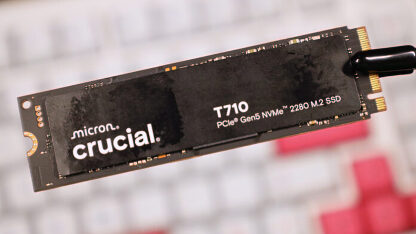
- Crucial T710 1 TB: 14,900 MB/s read, 13,800 MB/s write
- Team Group Z54E 1 TB: 14,900 MB/s read, 14,000 MB/s write
For random access, Corsair rates the 4TB at 2,700,000 read IOPS and 3,300,000 write IOPS at QD32. The asymmetric IOPS profile — write IOPS exceeding read IOPS — is a genuine characteristic of the Phison E28 architecture. The E28's internal buffer design is optimised for random write density, and the 3.3 million write IOPS figure is among the highest published for any consumer NVMe drive. The 4TB's 2.7 million read IOPS is the highest in the Pro XT line, where the 1TB is rated at 1.5 million — more NAND die provides more parallel read channels.
Thermal behaviour on the 4TB follows the same E28 pattern as smaller capacities. The 6nm controller keeps active power below 6.5W, well below the 9–10W that early E26 Gen5 drives produced under heavy load. This allows the drive to sustain rated speeds under typical desktop workloads without active cooling. The 4TB benefits from this efficiency most at scale: a content creator running sustained 4K video exports or a developer syncing multi-terabyte archives will see the E28's thermal headroom directly in the consistency of write throughput, rather than periodic speed dips caused by thermal throttle events.
Corsair MP700 Pro XT vs Competitors
See how the MP700 Pro XT stacks up against other M.2 5.0 drives in our database:
Compare with rival drives:
Endurance, TBW & Warranty
Corsair backs the MP700 Pro XT with a 5-year limited warranty across all capacity variants. The 4TB model carries an endurance rating of 2,800 TBW — the total write volume covered before the endurance warranty clause applies. At 200 GB per day of writes — a heavy content-creation workload — 2,800 TBW represents over 38 years of use before the rated limit is reached. At 500 GB per day, which would be exceptional even for professional video capture workflows, the drive would take over 15 years to exhaust its endurance budget. The 2,800 TBW figure scales directly from Corsair's 700 TBW-per-TB endurance rating applied across the Pro XT line, meaning the 4TB offers the highest absolute TBW of any variant. For the overwhelming majority of buyers the 5-year warranty period will be the binding constraint, not the endurance rating. Corsair handles warranty service through its established RMA process, with coverage available across major Western markets through Corsair's retail and online distribution network.
Corsair MP700 Pro XT 4 TB Specifications
| Category | Value |
|---|---|
| Capacity [?] | 4 TB |
| Interface [?] | M.2 5.0 |
| Controller [?] | Phison PS5028-E28 8 Channel |
| Memory type [?] | Kioxia BiCS8 218-L TLC |
| DRAM [?] | Yes |
| Read speed (MB/s) [?] | 14900 |
| Write speed (MB/s) [?] | 14400 |
| Read IOPS [?] | 2700000 |
| Write IOPS [?] | 3300000 |
| Endurance (TBW) [?] | 2800 |
| MTBF (million hours) [?] | 2000000 |
| Warranty (years) [?] | 5 |
Verdict: Is the MP700 Pro XT Worth It in 2026?
The Corsair MP700 Pro XT 4TB is the most complete package in the Pro XT lineup: maximum NAND parallelism, 4GB of LPDDR4 DRAM, the largest pSLC cache, 2,800 TBW endurance, and the same 14,900 MB/s sequential read performance as the smaller capacities — all behind Corsair's 5-year warranty. The Phison E28's 6nm efficiency advantage over E26-based rivals keeps the drive well within thermal limits without active cooling, which matters at 4TB where sustained workloads are more common.
The primary audience is content creators, video editors, and users who need to consolidate large working sets onto a single high-speed drive. For a gaming PC where sequential bandwidth rarely affects load times, the 4TB represents a capacity premium over what most titles demand — but for anyone who has filled a 2TB drive and wants one slot to handle everything, it is the right answer. The main friction points are real: PCIe 5.0 is required to reach rated speeds, and the price of entry at this capacity reflects that. Against the Crucial T705 4TB and ADATA XPG Legend 970 Pro 4TB, the Pro XT competes on warranty terms, thermal efficiency, and the established Corsair support network.
+ Pros
- 14,900 MB/s sequential reads and 14,400 MB/s sequential writes — full PCIe 5.0 x4 bandwidth
- 2,700,000 read IOPS and 3,300,000 write IOPS — highest random performance in the Pro XT line
- Phison E28 (6nm) runs under 6.5W — substantially cooler than first-gen E26 drives
- Kioxia BiCS8 218-layer TLC with 4GB SK hynix LPDDR4 DRAM
- 2,800 TBW endurance — highest absolute TBW in the Pro XT lineup
- 5-year warranty with AES 256-bit hardware encryption
- 4TB capacity consolidates large game libraries, video archives, and project files onto one M.2 slot
- Cons
- Requires PCIe 5.0 M.2 slot to reach rated speeds — older platforms cap at Gen4 rates
- Premium pricing at $459; significant step up from 2TB for modest real-world speed gains
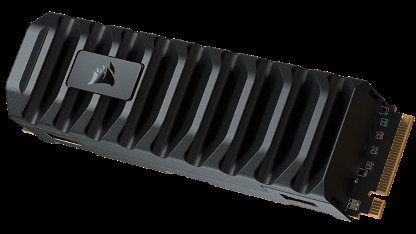
- No heatsink included — relies on copper thermal label layer and motherboard thermal pads
- 4TB capacity is excessive for users whose workloads do not fill a 2TB drive
- Write speed (14,400 MB/s) matches the 2TB but does not exceed it despite higher die count
Buy this or similar SSD Storage:



Video Review
The Fastest Gen5 SSD? - Corsair MP700 Pro XT Review