Gigabyte AORUS RGB 512GB NVMe SSD — Review (2026)
Quick answer
The AORUS RGB 512GB is the sweet spot in the lineup: twice the capacity and nearly twice the write speed of the 256GB model for a modest price increase.
Read: 3480 MB/s Write: 2000 MB/s Endurance: 800 TBW Warranty: 5 years Interface: M.2 3.0 x 4
The Gigabyte AORUS RGB 512GB balances Phison E12 performance — 3,480 MB/s read, 2,000 MB/s write — with an RGB-lit heatsink designed for showpiece desktop builds.
Controller & Memory
The AORUS RGB 512GB uses the same Phison PS5012-E12 controller and Toshiba 64-layer 3D TLC platform as the rest of the AORUS RGB lineup, but at 512GB it hits a much more usable performance envelope than the 256GB variant. The E12 features dual Arm Cortex-R5 cores running eight NAND channels with SK Hynix DDR4 DRAM for the flash translation layer.
Gigabyte rates the 512GB at 3,480 MB/s sequential read and 2,000 MB/s sequential write with 360,000 random read and 440,000 random write IOPS. These are meaningful jumps over the 256GB model — write speed nearly doubles and random IOPS roughly double thanks to the additional NAND dies providing more parallelism. The drive also ships in a 1TB variant that shares the same rated speeds.
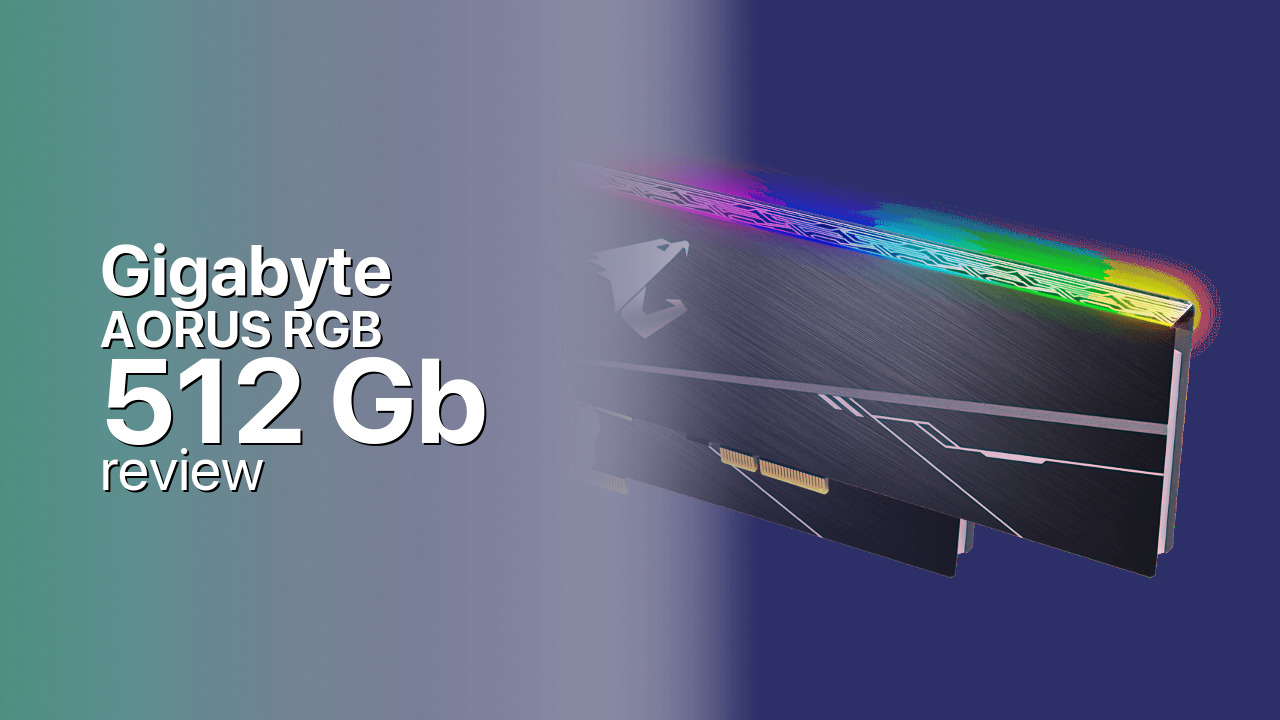
The included M.2 heatsink incorporates RGB LEDs under the Aorus eagle logo. In default mode, the lighting cycles through colors autonomously. Control through Gigabyte's RGB Fusion 2.0 is limited to a small set of supported Z390 motherboards. The heatsink and double-sided PCB make the drive too tall for most laptop M.2 slots. Competitors at 512GB on the same E12 platform include the ADATA XPG SX8200 Pro, Corsair Force MP510, and Kingston KC2000 — all of which offer similar performance without the RGB premium.
Storage Comparisons:
AORUS RGB Performance & Benchmarks
The 512GB AORUS RGB is rated at 3,480 MB/s sequential read and 2,000 MB/s sequential write. AnandTech's independent testing confirmed these figures, finding the drive performs identically to other Phison E12 drives at the same capacity. The 360K read and 440K write IOPS represent the full E12 platform capability unlocked by the higher NAND die count at 512GB.
Gigabyte AORUS RGB 512 GB vs M.2 3.0 x 4 peers
Switch between sequential throughput and random IOPS to see how this drive stacks up against other M.2 3.0 x 4 SSDs in our database. The highlighted bar is the drive on this page — click any other bar to open that drive.
- ADATA SX 8800 Pro 512 GB: 3,500 MB/s read, 2,700 MB/s write
- ADATA SX 8800 Pro 1 TB: 3,500 MB/s read, 2,700 MB/s write
- ADATA XPG Spectrix S40G RGB 256 GB: 3,500 MB/s read, 3,000 MB/s write
- ADATA XPG Spectrix S40G RGB 512 GB: 3,500 MB/s read, 3,000 MB/s write
- Gigabyte AORUS RGB 512 GB (this drive): 3,480 MB/s read, 2,000 MB/s write
In real-world use, the drive delivers the responsive desktop experience expected from a PCIe 3.0 x4 NVMe SSD. Game load times, OS boot, and application launches are competitive with other E12 drives. The SLC cache is generous at roughly one-third of the usable capacity (about 170 GB), and sustained writes after the cache fills settle to around 800 MB/s in TLC mode. For gaming, content creation, and general desktop use, the cache is large enough that the post-cache speed rarely matters. The drive handles mixed read/write workloads well thanks to the DRAM cache and Phison's mature firmware.
Gigabyte AORUS RGB vs Competitors
See how the AORUS RGB stacks up against other M.2 3.0 x 4 drives in our database:
Compare with rival drives:
Endurance, TBW & Warranty
The 512GB model is rated for 800 TBW endurance with a 5-year limited warranty. This works out to roughly 438 GB of writes per day over five years — well above any typical consumer workload. The endurance ratio of 0.85 drive writes per day is consistent across the AORUS RGB lineup, meaning each capacity tier scales TBW proportionally. At 512GB, the drive is well-suited for use as a combined OS, application, and game library drive where writes are modest and reads dominate. The MTBF is rated at 1.8 million hours.
Gigabyte AORUS RGB 512 GB Specifications
| Category | Value |
|---|---|
| Capacity [?] | 512 GB |
| Interface [?] | M.2 3.0 x 4 |
| Controller [?] | Phison PS5012-E12 |
| Memory type [?] | Toshiba TLC |
| DRAM [?] | SK Hynix DDR4 |
| Read speed (MB/s) [?] | 3480 |
| Write speed (MB/s) [?] | 2000 |
| Read IOPS [?] | 360000 |
| Write IOPS [?] | 440000 |
| Endurance (TBW) [?] | 800 |
| MTBF (million hours) [?] | 1.8 |
| Warranty (years) [?] | 5 |
Verdict: Is the AORUS RGB Worth It in 2026?
The AORUS RGB 512GB is the sweet spot in the lineup: twice the capacity and nearly twice the write speed of the 256GB model for a modest price increase. The Phison E12 platform delivers reliable PCIe 3.0 performance that remains competitive for gaming and desktop use in 2026. The RGB lighting and heatsink add aesthetic value but also cost and height, making this drive best suited for desktop builders who specifically want a visible, lit M.2 SSD. For performance-focused builds where RGB is not a priority, the ADATA XPG SX8200 Pro 512GB or Kingston KC2000 512GB deliver the same controller and NAND for less.
+ Pros
- 3,480 MB/s sequential read, 2,000 MB/s write
- 360K read and 440K write IOPS
- RGB lighting with customizable Aorus logo
- 800 TBW endurance with 5-year warranty
- DRAM-based Phison E12 platform
- Cons
- RGB control limited to Gigabyte Z390 boards
- Heatsink too tall for laptop M.2 slots
- RGB premium over non-lit E12 drives
- PCIe 3.0, not Gen4
Buy this or similar SSD Storage:
Video Review
This SSD is Lit... lit-erally | Gigabyte AORUS RGB M.2 NVMe SSD review