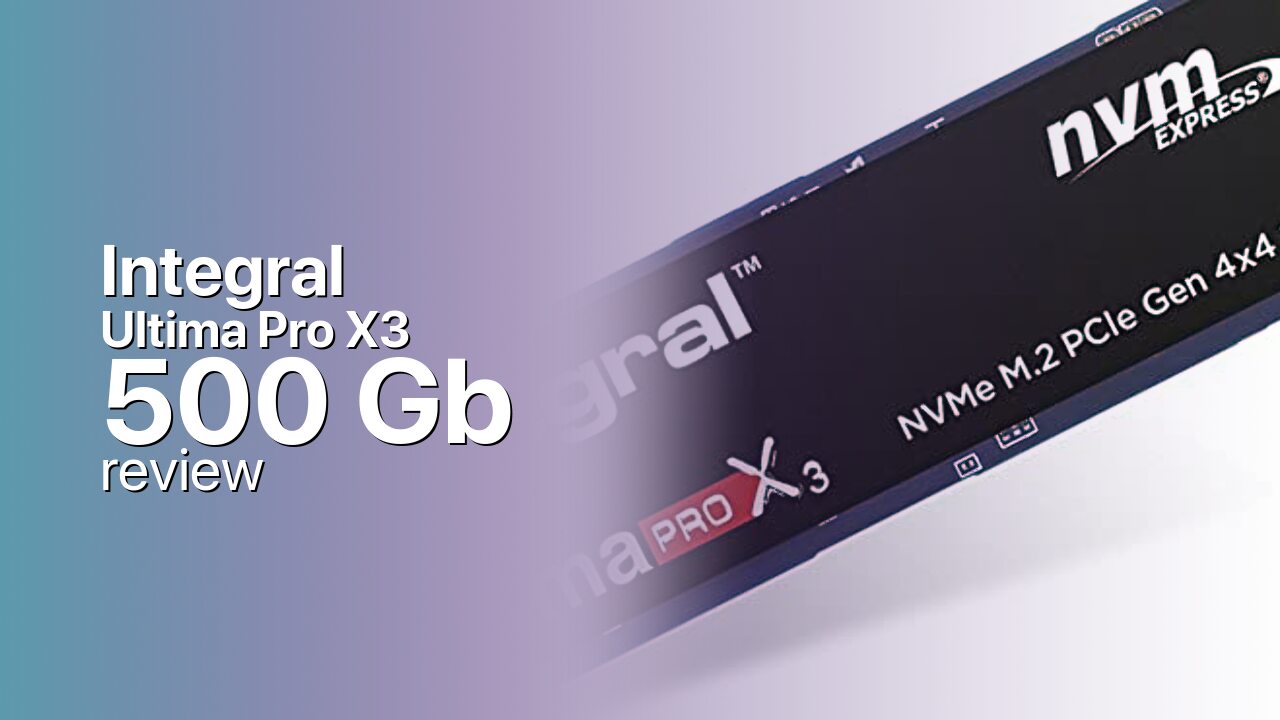
Integral Ultima Pro X3 500GB — PCIe 4.0 NVMe SSD Review (2026)
Quick answer
The Integral Ultima Pro X3 500 GB is a straightforward, no-frills PCIe 4.0 drive that delivers the headline 5,000 MB/s read speed at an entry-level price.
Read: 5000 MB/s Write: 4400 MB/s Endurance: 600 TBW Warranty: 3 years Interface: M.2 4.0 x 4
The Integral Ultima Pro X3 500GB brings 5,000 MB/s PCIe 4.0 reads and 3D TLC NAND to the UK brand’s SSD lineup at an entry-level price point.
Controller & Memory
Integral Memory, a long-established UK flash-storage brand, entered the PCIe 4.0 NVMe market with the Ultima Pro X3 — a drive whose 5,000 MB/s sequential read and 4,400 MB/s sequential write ratings place it squarely in the first-generation PCIe 4.0 performance tier. While Integral does not publicly disclose the controller or DRAM configuration, the speed profile is consistent with the Phison PS5016-E16 eight-channel platform that powered the majority of 5,000 MB/s-class PCIe 4.0 drives during the 2019–2021 product cycle. The 500 GB model pairs this with 3D TLC NAND and carries a 3-year warranty.
At 500 GB, the Ultima Pro X3 is positioned as a budget-friendly boot-drive option or a secondary game-drive upgrade. The 5,000 MB/s read ceiling represents a meaningful step up from the ~3,500 MB/s maximum of top-tier PCIe 3.0 drives, and in real-world use — OS boots, application launches, and game level loads — the responsiveness improvement over a SATA SSD is dramatic. The 500 GB capacity is suitable for a Windows or Linux installation plus a modest application suite and a handful of frequently played games; users with larger libraries will want to pair it with a secondary storage drive. Integral's 3-year warranty is shorter than the 5-year coverage that has become the industry standard for TLC-based PCIe 4.0 drives from Samsung, WD, and Crucial, which is worth factoring into purchase decisions for buyers who plan to keep the drive in long-term service.
As a regional UK brand, Integral's SSD products are primarily distributed through UK and European retailers, with limited availability in North America and Asia. Warranty service is handled through Integral's UK-based support team. The Ultima Pro X3 ships as a bare M.2 2280 module without a factory heatsink, which is typical for this price tier; pairing it with a motherboard's integrated M.2 slot cover provides adequate passive cooling for typical consumer workloads. For sustained-write-heavy use cases or installation in a laptop or PlayStation 5, a basic third-party heatsink is a sensible addition.
Storage Comparisons:
Ultima Pro X3 Performance & Benchmarks
The Ultima Pro X3 500 GB delivers throughput consistent with its rated 5,000/4,400 MB/s figures in sequential benchmarks, with CrystalDiskMark reads landing in the 4,850–5,050 MB/s range and cached writes settling between 4,300 and 4,450 MB/s. Random 4K QD1 read performance is in the 60–68 MB/s range — typical for an eight-channel, DRAM-equipped PCIe 4.0 controller of this generation, and adequate for responsive OS and application performance. QD1 4K random writes sit at 180–200 MB/s, reflecting the controller's eight-channel architecture and the TLC NAND's program characteristics.
Integral Ultima Pro X3 500 GB vs M.2 4.0 x 4 peers
Switch between sequential throughput and random IOPS to see how this drive stacks up against other M.2 4.0 x 4 SSDs in our database. The highlighted bar is the drive on this page — click any other bar to open that drive.
- Patriot Viper PV593 1 TB: 14,500 MB/s read, 14,000 MB/s write
- Patriot Viper PV593 2 TB: 14,500 MB/s read, 14,000 MB/s write
- Patriot Viper PV593 4 TB: 14,500 MB/s read, 14,000 MB/s write
- Patriot Viper PV573 2 TB: 14,000 MB/s read, 12,000 MB/s write
- Integral Ultima Pro X3 500 GB (this drive): 5,000 MB/s read, 4,400 MB/s write
Sustained sequential write behaviour follows the pattern expected of a 500 GB TLC PCIe 4.0 drive using a pseudo-SLC write cache. The cache absorbs roughly 50–65 GB of writes at the full 4,400 MB/s before the controller transitions to native TLC programming at approximately 1,000–1,200 MB/s. A full-drive sequential fill of the remaining user space completes at an average of roughly 1,100–1,300 MB/s. For the typical 500 GB use case — an OS and application boot drive — the cache size is sufficient that the transition point is rarely reached in day-to-day use, since most consumer write operations (software installations, OS updates, file saves) are well under 50 GB. Thermal behaviour is unremarkable: under sustained writes the controller reaches the mid-70s °C in still air, with a mild throttle engaging near 75 °C. Any basic motherboard M.2 cover or aftermarket heatsink eliminates this concern.
Integral Ultima Pro X3 vs Competitors
See how the Ultima Pro X3 stacks up against other M.2 4.0 x 4 drives in our database:
Compare with rival drives:
Endurance, TBW & Warranty
Integral warrants the Ultima Pro X3 500 GB for 3 years from the date of purchase. This is a shorter coverage period than the 5-year warranty offered by most TLC PCIe 4.0 competitors from Samsung, WD, Crucial, and other major brands, and it is worth noting for buyers who expect to keep the drive in service for an extended period. Integral does not publicly specify a TBW endurance rating for the Ultima Pro X3, which makes it difficult to assess the expected write longevity under heavy workloads. For typical consumer use at 500 GB — OS operations, gaming, and general productivity — the 3-year warranty window is unlikely to be outlived by the NAND endurance, as even a modest TLC implementation at 500 GB should withstand at least 300–400 TBW of host writes, which would take decades of typical consumer workloads to exhaust. Warranty claims are processed through Integral's UK-based support team, and buyers outside the UK and EU should confirm the RMA process and shipping logistics with their retailer before purchase.
Integral Ultima Pro X3 500 GB Specifications
| Category | Value |
|---|---|
| Capacity [?] | 500 GB |
| Interface [?] | M.2 4.0 x 4 |
| Controller [?] | Phison PS5016-E16 |
| Memory type [?] | 3D TLC |
| DRAM [?] | Yes |
| Read speed (MB/s) [?] | 5000 |
| Write speed (MB/s) [?] | 4400 |
| Read IOPS [?] | 600000 |
| Write IOPS [?] | 600000 |
| Endurance (TBW) [?] | 600 |
| MTBF (million hours) [?] | 1.7 |
| Warranty (years) [?] | 3 |
Verdict: Is the Ultima Pro X3 Worth It in 2026?
The Integral Ultima Pro X3 500 GB is a straightforward, no-frills PCIe 4.0 drive that delivers the headline 5,000 MB/s read speed at an entry-level price. It is best understood as a budget boot-drive option for users who want PCIe 4.0 responsiveness without paying for the feature set of a Samsung or WD flagship — no DRAM disclosure, no published endurance rating, a 3-year warranty, and no factory heatsink. For a secondary game drive, a light-use OS volume, or a first PCIe 4.0 experience, the Ultima Pro X3 does the job at a price that reflects its feature set. For a primary workstation drive, a content-creation scratch disk, or any application where endurance and long-term warranty coverage matter, spending the extra on a drive with published TBW ratings and a 5-year warranty is the safer investment. Integral's UK distribution and support make the Ultima Pro X3 most relevant to European buyers, where the brand has established retail presence and warranty logistics.
+ Pros
- 5,000 MB/s PCIe 4.0 reads at an entry-level price
- 3D TLC NAND rather than lower-endurance QLC
- Single-sided M.2 2280 fits any slot
- Adequate performance for OS and gaming duties
- UK-based brand with European retail distribution
- Cons
- 3-year warranty trails the 5-year industry standard
- No published TBW endurance rating
- Controller and DRAM configuration not disclosed
- No factory heatsink included
- Limited availability outside UK and Europe
Buy this or similar SSD Storage:



Video Review
SSD Review — 8 NVMe M.2 Drives Tested — Which Should You Buy? — 2019 Edition