Leven JPR600 2TB SSD — In-Depth Review & Specs (2026)
Quick answer
The Leven JPR600 2TB serves a specific audience: budget builders who need 2 TB of NVMe storage and are willing to accept the limitations of a DRAM-less, 4-channel controller to hit a low price point.
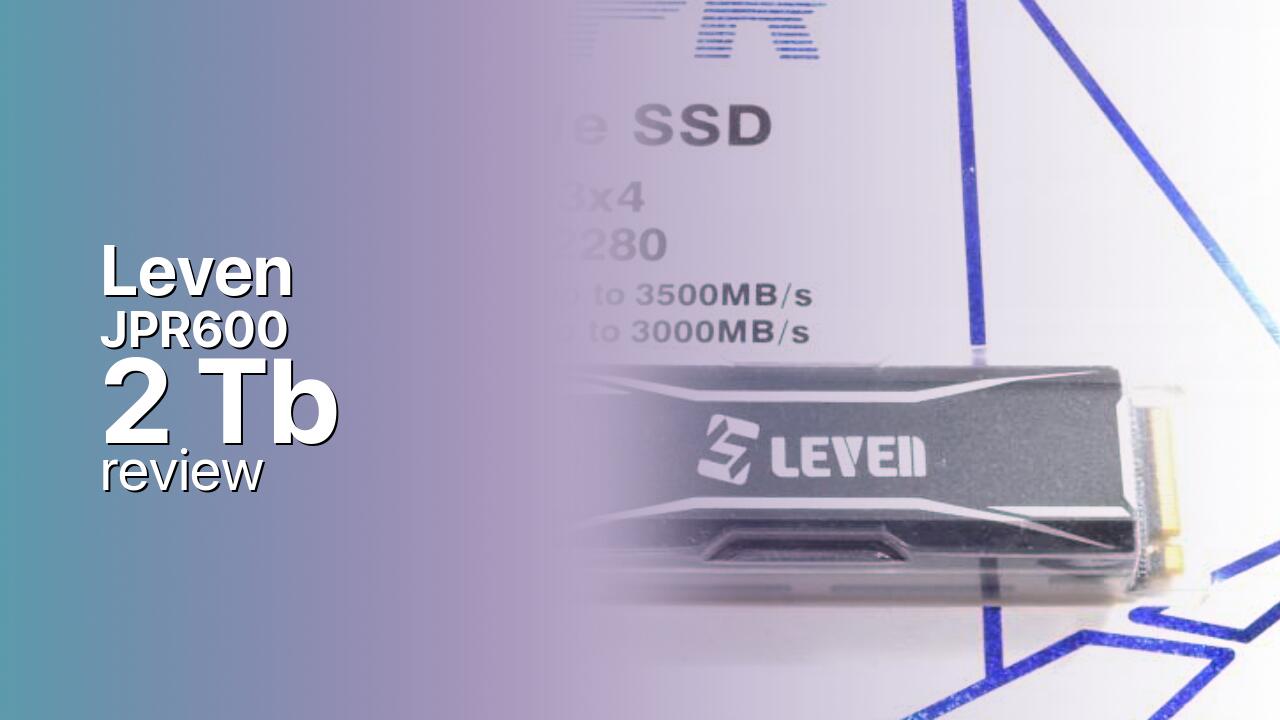
Read: 3400 MB/s Write: 3000 MB/s Endurance: 3300 TBW Warranty: 5 years Interface: M.2 3.0 x 4
The Leven JPR600 2TB is the highest-capacity model in Leven's entry-level NVMe lineup. Built on the same Silicon Motion SM2263XT 4-channel DRAM-less platform as its smaller siblings, it pairs Host Memory Buffer (HMB) technology with 3D TLC NAND to deliver 2 TB of NVMe storage at a budget price point. For builders who need capacity on a budget — a large Steam library, a media collection, or a single-drive solution for an older system — the JPR600 2TB is one of the more affordable ways to reach this storage tier in an M.2 form factor.
Controller & Memory
The SM2263XT is a DRAM-less, 4-channel PCIe 3.0 x4 controller built on a 28nm process. Without dedicated DRAM, it relies on the NVMe HMB protocol to borrow a small chunk of system RAM (32–64 MB) for the flash translation layer mapping table. At 2 TB, this controller is being pushed to its practical capacity limit — the 4-channel architecture means fewer NAND dies can be accessed in parallel compared to an 8-channel controller, and the DRAM-less design means the FTL table, which scales with capacity, must be partially swapped in and out of the limited HMB allocation. The NAND is unspecified 3D TLC sourced on the spot market.
Leven is a budget brand sold primarily through online retailers. The JPR600 2TB competes in a sparse segment: high-capacity PCIe 3.0 drives at the low end of the pricing ladder. At the time of writing, few other brands offer a 2TB SM2263XT-based drive, giving the JPR600 a niche position for capacity-focused budget builders. The 5-year warranty provides some reassurance, though Leven's limited track record means warranty fulfillment is not as well-documented as with established brands like Crucial or WD. The rated endurance of 3,300 TBW — equivalent to writing 1.8 TB per day for five years — appears to be a single figure applied across all JPR600 capacities without scaling. For the 2TB model, this endurance is more plausible (though still optimistic) than on the 512GB or 1TB variants.
Storage Comparisons:
JPR600 Performance & Benchmarks
Real-world sequential performance on the SM2263XT platform typically settles around 2,000–2,400 MB/s read and 1,200–1,700 MB/s write — the practical ceiling for this 4-channel controller. While the rated 3,400/3,000 MB/s figures exceed these bounds, the actual throughput is still roughly 4x faster than SATA and entirely adequate for a general-purpose storage drive. Random 4K performance in the 200,000–300,000 IOPS range provides snappy application launches and responsive multitasking, though sustained mixed workloads will expose the DRAM-less architecture's latency limitations compared to a DRAM-equipped drive.
Leven JPR600 2 TB vs M.2 3.0 x 4 peers
Switch between sequential throughput and random IOPS to see how this drive stacks up against other M.2 3.0 x 4 SSDs in our database. The highlighted bar is the drive on this page — click any other bar to open that drive.
- ADATA SX 8800 Pro 512 GB: 3,500 MB/s read, 2,700 MB/s write
- ADATA SX 8800 Pro 1 TB: 3,500 MB/s read, 2,700 MB/s write
- ADATA XPG Spectrix S40G RGB 256 GB: 3,500 MB/s read, 3,000 MB/s write
- ADATA XPG Spectrix S40G RGB 512 GB: 3,500 MB/s read, 3,000 MB/s write
- Leven JPR600 2 TB (this drive): 3,400 MB/s read, 3,000 MB/s write
The 2TB capacity brings a larger dynamic SLC write cache — typically 100–150 GB — which means most real-world write bursts never leave the cached zone. Post-cache native TLC writes settle around 400–600 MB/s. For the kind of large sequential writes that a 2TB drive encourages (game library downloads, media file transfers), the deeper cache is a meaningful advantage over the smaller capacities. Thermal output is minimal, with the controller rarely exceeding 55°C. Power consumption peaks at roughly 3.5 W, making the drive suitable for bus-powered external enclosures.
Leven JPR600 vs Competitors
See how the JPR600 stacks up against other M.2 3.0 x 4 drives in our database:
Compare with rival drives:
Endurance, TBW & Warranty
Leven provides a 5-year limited warranty on the JPR600 2TB. The 3,300 TBW endurance rating — while more plausible at this capacity than on the smaller models — should still be confirmed with Leven support for write-intensive use cases. Verify regional warranty support and the RMA process before purchasing.
Leven JPR600 2 TB Specifications
| Category | Value |
|---|---|
| Capacity [?] | 2 TB |
| Interface [?] | M.2 3.0 x 4 |
| Controller [?] | Silicon Motion SM2263XT |
| Memory type [?] | 3D TLC |
| DRAM [?] | No (HMB) |
| Read speed (MB/s) [?] | 3400 |
| Write speed (MB/s) [?] | 3000 |
| Read IOPS [?] | 360000 |
| Write IOPS [?] | 460000 |
| Endurance (TBW) [?] | 3300 |
| MTBF (million hours) [?] | 1.5 |
| Warranty (years) [?] | 5 |
Verdict: Is the JPR600 Worth It in 2026?
The Leven JPR600 2TB serves a specific audience: budget builders who need 2 TB of NVMe storage and are willing to accept the limitations of a DRAM-less, 4-channel controller to hit a low price point. The SM2263XT is a proven platform that delivers a genuine NVMe experience — fast boot times, responsive application launches — even if it does not approach the rated 3,400 MB/s headline number. The inflated spec sheet is a distraction; what matters is that you are getting 2 TB of TLC-based NVMe storage with a 5-year warranty at a competitive price. If your use case is a game library, media storage, or a secondary drive where peak throughput is less critical than cost per gigabyte, the JPR600 2TB is worth a look. For a primary OS drive with heavy multitasking, a DRAM-equipped alternative will provide a smoother experience.
+ Pros
- 2 TB of NVMe storage at a budget-friendly price
- Silicon Motion SM2263XT — proven, widely deployed controller
- Deeper SLC cache than smaller capacity siblings
- 5-year warranty — unusual for this price segment
- Single-sided M.2 2280 with low power consumption
- Cons
- 4-channel DRAM-less design strained at 2 TB capacity
- Rated speeds far exceed the SM2263XT practical ceiling
- Undisclosed NAND supplier — spot-market sourcing
- Leven brand has limited support track record
- HMB-only — no dedicated DRAM for FTL at this capacity
Buy this or similar SSD Storage:



Video Review
SSD Review — 8 NVMe M.2 Drives Tested — Which Should You Buy? — 2019 Edition