Silicon Power UD70 500GB QLC NVMe SSD Review (2026)
Quick answer
The Silicon Power UD70 500GB is a budget PCIe 3.0 NVMe drive that delivers on read speed (3,400 MB/s) and includes DRAM cache — two features not always found at this price point.
Read: 3400 MB/s Write: 3000 MB/s Endurance: 120 TBW Warranty: 5 years Interface: M.2 3.0 x 4
The Silicon Power UD70 500GB is a PCIe 3.0 NVMe SSD built on Micron QLC NAND and the Phison E12S controller, aiming to deliver mainstream NVMe speeds at a budget-friendly price.
Controller & Memory
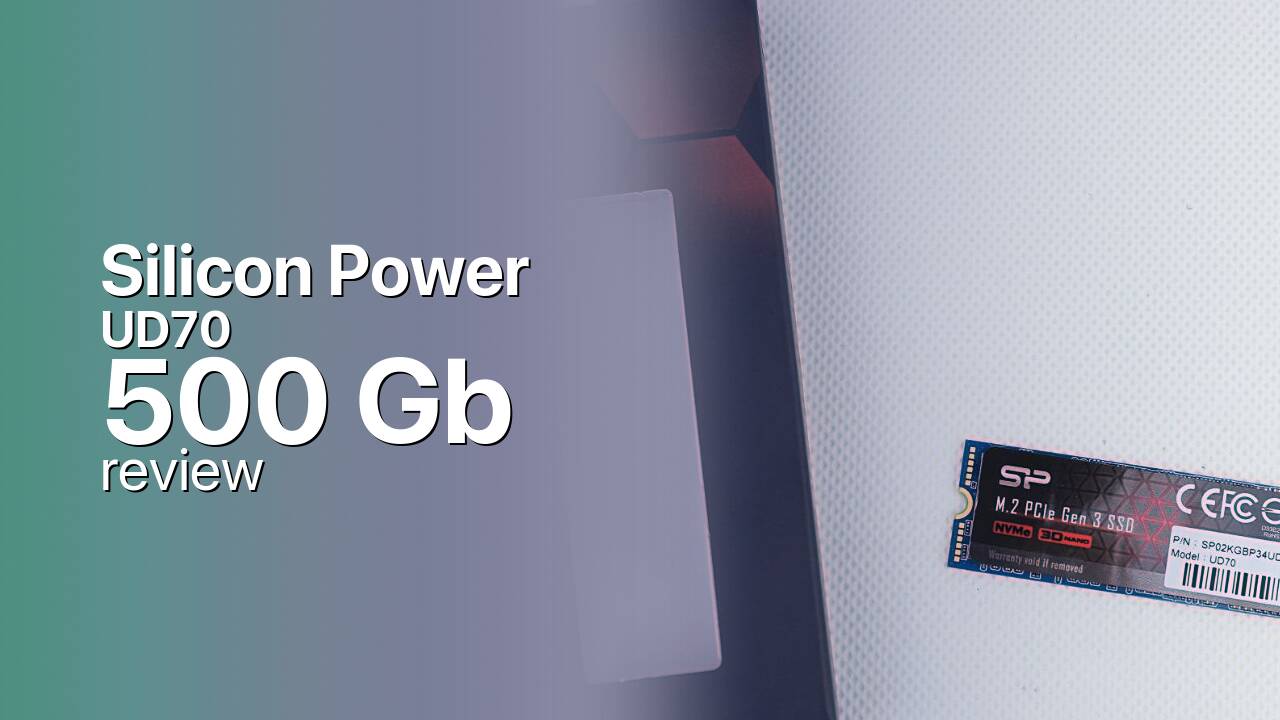
The UD70 uses the Phison PS5012-E12S-32 controller, a cost-optimized variant of the well-regarded Phison E12, paired with Micron 3D QLC (quad-level cell) NAND. QLC stores four bits per cell versus TLC's three, which increases density and reduces cost but lowers write endurance and sustained write performance. The UD70 also includes a DRAM cache buffer to help manage the flash translation layer and mitigate QLC's slower native write speeds.
On the 500GB model, Silicon Power rates sequential reads at 3,400 MB/s and writes at 3,000 MB/s. These numbers are competitive with TLC-based PCIe 3.0 drives in burst workloads, but sustained writes after the SLC cache fills drop significantly because QLC's native write speed is roughly half that of TLC. The 500GB variant is the smallest in the UD70 range, which also includes 1TB and 2TB capacities — larger models have more NAND die for parallel writes and generally sustain higher throughput under load.
The drive uses an M.2 2280 single-sided form factor, making it compatible with most desktops and many laptops. No heatsink is included. The UD70 targets budget builders who prioritize capacity per dollar over peak write performance, and it competes with other QLC-based NVMe drives like the Crucial P1 and Intel 660p.
Storage Comparisons:
UD70 Performance & Benchmarks
The UD70 500GB is rated for 3,400 MB/s sequential reads and 3,000 MB/s sequential writes. These peak figures apply only while the dynamic SLC cache has capacity — the drive writes incoming data to a high-speed SLC-mode portion of the QLC flash, then folds it to QLC in the background. Once the SLC cache fills, write speeds drop to native QLC rates, which typically sit around 80–160 MB/s on a 500GB QLC drive — slower than a SATA SSD.
Silicon Power UD70 500 GB vs M.2 3.0 x 4 peers
Switch between sequential throughput and random IOPS to see how this drive stacks up against other M.2 3.0 x 4 SSDs in our database. The highlighted bar is the drive on this page — click any other bar to open that drive.
- ADATA SX 8800 Pro 512 GB: 3,500 MB/s read, 2,700 MB/s write
- ADATA SX 8800 Pro 1 TB: 3,500 MB/s read, 2,700 MB/s write
- ADATA XPG Spectrix S40G RGB 256 GB: 3,500 MB/s read, 3,000 MB/s write
- ADATA XPG Spectrix S40G RGB 512 GB: 3,500 MB/s read, 3,000 MB/s write
- Silicon Power UD70 500 GB (this drive): 3,400 MB/s read, 3,000 MB/s write
The SLC cache size on the 500GB model is relatively small, roughly 20–40 GB depending on how full the drive is. For everyday tasks — booting the OS, launching applications, browsing the web — the UD70 reads at full speed and handles short writes within the cache without issue. The performance penalty shows up during large file copies, game installations, or any sustained write workload that exceeds the cache. Random read performance is adequate for a boot drive, though random writes are modest compared to TLC alternatives. Buyers should understand that QLC's strength is read-heavy workloads at a low price, not sustained write throughput.
Silicon Power UD70 vs Competitors
See how the UD70 stacks up against other M.2 3.0 x 4 drives in our database:
Compare with rival drives:
Endurance, TBW & Warranty
Silicon Power covers the UD70 500GB with a five-year limited warranty. Silicon Power does not publish a specific TBW rating for the 500GB UD70 model in most spec sheets — a common omission for QLC drives, where endurance varies significantly with write patterns. QLC NAND has lower write endurance than TLC, typically rated for roughly 1,000 program-erase cycles per cell versus 3,000 for TLC. For a read-heavy desktop workload (OS boot drive, application storage), endurance is unlikely to be a concern within the warranty period. Heavy-write workloads like video scratch disks or continuous data logging are less suited to QLC drives. The warranty is handled through the retailer or Silicon Power's direct RMA process.
Silicon Power UD70 500 GB Specifications
| Category | Value |
|---|---|
| Capacity [?] | 500 GB |
| Interface [?] | M.2 3.0 x 4 |
| Controller [?] | Phison PS5012-E12S-32 |
| Memory type [?] | Micron 3D QLC |
| DRAM [?] | SLC Caching DRAM Buffer |
| Read speed (MB/s) [?] | 3400 |
| Write speed (MB/s) [?] | 3000 |
| Read IOPS [?] | 250000 |
| Write IOPS [?] | 650000 |
| Endurance (TBW) [?] | 120 |
| MTBF (million hours) [?] | 1.8 |
| Warranty (years) [?] | 5 |
Verdict: Is the UD70 Worth It in 2026?
The Silicon Power UD70 500GB is a budget PCIe 3.0 NVMe drive that delivers on read speed (3,400 MB/s) and includes DRAM cache — two features not always found at this price point. The QLC NAND limitation is the real trade-off: sustained writes after the SLC cache fills can drop below SATA SSD speeds, and long-term write endurance is lower than TLC alternatives. For a read-heavy boot drive or general desktop use where budget matters more than sustained write throughput, the UD70 gets the job done. Content creators and anyone moving large files regularly should step up to a TLC-based drive like the Silicon Power P34A80 or the Kingston A2000, which offer more consistent write performance at a modest price increase.
+ Pros
- 3,400 MB/s sequential reads on PCIe 3.0
- DRAM cache buffer included at a budget price
- Single-sided M.2 2280 fits most laptops and desktops
- Five-year warranty coverage
- Competitive price per GB for a DRAM NVMe drive
- Cons
- QLC NAND — slow sustained writes after SLC cache fills
- QLC endurance lower than TLC alternatives
- No published TBW rating for the 500GB model
- Small SLC cache on the 500GB capacity
- Not suitable for heavy-write workloads
Buy this or similar SSD Storage:



Video Review
Silicon Power US70 UD70 A80 A60 Round-Up | Gen3 vs Gen4 | Incredible Temperature Results !