Fanxiang S660 512GB Review — Budget PCIe 4.0 with QLC Limits (2026)
Quick answer
The Fanxiang S660 512 GB makes sense only as the cheapest possible PCIe 4.0 boot drive for a secondary or budget system where every dollar counts and no important data lives on the drive without a backup.
Read: 5000 MB/s Write: 4500 MB/s Endurance: 400 TBW Warranty: 5 years Interface: M.2 4.0 x 4
The Fanxiang S660 512 GB is the cheapest ticket into the PCIe 4.0 club — a DRAM-less QLC drive that reads fast but writes like a hard drive once its cache folds, and at this capacity the trade-offs stack up quickly.
Controller & Memory
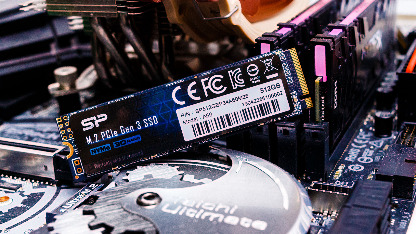
The S660 is built on the Phison PS5021-E21T, a 4-channel DRAM-less controller that also powers the Crucial P3 Plus. It relies entirely on Host Memory Buffer (HMB) — borrowing 64 MB of system RAM — to manage its mapping tables, with no onboard DRAM. The NAND is Micron 176-layer QLC, confirmed via Flash ID tools despite some retailer listings labelling it as TLC. The PCB is single-sided M.2 2280, which is a genuine advantage for thin laptops and PS5 installations.
At 512 GB, this is the entry-level capacity in a family that runs up to 4 TB. Smaller-capacity QLC drives suffer more than TLC counterparts from reduced NAND parallelism — fewer dies to spread writes across — so sequential write speeds and sustained throughput are likely lower at 512 GB than the rated figures suggest. The S660 is also offered in 1 TB, 2 TB, and 4 TB variants, with the larger capacities delivering better sustained performance and proportionally higher endurance.
In the budget PCIe 4.0 segment, the S660 competes with the Crucial P3 Plus, Silicon Power UD90, and Team Group MP44Q — all DRAM-less QLC designs. The S660 typically comes in at the lowest price, but the Crucial and Team Group alternatives offer more predictable component sourcing and better warranty infrastructure.
Storage Comparisons:
S660 Performance & Benchmarks
Rated sequential speeds are 5,000 MB/s reads and 4,500 MB/s writes, though at 512 GB the write figure may be lower in practice due to reduced NAND parallelism. Random IOPS are in the range of 600,000 reads and 500,000 writes — adequate for boot and gaming use but well below DRAM-backed drives in the same interface class.
Fanxiang S660 512 GB vs M.2 4.0 x 4 peers
Switch between sequential throughput and random IOPS to see how this drive stacks up against other M.2 4.0 x 4 SSDs in our database. The highlighted bar is the drive on this page — click any other bar to open that drive.
- Patriot Viper PV593 1 TB: 14,500 MB/s read, 14,000 MB/s write
- Patriot Viper PV593 2 TB: 14,500 MB/s read, 14,000 MB/s write
- Patriot Viper PV593 4 TB: 14,500 MB/s read, 14,000 MB/s write
- Patriot Viper PV573 2 TB: 14,000 MB/s read, 12,000 MB/s write
- Fanxiang S660 512 GB (this drive): 5,000 MB/s read, 4,500 MB/s write
The defining performance characteristic of the S660 is its post-cache write behaviour. The drive uses a pseudo-SLC cache to hit rated speeds, but once that cache fills — which happens faster on a 512 GB drive with less free NAND to allocate as cache — write speeds collapse to roughly 1,400 MB/s in the folding phase and eventually settle around 530 MB/s at native QLC speed. That is SATA territory. For a boot drive or a game library where writes are mostly small and bursty, this is rarely noticeable. For anyone who regularly moves large files, the S660 at 512 GB is the wrong tool.
Fanxiang S660 vs Competitors
See how the S660 stacks up against other M.2 4.0 x 4 drives in our database:
Compare with rival drives:
Endurance, TBW & Warranty
Fanxiang claims a 5-year warranty on the S660, though the drive is not even listed on the company's official website. The 512 GB endurance rating is not published, but based on the 4 TB model's confirmed 2,800 TBW, this capacity should carry roughly 400 TBW. At a typical 20 GB per day, that yields over 50 years of writes — QLC endurance concerns are largely theoretical for light consumer workloads. The practical warranty issue, as with all Fanxiang products, is whether anyone at the company will actually process your claim. Multiple user reviews report two S660 drives failing within 40 hours of use with no manufacturer response.
Fanxiang S660 512 GB Specifications
| Category | Value |
|---|---|
| Capacity [?] | 512 GB |
| Interface [?] | M.2 4.0 x 4 |
| Controller [?] | Phison PS5021-E21T 4 Channel |
| Memory type [?] | Micron 176-L QLC |
| DRAM [?] | No |
| Read speed (MB/s) [?] | 5000 |
| Write speed (MB/s) [?] | 4500 |
| Read IOPS [?] | 600000 |
| Write IOPS [?] | 500000 |
| Endurance (TBW) [?] | 400 |
| MTBF (million hours) [?] | 1500000 |
| Warranty (years) [?] | 5 |
Verdict: Is the S660 Worth It in 2026?
The Fanxiang S660 512 GB makes sense only as the cheapest possible PCIe 4.0 boot drive for a secondary or budget system where every dollar counts and no important data lives on the drive without a backup. For anything else — a primary system drive, a laptop with irreplaceable files, or any workflow involving regular large transfers — spend the modest premium for a Crucial P3 Plus or Team Group MP44Q. The S660's single-sided PCB and included heatsink are nice touches, but they do not compensate for QLC write cliffs and a warranty that exists mostly on paper.
+ Pros
- 5,000 MB/s PCIe 4.0 reads at a very low entry price
- Single-sided PCB fits thin laptops and PS5
- Includes heatsink and mounting hardware in the box
- 5-year warranty period on paper
- Cons
- QLC NAND with severe post-cache write drop to ~530 MB/s
- DRAM-less HMB design struggles under sustained mixed I/O
- Marketed as TLC on some store listings but confirmed QLC via Flash ID
- Warranty support is practically non-existent per user reports
- 512 GB capacity has reduced NAND parallelism — writes likely below rated spec
Buy this or similar SSD Storage:
Video Review
Fanxiang S660 Operation Video