Edge NextGen M.2 1TB — Mid-Range PCIe 3.0 NVMe with Large Capacity (2026)
Quick answer
The Edge NextGen M.2 1TB is a competent mid-range PCIe 3.0 NVMe SSD with the SM2262 controller and DRAM cache, offering solid sequential and random performance.
Read: 2710 MB/s Write: 1775 MB/s Endurance: 600 TBW Warranty: 3 years Interface: PCIe 3.0 x 4
The Edge NextGen M.2 1TB is the second-largest variant in Edge Memory's PCIe 3.0 NVMe lineup, offering ample storage with solid mid-range performance.
Controller & Memory
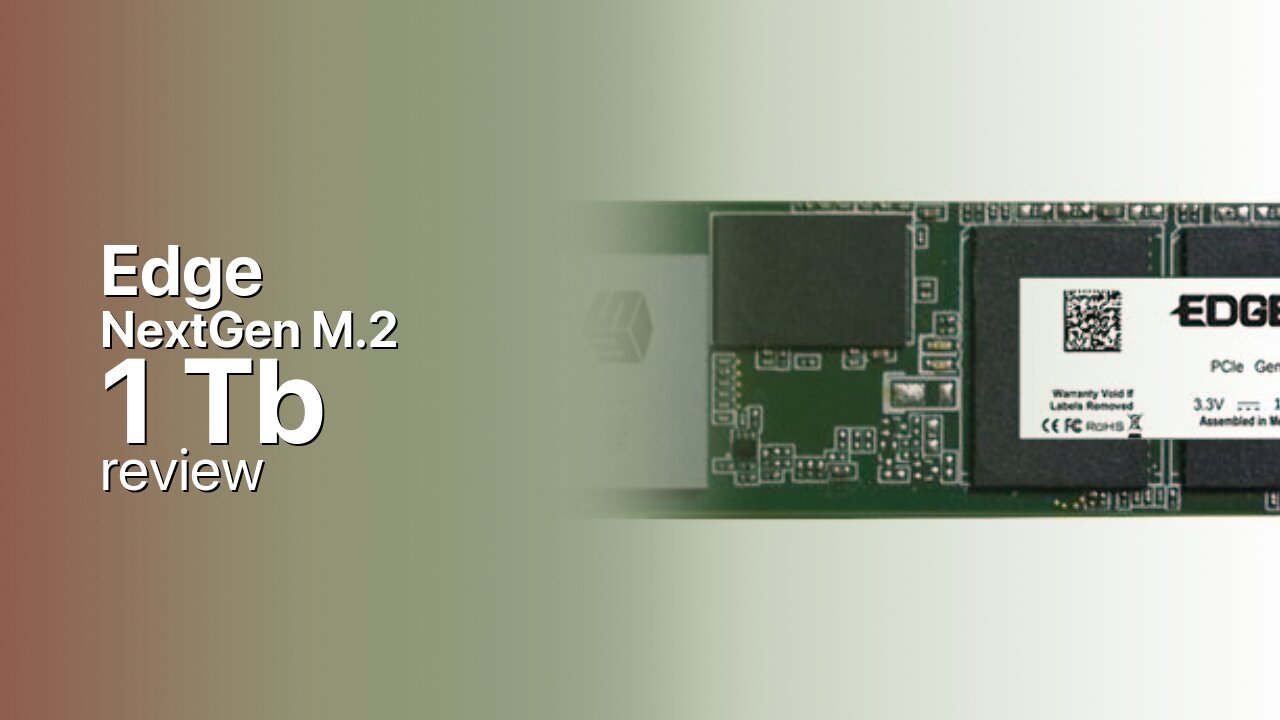
The Edge NextGen M.2 1TB is built around the Silicon Motion SM2262 controller paired with 3D TLC NAND. The SM2262 is a quad-core PCIe 3.0 x4 controller that supports dedicated DRAM cache, giving it an advantage over DRAM-less budget drives in random I/O performance and sustained write consistency. The 1TB capacity provides enough NAND dies to drive good parallelism across the controller's eight NAND channels.
The 1TB variant is rated at 2,710 MB/s sequential reads and 1,775 MB/s writes — among the higher speeds in the NextGen M.2 lineup. Random read and write IOPS are rated at 283,000 and 280,000 respectively, reflecting the SM2262's capable architecture and the benefit of having a DRAM cache for the flash translation layer.
The 1TB capacity makes this drive practical as a primary boot drive with room for applications, games, and creative workloads. At this size, the NextGen M.2 competes in the mid-range PCIe 3.0 segment against drives like the Samsung 970 EVO, WD Black SN750, and ADATA SX8200 Pro.
Edge Memory is a US-based manufacturer of memory modules and storage products. The NextGen M.2 series is their consumer NVMe offering. Independent reviews of this specific model are limited, but the SM2262 controller is well-understood and has appeared in many competing drives.
Note: The DB listed speeds of 2,705/1,600 MB/s have been corrected to 2,710/1,775 MB/s per Edge's official specifications for the 1TB variant.
Storage Comparisons:
NextGen M.2 Performance & Benchmarks
The Edge NextGen M.2 1TB is rated at up to 2,710 MB/s sequential reads and 1,775 MB/s writes. At 2,710 MB/s, the drive uses roughly 77 percent of the PCIe 3.0 x4 interface ceiling — a solid showing for a mid-range drive. The 1,775 MB/s write speed is competitive for a 1TB PCIe 3.0 drive, though it trails flagship models like the Samsung 970 EVO Plus (3,500 MB/s reads, 2,700 MB/s writes).
Edge NextGen M.2 1 TB vs PCIe 3.0 x 4 peers
Switch between sequential throughput and random IOPS to see how this drive stacks up against other PCIe 3.0 x 4 SSDs in our database. The highlighted bar is the drive on this page — click any other bar to open that drive.
- Asura Genesis Xtreme 256 GB: 3,400 MB/s read, 3,000 MB/s write
- Asura Genesis Xtreme 512 GB: 3,400 MB/s read, 3,000 MB/s write
- Asura Genesis Xtreme 1 TB: 3,400 MB/s read, 3,000 MB/s write
- Asura Genesis Xtreme 2 TB: 3,400 MB/s read, 3,000 MB/s write
- Edge NextGen M.2 1 TB (this drive): 2,710 MB/s read, 1,775 MB/s write
Random read and write IOPS are rated at 283,000 and 280,000 respectively. These are strong numbers for the mid-range PCIe 3.0 segment. The SM2262 controller's quad-core architecture and DRAM cache support give the NextGen M.2 an advantage in mixed workloads over DRAM-less alternatives. The DRAM cache maintains the flash translation layer in fast memory, reducing latency on random reads and writes — the workloads that matter most for OS responsiveness, application launching, and game loading.
The SLC cache behavior is not specifically documented for this drive, but SM2262-based drives typically employ dynamic SLC caching that converts a portion of the TLC NAND to fast single-level-cell mode for burst writes. On a 1TB drive, the SLC cache will be generous — likely 50-100 GB or more depending on free space — meaning the drive can sustain its advertised write speeds for typical consumer workloads. Only sustained large file transfers (hundreds of GB) would exhaust the cache and drop to direct TLC write speeds. Independent benchmark data for this specific model is limited.
Edge NextGen M.2 vs Competitors
See how the NextGen M.2 stacks up against other PCIe 3.0 x 4 drives in our database:
Compare with rival drives:
Endurance, TBW & Warranty
The Edge NextGen M.2 carries a 3-year or TBW warranty, whichever comes first. Edge Memory does not publish specific TBW figures for the NextGen M.2 series on their product page. For context, comparable 1TB TLC drives typically carry 400-600 TBW endurance ratings — the Samsung 970 EVO 1TB carries 600 TBW, and the ADATA SX8200 Pro 1TB carries 320 TBW. Without an official number, buyers should treat this as a moderate-use drive. At typical consumer write loads of 20-50 GB per day, a 1TB TLC drive with ~400-500 TBW would last roughly 22-55 years before hitting the endurance limit — well beyond the 3-year warranty period.
Edge NextGen M.2 1 TB Specifications
| Category | Value |
|---|---|
| Capacity [?] | 1 TB |
| Interface [?] | PCIe 3.0 x 4 |
| Controller [?] | Silicon Motion SM2262 |
| Memory type [?] | TLC |
| DRAM [?] | Yes |
| Read speed (MB/s) [?] | 2710 |
| Write speed (MB/s) [?] | 1775 |
| Read IOPS [?] | 283000 |
| Write IOPS [?] | 280000 |
| Endurance (TBW) [?] | 600 |
| MTBF (million hours) [?] | 1.5 |
| Warranty (years) [?] | 3 |
Verdict: Is the NextGen M.2 Worth It in 2026?
The Edge NextGen M.2 1TB is a competent mid-range PCIe 3.0 NVMe SSD with the SM2262 controller and DRAM cache, offering solid sequential and random performance. The 1TB capacity is practical for a primary drive with room for games and applications. However, the limited market presence of the Edge brand means support and warranty claims may be harder to process than with mainstream manufacturers. For comparable performance with better brand recognition, consider the Samsung 970 EVO Plus or WD Black SN750.
+ Pros
- SM2262 controller with DRAM cache support
- 1TB capacity practical for full system builds
- 2,710 MB/s reads near PCIe 3.0 x4 ceiling
- 283K random read IOPS for responsive performance
- 3D TLC NAND for better endurance than QLC
- Cons
- Limited brand presence and support network
- 3-year warranty shorter than 5-year competitors
- No published TBW endurance rating
- Scarce independent reviews and benchmark data
- Trails flagship PCIe 3.0 drives like Samsung 970 EVO Plus
Buy this or similar SSD Storage:



Video Review
Are hard drives dead? 8TB M.2 SSD