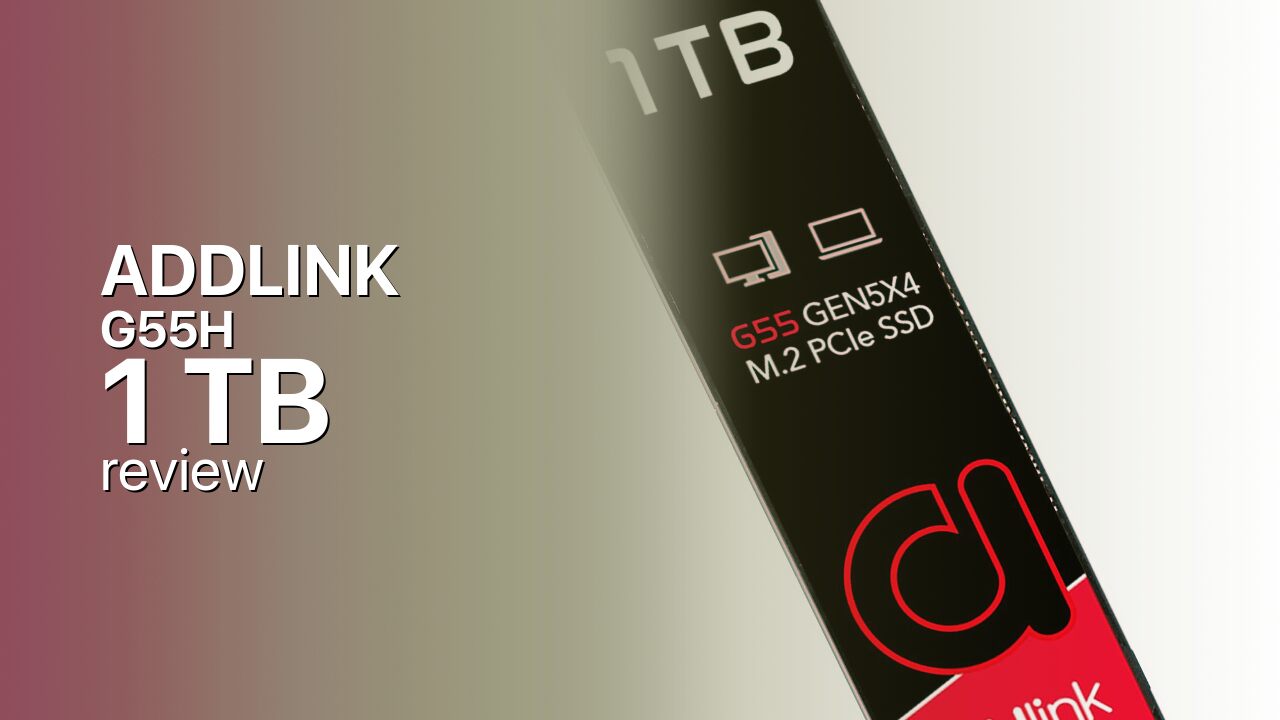
Addlink G55H 1TB Review: PCIe 5.0 NVMe SSD With Heatsink (2026)
Quick answer
The Addlink G55H 1 TB is a solid pick for anyone building or upgrading a Gen5 desktop who also wants PS5 compatibility without buying a separate heatsink.
Read: 10300 MB/s Write: 9000 MB/s Endurance: 600 TBW Warranty: 5 years Interface: M.2 5.0
The Addlink G55H 1 TB pairs a PCIe 5.0 NVMe controller with a pre-installed 8.75mm heatsink, hitting 10,300 MB/s reads in a PS5-ready package.
Controller & Memory
The G55H is the heatsink-equipped sibling of Addlink's G55, both built around the Phison E31T 7nm DRAM-less controller paired with 3D TLC NAND. Without dedicated DRAM, the drive relies on the Host Memory Buffer (HMB) protocol to borrow a small slice of system RAM for its mapping tables, which keeps the bill of materials lean without gutting random performance. Addlink also layers SLC caching and LDPC error correction on top, and the firmware supports SMART health monitoring, TRIM, and thermal throttling.
The included aluminum heatsink uses a crosscut grid design with a thermal silica pad, adding 8.75mm of total height. That puts it safely under Sony's 11.25mm ceiling for PS5 expansion, and the drive exceeds the 5,500 MB/s minimum read speed Sony recommends. In a desktop Gen5 slot the G55H runs at full speed; in a Gen4 slot (including the PS5) it caps at roughly 7,000 MB/s, which still doubles SATA-era throughput. Addlink's own marketing claims the heatsink runs up to 45% cooler than a bare PCB, and the low-power 7nm controller draws significantly less than earlier Gen5 designs that ran hot enough to throttle under load.
The G55H also comes in 2 TB and 4 TB capacities that share the same rated sequential reads. Write speeds may differ slightly across capacities, and endurance scales proportionally. Direct rivals include the Crucial T705 and Samsung 990 EVO Plus on the PCIe 5.0 side, while anyone whose motherboard tops out at Gen4 can get comparable practical performance from the WD Black SN850X at a lower price.
Storage Comparisons:
G55H Performance & Benchmarks
Addlink rates the G55H 1 TB at up to 10,300 MB/s sequential read and 9,000 MB/s sequential write over the PCIe 5.0 x4 bus. The spec sheet lists up to 1,300K random read and 1,500K random write IOPS, which are strong numbers for a DRAM-less design. In practice, expect those ceiling figures inside the SLC cache window; once the static cache fills during sustained large-file transfers, writes will drop to the native TLC write speed, which is typical for drives in this segment.
ADDLINK G55H 1 TB vs M.2 5.0 peers
Switch between sequential throughput and random IOPS to see how this drive stacks up against other M.2 5.0 SSDs in our database. The highlighted bar is the drive on this page — click any other bar to open that drive.
- Corsair MP700 Pro XT 1 TB: 14,900 MB/s read, 14,200 MB/s write
- Corsair MP700 Pro XT 2 TB: 14,900 MB/s read, 14,500 MB/s write
- Corsair MP700 Pro XT 4 TB: 14,900 MB/s read, 14,400 MB/s write
- Crucial T710 1 TB: 14,900 MB/s read, 13,800 MB/s write
- ADDLINK G55H 1 TB (this drive): 10,300 MB/s read, 9,000 MB/s write
On a PCIe 4.0 slot the interface bottleneck reduces real-world throughput to roughly 7,000 MB/s reads, matching what the PS5 can accept. For gaming and general desktop use, the gap between Gen4 and Gen5 is minor: game load times, OS boot, and application launches are largely bound by random 4K performance and latency, where the G55H's HMB architecture holds its own. The real Gen5 advantage shows up in large-file workflows: transferring a 50 GB video project or unpacking a game archive will feel meaningfully faster than on any Gen4 drive. Independent reviewers have called the G55H one of the fastest DRAM-less PCIe 5.0 SSDs tested, noting competitive benchmark scores alongside low power draw.
ADDLINK G55H vs Competitors
See how the G55H stacks up against other M.2 5.0 drives in our database:
Compare with rival drives:
Endurance, TBW & Warranty
Addlink backs the G55H with a 5-year limited warranty, ending when the stated TBW endurance or the five-year term is reached, whichever comes first. The 1 TB model carries a 600 TBW endurance rating. At a typical consumer write workload of 20 to 50 GB per day, 600 TBW translates to roughly 33 to 82 years before the endurance counter would theoretically expire, so the warranty period is almost always the binding constraint. The drive reports its remaining endurance percentage through SMART (CrystalDiskInfo reads attribute 05, labeled Percentage Used), so it is straightforward to monitor health over time. The drive is rated for 1.5 million hours MTBF, a population-level reliability statistic rather than a per-unit guarantee, but it reflects the confidence level typical of modern TLC consumer drives. RMA is handled through the retailer or by contacting Addlink support directly.
ADDLINK G55H 1 TB Specifications
| Category | Value |
|---|---|
| Capacity [?] | 1 TB |
| Interface [?] | M.2 5.0 |
| Controller [?] | Phison E31T 4 Channel |
| Memory type [?] | Kioxia 218-L TLC |
| DRAM [?] | HMB |
| Read speed (MB/s) [?] | 10300 |
| Write speed (MB/s) [?] | 9000 |
| Read IOPS [?] | 1000000 |
| Write IOPS [?] | 1000000 |
| Endurance (TBW) [?] | 600 |
| MTBF (million hours) [?] | 1500000 |
| Warranty (years) [?] | 5 |
Verdict: Is the G55H Worth It in 2026?
The Addlink G55H 1 TB is a solid pick for anyone building or upgrading a Gen5 desktop who also wants PS5 compatibility without buying a separate heatsink. Its DRAM-less architecture keeps the price competitive, and the included 8.75mm aluminum heatsink removes the guesswork around thermal management. Skip it if the workstation runs PCIe 4.0 only and has no upgrade path, since a WD Black SN850X or Samsung 990 Pro delivers identical practical speed at a lower cost. The main alternative in the Gen5 space is the Crucial T705, which trades blows on benchmarks but ships without a heatsink on most SKUs. Overall, the G55H 1 TB covers the bases that matter for mainstream Gen5 adoption: fast sequential throughput, PS5-ready out of the box, and a 5-year warranty.
+ Pros
- Up to 10,300 MB/s sequential reads
- Pre-installed 8.75mm aluminum heatsink fits PS5
- Low-power 7nm Phison E31T controller
- 5-year limited warranty
- Backward compatible with PCIe 4.0 and 3.0 slots
- Up to 1,500K random write IOPS
- Cons
- DRAM-less design relies on HMB support
- No hardware encryption
- Gen5 speed only on Gen5-capable motherboards
- SLC cache is finite; sustained writes drop to TLC speed
- Addlink has smaller RMA footprint than Samsung or WD
Buy this or similar SSD Storage:
Video Review
Addlink G55 Gen5 SSD Review - Best DRAMLESS SSD EVER?