ADATA XPG Mars 970 Storm 1TB — PCIe 5.0 SSD with Liquid Cooling (2026)
Quick answer
The XPG Mars 970 Storm 1TB is the right choice if you push PCIe 5.0 SSDs hard enough that thermal throttling is a real concern — sustained large-file transfers, video production scratch disks, AI model training, or 24/7 server workloads.
Read: 14000 MB/s Write: 12000 MB/s Endurance: 1200 TBW Warranty: 5 years Interface: M.2 5.0
The ADATA XPG Mars 970 Storm 1TB is a PCIe 5.0 NVMe SSD that pairs a Silicon Motion SM2508 controller and 232-layer 3D TLC NAND with a patented hybrid liquid-and-fan cooling system for sustained peak performance.
Controller & Memory
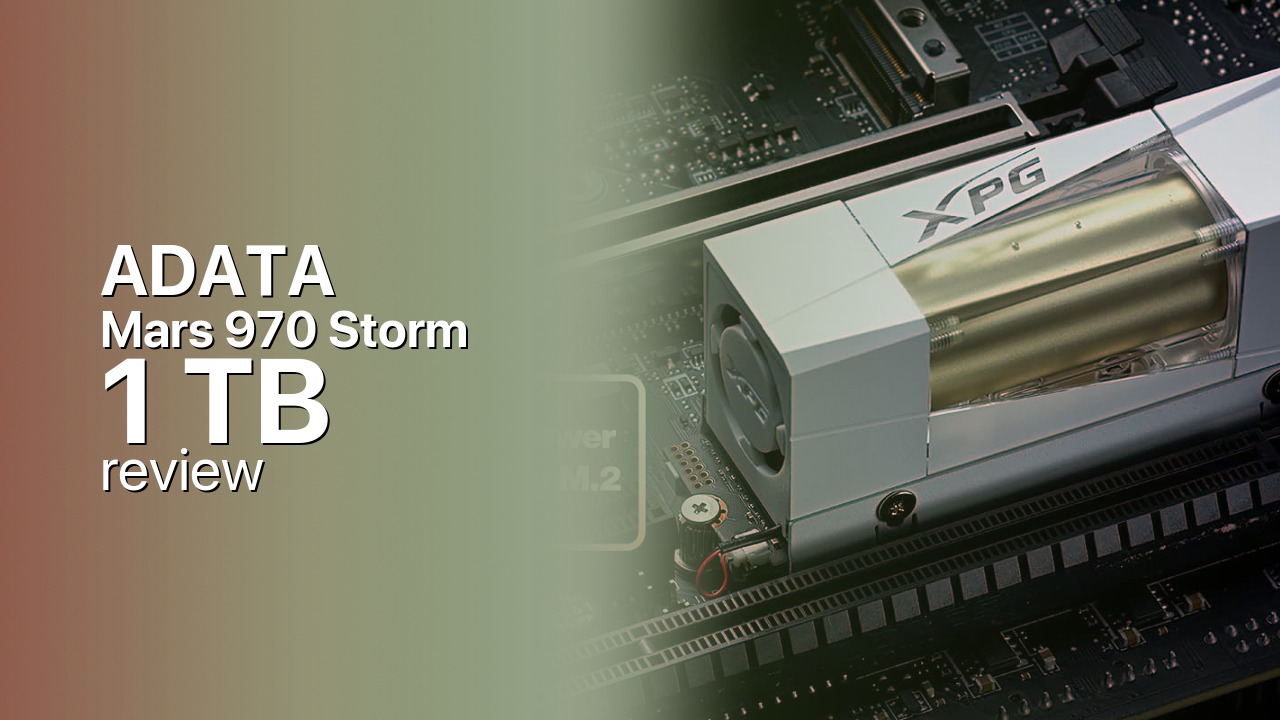
The Mars 970 Storm is ADATA's flagship PCIe 5.0 SSD featuring an aggressive cooling solution that sets it apart from conventional SSDs. It uses the Silicon Motion SM2508 eight-channel controller built on TSMC's 6 nm process, paired with 232-layer 3D TLC NAND and a DRAM cache buffer. The drive's defining feature is its patented dual-mode cooling system, which combines a liquid-filled thermal chamber with two 25 mm fans powered directly from the M.2 slot — no additional cables required.
This active cooling design reduces drive temperatures by up to 20% compared to passive heatsinks, according to ADATA, which allows the SM2508 controller to maintain peak boost clocks during sustained write workloads. At 1TB, the sequential read speed reaches 14,000 MB/s with writes up to 12,000 MB/s. The drive is available in 1 TB, 2 TB, 4 TB, and 8 TB capacities.
The cooling assembly is substantial — measuring approximately 30 mm tall — so compatibility is limited to desktop PCs with adequate clearance. This is not a drive for laptops, thin ITX builds, or the PlayStation 5. The target audience is enthusiasts, content creators, and AI workload users who push their SSDs hard enough that thermal throttling becomes a concern on conventionally cooled drives.
Storage Comparisons:
Mars 970 Storm Performance & Benchmarks
The Mars 970 Storm 1TB delivers sequential reads up to 14,000 MB/s and writes up to 12,000 MB/s over PCIe 5.0 x4. Random 4K performance reaches 2,000K read IOPS and 1,650K write IOPS. These figures place it among the fastest PCIe 5.0 SSDs available, comparable to the Crucial T705 and WD Black SN8100 in sequential throughput.
ADATA Mars 970 Storm 1 TB vs M.2 5.0 peers
Switch between sequential throughput and random IOPS to see how this drive stacks up against other M.2 5.0 SSDs in our database. The highlighted bar is the drive on this page — click any other bar to open that drive.
- Corsair MP700 Pro XT 1 TB: 14,900 MB/s read, 14,200 MB/s write
- Corsair MP700 Pro XT 2 TB: 14,900 MB/s read, 14,500 MB/s write
- Corsair MP700 Pro XT 4 TB: 14,900 MB/s read, 14,400 MB/s write
- Crucial T710 1 TB: 14,900 MB/s read, 13,800 MB/s write
- ADATA Mars 970 Storm 1 TB (this drive): 14,000 MB/s read, 12,000 MB/s write
The key differentiator is sustained write performance under heavy load. The SM2508 controller's 6 nm process is relatively power-efficient for a Gen5 controller, but sustained write workloads still generate significant heat. The Storm's liquid-and-fan cooling system effectively eliminates thermal throttling as a limiting factor, allowing the drive to maintain peak write speeds for longer than any passively cooled Gen5 SSD.
The pSLC cache provides a generous write buffer at 1TB. After the cache fills, write speeds transition to native TLC rates. With the Storm's cooling, these sustained TLC speeds are higher than what passively cooled SM2508 drives achieve under the same workload — the active cooling directly translates to better real-world throughput during large file transfers, game installations, and backup operations.
ADATA Mars 970 Storm vs Competitors
See how the Mars 970 Storm stacks up against other M.2 5.0 drives in our database:
Compare with rival drives:
Endurance, TBW & Warranty
ADATA backs the Mars 970 Storm with a 5-year warranty and an endurance rating of 1200 TBW for the 1TB model. The TBW scales linearly with capacity: 1,200 TBW at 1 TB, 2,400 at 2 TB, 4,800 at 4 TB, and 9,600 at 8 TB. The MTBF is rated at 2 million hours. For a typical user writing 30 GB per day, the 1TB drive would take many decades to exhaust its TBW allowance. The warranty covers the active cooling system as part of the SSD assembly — fan failure would be covered under the same terms.
ADATA Mars 970 Storm 1 TB Specifications
| Category | Value |
|---|---|
| Capacity [?] | 1 TB |
| Interface [?] | M.2 5.0 |
| Controller [?] | Silicon Motion SM2508 |
| Memory type [?] | 232-Layer 3D TLC |
| DRAM [?] | Yes |
| Read speed (MB/s) [?] | 14000 |
| Write speed (MB/s) [?] | 12000 |
| Read IOPS [?] | 2000000 |
| Write IOPS [?] | 1650000 |
| Endurance (TBW) [?] | 1200 |
| MTBF (million hours) [?] | 2000000 |
| Warranty (years) [?] | 5 |
Verdict: Is the Mars 970 Storm Worth It in 2026?
The XPG Mars 970 Storm 1TB is the right choice if you push PCIe 5.0 SSDs hard enough that thermal throttling is a real concern — sustained large-file transfers, video production scratch disks, AI model training, or 24/7 server workloads.
Skip it if you do not need the active cooling. For gaming, everyday use, or light creative work, a passively cooled Gen5 drive like the Mars 980 Blade or Crucial T705 performs identically at a lower price and in a smaller physical footprint.
The Seagate FireCuda 540 and the actively cooled variants of the Gigabyte Aorus Gen5 12000 are the closest alternatives. The Storm's liquid-and-fan design is unique in the consumer SSD market, and if your workflow genuinely requires sustained Gen5 writes, there is no better-cooled drive available at this price.
+ Pros
- Patented liquid-and-fan active cooling
- No additional power cable needed
- 14,000 MB/s sequential reads
- No thermal throttling under sustained load
- 5-year warranty
- Available up to 8 TB
- Cons
- Very large cooler — not laptop or PS5 compatible
- Premium price over passively cooled Gen5 drives
- Write speed trails newer SM2508 drives
- Fan noise under load
Buy this or similar SSD Storage:



Video Review
A Deep Dive into the ADATA #LEGEND970 #PCIe #Gen5 #NVMe M.2 #SSD: Speed, Cooling, and Performance!