Acer Predator GM9 1TB NVMe SSD tech specifications (2026)
Quick answer
The Acer Predator GM9 1TB fills the gap between the entry-level FA300 and the flagship GM9000 in Acer's Gen5 lineup.
Read: 14500 MB/s Write: 11000 MB/s Endurance: 625 TBW Warranty: 5 years Interface: M.2 5.0
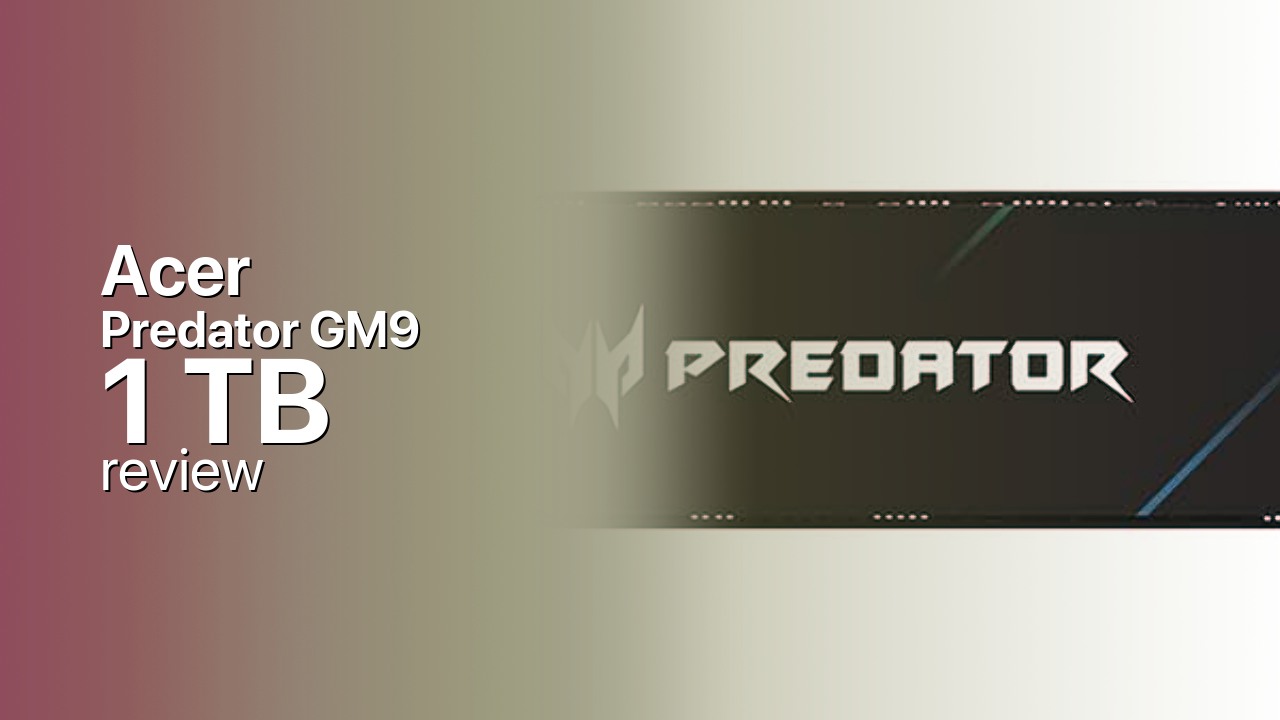
The Acer Predator GM9 1TB is a PCIe 5.0 NVMe SSD built around the Maxio MAP1806A-F2C controller, offering competitive Gen5 transfer speeds at a mid-range price point.
Controller & Memory
The Predator GM9 represents Acer's mid-range Gen5 offering, sitting between the DRAM-less FA300 and the flagship GM9000 in the company's SSD stack. It uses the Maxio MAP1806A-F2C eight-channel controller, which is a less common choice than the Silicon Motion SM2508 found in the GM9000. Maxio controllers have appeared in drives from brands like Lexar and Solidigm, typically paired with various TLC NAND suppliers depending on the market and production batch.
The GM9 is a DRAM-less design that relies on the Host Memory Buffer (HMB) protocol through NVMe 2.0, similar to the FA300. This means it borrows a small portion of system RAM for the flash translation layer rather than carrying dedicated DRAM onboard. The practical impact is that the GM9 may lose some sustained write performance under heavy multi-tasking compared to the DRAM-equipped GM9000, but it costs less and draws less power, which benefits laptop users.
At 1TB, the GM9 is the entry capacity in a lineup that also includes 2TB and 4TB variants. The 1TB model has fewer NAND die to interleave, which typically results in lower sequential write speeds compared to the larger capacities. The drive uses a standard M.2 2280 form factor and supports NVMe 2.0.
Competing Gen5 drives at the 1TB capacity include the Samsung 9100 EVO, which uses a similar DRAM-less HMB approach, the Crucial T705 with DRAM, and the Kingston FURY Renegade 5.0. The GM9 differentiates itself with Acer's Predator branding and a read speed of 14,500 MB/s that is among the highest available. The Overclockers review of the 2TB model found it suitable for gaming, 4K and 8K video production, and AI computational workloads.
Storage Comparisons:
Predator GM9 Performance & Benchmarks
Acer rates the GM9 1TB at up to 14,500 MB/s sequential read and 11,000 MB/s sequential write. The read speed is among the highest available on any Gen5 consumer SSD, while the write speed sits below the GM9000's 12,000 MB/s at the same capacity. Random IOPS figures are not published by Acer or listed in the johnnylucky.org database, which is common for Maxio-based drives where the manufacturer emphasizes sequential throughput over random metrics.
Acer Predator GM9 1 TB vs M.2 5.0 peers
Switch between sequential throughput and random IOPS to see how this drive stacks up against other M.2 5.0 SSDs in our database. The highlighted bar is the drive on this page — click any other bar to open that drive.
- Corsair MP700 Pro XT 1 TB: 14,900 MB/s read, 14,200 MB/s write
- Corsair MP700 Pro XT 2 TB: 14,900 MB/s read, 14,500 MB/s write
- Corsair MP700 Pro XT 4 TB: 14,900 MB/s read, 14,400 MB/s write
- Crucial T710 1 TB: 14,900 MB/s read, 13,800 MB/s write
- Acer Predator GM9 1 TB (this drive): 14,500 MB/s read, 11,000 MB/s write
The DRAM-less HMB architecture means that the GM9 performs best in systems with ample RAM and a direct CPU connection to the M.2 slot. Performance may be reduced in systems where the M.2 slot is routed through the chipset, as this adds latency to the HMB path. The SLC write cache absorbs burst writes effectively, and most consumer workloads including game loading and file copies will not exceed the cache capacity at the 1TB tier.
The Maxio MAP1806A-F2C controller is relatively new to the Western market, so long-term firmware maturity and compatibility data is more limited than for the widely deployed SM2508 platform used in the GM9000. However, early reviews indicate competitive real-world performance for gaming and general use, with the 14,500 MB/s read speed delivering fast game loading and responsive system behavior.
Acer Predator GM9 vs Competitors
See how the Predator GM9 stacks up against other M.2 5.0 drives in our database:
Compare with rival drives:
Endurance, TBW & Warranty
Acer covers the Predator GM9 with a five-year limited warranty. The total lineup endurance is rated at 2,500 TBW (2.5 PBW), with the 1TB model carrying approximately 625 TBW of that figure. At 625 TBW over five years, that works out to roughly 342 GB of writes per day to reach the warranty threshold. This is lower than the GM9000's endurance per terabyte but still adequate for consumer and light professional use. For comparison, most gamers and general users write well under 50 GB per day. The drive supports SMART health monitoring through standard utilities like CrystalDiskInfo, where you can track total bytes written and remaining spare block status.
Acer Predator GM9 1 TB Specifications
| Category | Value |
|---|---|
| Capacity [?] | 1 TB |
| Interface [?] | M.2 5.0 |
| Controller [?] | Maxio MAP1806A-F2C 8 Channel |
| Memory type [?] | 3D TLC |
| DRAM [?] | HMB |
| Read speed (MB/s) [?] | 14500 |
| Write speed (MB/s) [?] | 11000 |
| Read IOPS [?] | n/a |
| Write IOPS [?] | n/a |
| Endurance (TBW) [?] | 625 |
| MTBF (million hours) [?] | 2000000 |
| Warranty (years) [?] | 5 |
Verdict: Is the Predator GM9 Worth It in 2026?
The Acer Predator GM9 1TB fills the gap between the entry-level FA300 and the flagship GM9000 in Acer's Gen5 lineup. Its Maxio controller delivers competitive read speeds at 14,500 MB/s, though the DRAM-less design and lower write speeds keep it a step behind the GM9000 in sustained workloads. Buyers who prioritize write performance and endurance should step up to the GM9000 1TB. Those who want a capable Gen5 drive for gaming and everyday use at a lower price point will find the GM9 a reasonable option. Competitors like the Samsung 9100 EVO offer similar DRAM-less positioning with a more established controller platform, while the GM9's 14,500 MB/s read speed gives it a slight edge on paper.
+ Pros
- 14,500 MB/s sequential read is among the fastest
- Maxio MAP1806A eight-channel controller
- Five-year warranty with 625 TBW at 1TB
- PCIe 5.0 performance at a mid-range price point
- DRAM-less HMB design reduces cost and power
- Cons
- DRAM-less design limits sustained write consistency
- 11,000 MB/s write trails the GM9000 at 1TB
- Maxio controller has less track record than SM2508
- Endurance per TB is lower than the GM9000
- Random IOPS not officially published by Acer
Buy this or similar SSD Storage:



Video Review
Finally Booting Up the Mystery SSD I Was Sent 😱