Addlink G55H 2 TB Review: Budget PCIe 5.0 With a Heatsink (2026)
Quick answer
The addlink G55H 2 TB makes the most sense for PS5 owners and desktop builders who want PCIe 5.0 speed with cooling already solved: screw it in, and the 8.75 mm heatsink, 1,200 TBW rating and five-year warranty take care of the rest.
Read: 10300 MB/s Write: 9000 MB/s Endurance: 1200 TBW Warranty: 5 years Interface: M.2 5.0
The addlink G55H 2 TB bolts an 8.75 mm heatsink onto Phison's DRAM-less E31T platform, turning a 10,300 MB/s PCIe 5.0 drive into one of the more sensible PS5-ready Gen5 upgrades.
Controller & Memory
Phison's E31T runs the show inside the addlink G55H 2 TB: a four-channel, DRAM-less controller built on TSMC's 7 nm process, paired with Kioxia's 218-layer BiCS8 TLC NAND running at 3,600 MT/s. There is no onboard DRAM; the controller maps its flash through a host memory buffer (HMB), borrowing a small slice of system RAM instead. That choice defines the product. It cuts cost and power draw, with addlink claiming roughly half the consumption of Gen5 SSDs built on older 12 nm controllers, and it trades away some of the heavy-workload consistency that DRAM-equipped flagships hold in reserve.
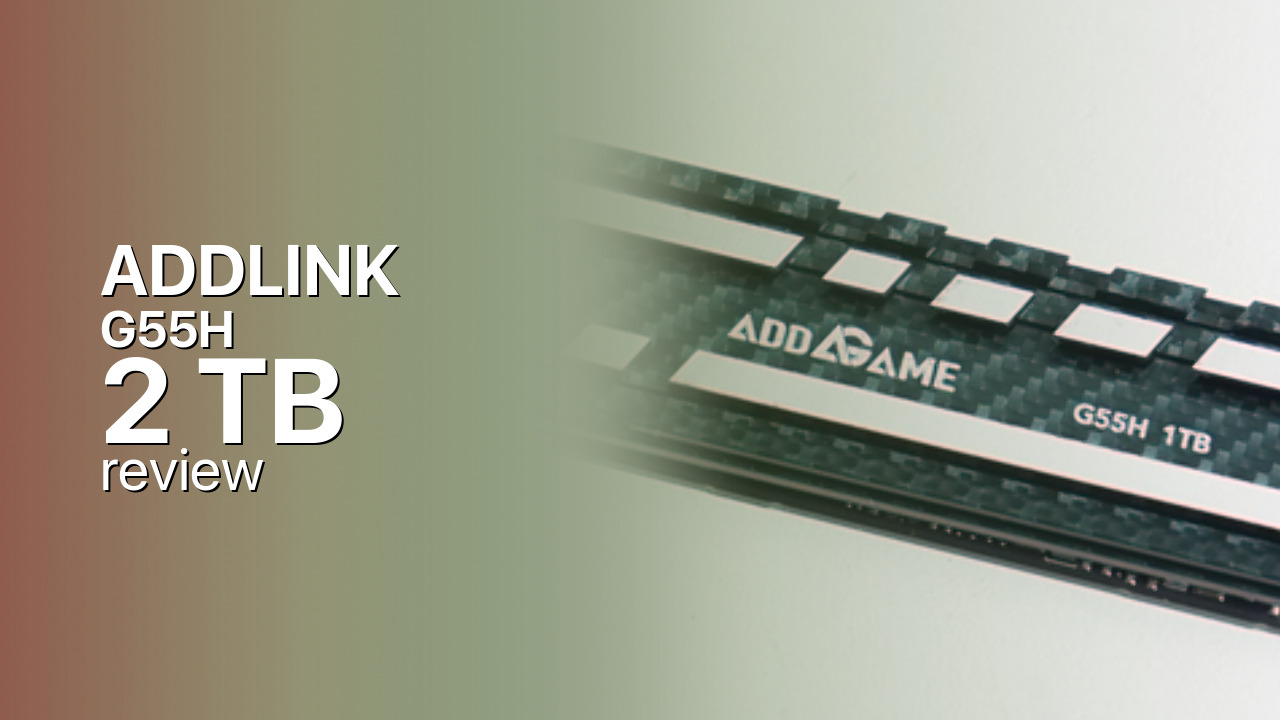
The H in the name marks the hardware difference: the G55H is the heatsink version of addlink's ultra-slim 2.3 mm G55. The M.2 2280 stick wears an 8.75 mm aluminum heatsink with a crosscut grid structure and a pre-applied thermal pad, so cooling is handled out of the box. The series is also available in 1 TB and 4 TB capacities; this 2 TB model carries the family's headline 10,300 MB/s read rating and keeps a single-sided layout despite the density.
That combination points at two buyers. The first is the PS5 owner: at 8.75 mm the drive clears Sony's 11.25 mm height limit with room to spare, and no extra cooling shopping is required. The second is the desktop builder who wants a fit-and-forget Gen5 boot and games drive without stepping up to flagship E26 hardware. Laptops and motherboards that insist on their own M.2 heatsinks are better served by the bare G55. Its natural rivals are the other Phison E31T budget Gen5 drives, the Corsair MP700 Elite and the PNY CS2150, with E26-based flagships like the Crucial T705 sitting a tier above for sustained-throughput work.
Storage Comparisons:
G55H Performance & Benchmarks
addlink rates the G55H 2 TB at up to 10,300 MB/s sequential reads and 9,000 MB/s sequential writes, the full-range figures for this capacity, with random performance rated at up to 1,300,000 IOPS reads and 1,500,000 IOPS writes. Those are burst numbers, achieved while writes land in the SLC cache, and like every DRAM-less design the G55H slows once a long transfer outruns that cache.
ADDLINK G55H 2 TB vs M.2 5.0 peers
Switch between sequential throughput and random IOPS to see how this drive stacks up against other M.2 5.0 SSDs in our database. The highlighted bar is the drive on this page — click any other bar to open that drive.
- Corsair MP700 Pro XT 1 TB: 14,900 MB/s read, 14,200 MB/s write
- Corsair MP700 Pro XT 2 TB: 14,900 MB/s read, 14,500 MB/s write
- Corsair MP700 Pro XT 4 TB: 14,900 MB/s read, 14,400 MB/s write
- Crucial T710 1 TB: 14,900 MB/s read, 13,800 MB/s write
- ADDLINK G55H 2 TB (this drive): 10,300 MB/s read, 9,000 MB/s write
In practice the drive holds up well against its peers. PCWorld, which tested both the 1 TB and 2 TB capacities, called it the fastest DRAM-less PCIe 5.0 drive it had benchmarked, beating the Corsair MP700 Elite and PNY CS2150 by several seconds in 48 GB real-world transfers, although the Corsair regained the lead in a 450 GB sustained write and the overall gaps sat within the margin of error. Translated to daily use: Windows boots, game loads and Steam installs feel identical to a top Gen4 drive, while bulk file moves, video project copies and DirectStorage asset streaming are where the doubled sequential ceiling shows. For a boot-plus-games drive the SLC cache limit is academic; if you routinely dump hundreds of gigabytes of camera footage in one session, a DRAM-equipped flagship is the safer tool.
ADDLINK G55H vs Competitors
See how the G55H stacks up against other M.2 5.0 drives in our database:
Compare with rival drives:
Endurance, TBW & Warranty
The 2 TB G55H is rated for 1,200 TBW, following the 600 TBW per terabyte that addlink assigns across the whole G55 family, and it is covered by a five-year limited warranty. Coverage ends at whichever arrives first, the five years or the rated writes; addlink says it judges the endurance side by the drive's reported Percentage Used SMART value rather than a raw byte counter, so you can check your standing in CrystalDiskInfo at any time. The rating is generous for a consumer drive: at a heavy 50 GB of writes per day, 1,200 TBW takes over 65 years to exhaust. The listed MTBF of 1.5 million hours is a population-level reliability statistic, not a promise about any individual drive's lifespan.
ADDLINK G55H 2 TB Specifications
| Category | Value |
|---|---|
| Capacity [?] | 2 TB |
| Interface [?] | M.2 5.0 |
| Controller [?] | Phison E31T 4 Channel |
| Memory type [?] | Kioxia 218-L TLC |
| DRAM [?] | HMB |
| Read speed (MB/s) [?] | 10300 |
| Write speed (MB/s) [?] | 9000 |
| Read IOPS [?] | 1300000 |
| Write IOPS [?] | 1500000 |
| Endurance (TBW) [?] | 1200 |
| MTBF (million hours) [?] | 1500000 |
| Warranty (years) [?] | 5 |
Verdict: Is the G55H Worth It in 2026?
The addlink G55H 2 TB makes the most sense for PS5 owners and desktop builders who want PCIe 5.0 speed with cooling already solved: screw it in, and the 8.75 mm heatsink, 1,200 TBW rating and five-year warranty take care of the rest. Skip it if your slot lives under a motherboard heatsink or inside a laptop, where the bare addlink G55 at 2.3 mm is the right pick, or if your work involves sustained hundred-gigabyte writes, where the Corsair MP700 Elite held on longer in PCWorld's testing and DRAM-equipped flagships like the Crucial T705 remain the stronger tool. As an all-round Gen5 drive for a gaming build, it earns its place on the shortlist: the speed is real, the endurance is generous, and the compromises are the sensible ones.
+ Pros
- 10,300 MB/s rated sequential reads
- 1,200 TBW endurance with a five-year warranty
- Included 8.75 mm heatsink clears the PS5 bay
- Efficient 7 nm Phison E31T controller
- Kioxia 218-layer BiCS8 TLC at 3,600 MT/s
- Single-sided layout at 2 TB
- Cons
- DRAM-less, leans on host memory buffer
- Sustained writes trail the Corsair MP700 Elite
- Heatsink height rules out laptops and slim builds
- PS5 slot limits it to PCIe 4.0 speeds
- Modest real-world gains over fast PCIe 4.0 drives
Buy this or similar SSD Storage:
Video Review
Addlink G55 Gen5 SSD Review - Best DRAMLESS SSD EVER?