BIWIN NV7200 512GB: Budget DRAM-less PCIe 4.0 NVMe (2026)
Quick answer
The NV7200 512GB suits budget builders who want a PCIe 4.0 boot drive or light-use secondary drive and don't need sustained write performance beyond typical OS and game-load workloads.
Read: 6300 MB/s Write: 3100 MB/s Endurance: 200 TBW Warranty: 5 years Interface: M.2 4.0 x 4
The BIWIN NV7200 512GB is a DRAM-less, budget-tier PCIe 4.0 NVMe SSD, rated for 6,300 MB/s reads but noticeably slower on writes than its larger siblings.
Controller & Memory
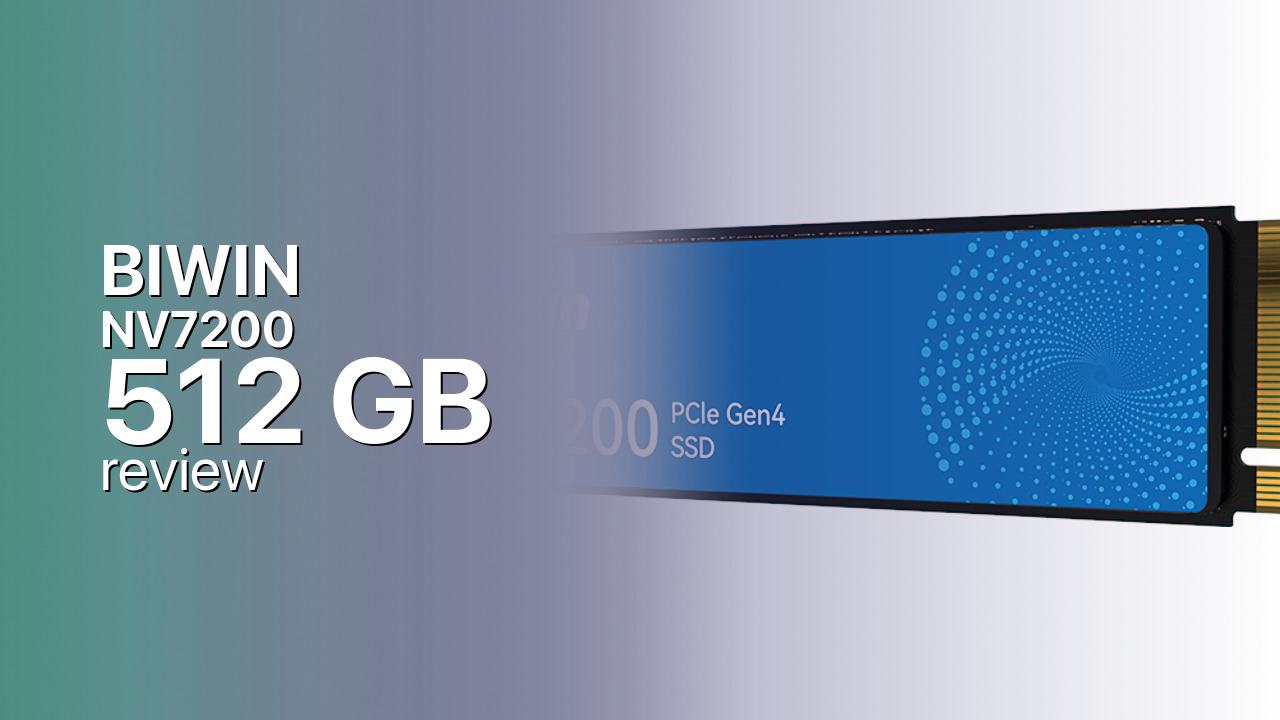
The NV7200 512GB runs a 4-channel Maxio MAP1602A-F3C controller with YMTC 232-layer TLC NAND and no onboard DRAM, relying on Host Memory Buffer for its mapping tables instead. This is BIWIN's budget line rather than the flagship Black Opal series, and the 512GB capacity shows it: with fewer NAND dies to spread work across, it caps out at 6,300 MB/s reads and 3,100 MB/s writes, well below the 7,200/6,200 MB/s the 1TB and larger capacities in this line achieve.
BIWIN sells the NV7200 in 512GB, 1TB, 2TB, and 4TB capacities, and 512GB is clearly the entry point rather than the sweet spot: random IOPS drop to 550K read and write versus 1,000K/800K on the 1TB and up, and endurance scales down to 200 TBW. Buyers who can stretch to the 1TB capacity get meaningfully higher sustained and random performance for a proportionally smaller cost increase than the capacity jump alone would suggest.
As a single-sided M.2 2280 drive with no DRAM chip to cool, the NV7200 512GB fits thin laptops and budget desktop builds as a boot drive or light-use secondary drive. It competes against other budget DRAM-less PCIe 4.0 drives at this capacity like the Kingston NV3 512GB and Crucial P3 512GB rather than performance-tier drives, since none of these budget 512GB SKUs are built for heavy sustained workloads. Laptops and desktops that only need a fast, inexpensive boot volume are the drive's intended home, not content-creation or large-library storage.
Storage Comparisons:
NV7200 Performance & Benchmarks
The 512GB NV7200 is rated for 6,300 MB/s sequential reads and 3,100 MB/s sequential writes, with random performance rated at 550,000 IOPS on both reads and writes, noticeably lower across the board than the 1TB and larger capacities in the same line. The write speed in particular is roughly half of what the 1TB achieves, since a 512GB drive has fewer NAND dies available for the controller to write across in parallel.
BIWIN NV7200 512 GB vs M.2 4.0 x 4 peers
Switch between sequential throughput and random IOPS to see how this drive stacks up against other M.2 4.0 x 4 SSDs in our database. The highlighted bar is the drive on this page — click any other bar to open that drive.
- Patriot Viper PV593 1 TB: 14,500 MB/s read, 14,000 MB/s write
- Patriot Viper PV593 2 TB: 14,500 MB/s read, 14,000 MB/s write
- Patriot Viper PV593 4 TB: 14,500 MB/s read, 14,000 MB/s write
- Patriot Viper PV573 2 TB: 14,000 MB/s read, 12,000 MB/s write
- BIWIN NV7200 512 GB (this drive): 6,300 MB/s read, 3,100 MB/s write
Like other DRAM-less TLC drives, the NV7200 leans on an SLC write cache to hit its rated write speed; at 512GB that cache is proportionally smaller than on the larger capacities, so it fills faster during sustained transfers and throughput drops toward native TLC speed sooner. BIWIN doesn't publish the exact cache size. For a boot drive or light gaming use, day-to-day performance (OS responsiveness, small file reads, game loads) will feel close to the larger capacities despite the lower rated numbers, since those workloads rarely sustain long enough to matter. Buyers planning heavier sustained write workloads, like large file transfers, should budget for the 1TB capacity or larger instead.
BIWIN NV7200 vs Competitors
See how the NV7200 stacks up against other M.2 4.0 x 4 drives in our database:
Compare with rival drives:
Endurance, TBW & Warranty
The 512GB NV7200 carries a 200 TBW endurance rating and a 5-year warranty. At a realistic consumer workload of 20 to 30GB written per day, which is proportionally appropriate for a 512GB boot drive, 200 TBW takes roughly 18 to 27 years to exhaust, comfortably outlasting the 5-year warranty window. BIWIN rates the NV7200 at 1,500,000 hours MTBF, a population-level reliability statistic rather than a guarantee for any individual drive. The 200 TBW figure is the lowest in the NV7200 line, proportional to the smaller capacity, so buyers with heavier write habits than a typical boot drive should consider a larger capacity rather than expecting this SKU to match the 1TB's endurance.
BIWIN NV7200 512 GB Specifications
| Category | Value |
|---|---|
| Capacity [?] | 512 GB |
| Interface [?] | M.2 4.0 x 4 |
| Controller [?] | Maxio MAP1602A |
| Memory type [?] | YMTC 232-L TLC |
| DRAM [?] | No |
| Read speed (MB/s) [?] | 6300 |
| Write speed (MB/s) [?] | 3100 |
| Read IOPS [?] | 550000 |
| Write IOPS [?] | 550000 |
| Endurance (TBW) [?] | 200 |
| MTBF (million hours) [?] | 1500000 |
| Warranty (years) [?] | 5 |
Verdict: Is the NV7200 Worth It in 2026?
The NV7200 512GB suits budget builders who want a PCIe 4.0 boot drive or light-use secondary drive and don't need sustained write performance beyond typical OS and game-load workloads. Buyers doing regular large file transfers or heavier write workloads should step up to the 1TB capacity in the same line, which roughly doubles both write speed and random IOPS rather than just capacity. The Kingston NV3 512GB and Crucial P3 512GB are close budget alternatives with similar DRAM-less designs and comparable pricing. For a no-frills, low-cost PCIe 4.0 boot drive, the NV7200 512GB's 6,300 MB/s reads and 5-year warranty are reasonable for the price tier, as long as expectations match its entry-level position in BIWIN's own lineup.
+ Pros
- 6,300 MB/s sequential reads on PCIe 4.0
- 5-year warranty despite budget pricing
- Low power draw from DRAM-less design
- Fits thin laptops without extra cooling
- Low-cost entry point into PCIe 4.0 NVMe
- Cons
- Write speed nearly halved versus 1TB sibling
- Random IOPS well below larger capacities
- 200 TBW is the lowest in the NV7200 line
- No onboard DRAM for mapping tables
- Not suited to sustained heavy write workloads
Buy this or similar SSD Storage:
Video Review
🔧 Biwin NV7200 SSD 2TB: velocidad extrema y rendimiento pro 🚀 #setup #gaming #pcgaming