ADDLINK G55H 4TB at a glance: internals, speed, and limits (2026)
Quick answer
The ADDLINK G55H 4TB makes a straightforward case for itself: PCIe 5.0 sequential speeds, a 5-year warranty with 2,400 TBW, and an integrated heatsink, at a price that undercuts most DRAM-equipped Gen 5 drives.
Read: 10300 MB/s Write: 9000 MB/s Endurance: 2400 TBW Warranty: 5 years Interface: M.2 5.0
The ADDLINK G55H 4TB is a PCIe 5.0 x4 NVMe SSD built around the Phison E31T controller, targeting buyers who want Gen 5 sequential speeds without the premium of a full DRAM-equipped flagship.
Controller & Memory
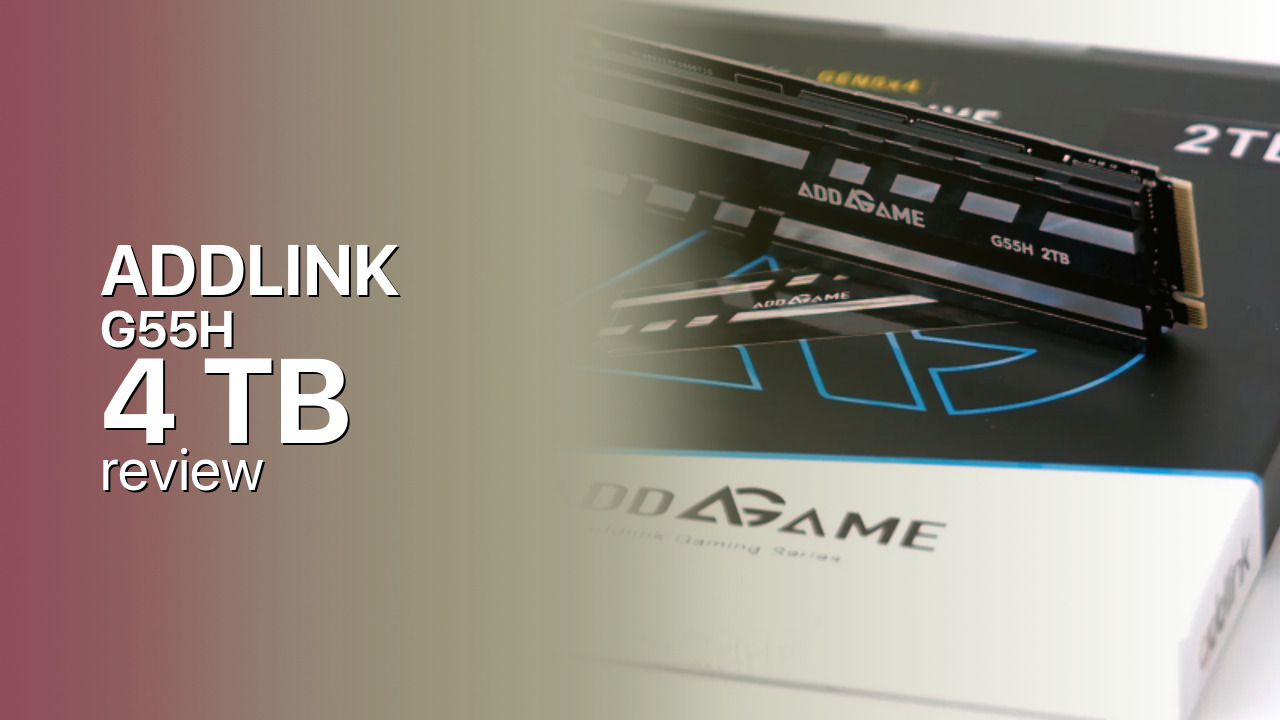
The G55H sits in ADDLINK's Gen 5 lineup alongside the ultra-slim G55, differentiated by its bundled aluminum heatsink — 8.75 mm tall, with a silica thermal pad — designed to keep the Phison E31T from throttling under sustained loads. Internally, the controller is the PS5031-E31T, a 4-channel, TSMC 7nm design without a dedicated DRAM cache. Instead it relies on Host Memory Buffer (HMB), borrowing a small allocation of system RAM to store the logical-to-physical address table. This keeps the BOM cost low and cuts idle power draw compared to DRAM-equipped drives, but the trade-off is visible under sustained mixed workloads where a full DRAM cache would normally absorb more random I/O pressure. The NAND is Kioxia 218-layer BiCS8 3D TLC (the same die used in several competing E31T drives), paired with an SLC write cache to accelerate burst writes before data is folded back to native TLC density.
The G55H is available in 1 TB, 2 TB, and 4 TB. The 4 TB occupies a standard M.2 2280 footprint, making it compatible with desktop motherboards and the PlayStation 5's M.2 expansion slot. Backward compatibility with PCIe 4.0 and 3.0 slots is supported, though sequential throughput caps near 7,000 MB/s in a Gen 4 slot.
The closest direct competitor on the same Phison E31T platform is the Corsair MP700 Elite, which adds a dedicated DRAM cache and typically costs more. Buyers who want a full DRAM cache in the PCIe 5.0 tier should look at the Crucial T705, which uses the higher-channel Phison E26 controller but carries a noticeably higher street price — especially at 4 TB. At PCIe 4.0, the WD Black SN850X remains relevant for workloads that favour low random latency over peak sequential throughput.
Storage Comparisons:
G55H Performance & Benchmarks
The ADDLINK G55H 4TB is rated at 10,300 MB/s sequential read and 9,000 MB/s sequential write, achieved over a PCIe 5.0 x4 NVMe interface. These figures are consistent with what Phison specifies for the E31T at its 4 TB configuration, where the additional NAND channels per package improve write parallelism over the 1 TB and 2 TB SKUs.
ADDLINK G55H 4 TB vs M.2 5.0 peers
Switch between sequential throughput and random IOPS to see how this drive stacks up against other M.2 5.0 SSDs in our database. The highlighted bar is the drive on this page — click any other bar to open that drive.
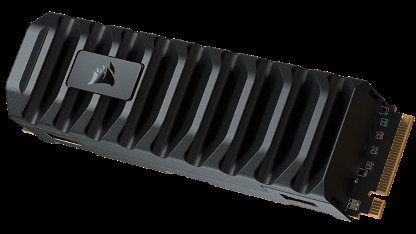
- Corsair MP700 Pro XT 1 TB: 14,900 MB/s read, 14,200 MB/s write
- Corsair MP700 Pro XT 2 TB: 14,900 MB/s read, 14,500 MB/s write
- Corsair MP700 Pro XT 4 TB: 14,900 MB/s read, 14,400 MB/s write
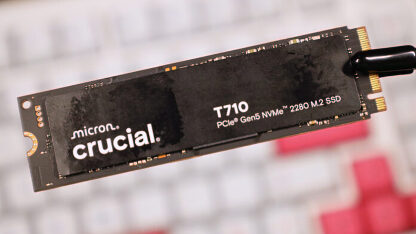
- Crucial T710 1 TB: 14,900 MB/s read, 13,800 MB/s write
- ADDLINK G55H 4 TB (this drive): 10,300 MB/s read, 9,000 MB/s write
Because the G55H uses HMB rather than a dedicated on-board DRAM chip, the drive borrows a small region of system RAM to cache the NAND address map. In day-to-day workloads — OS boots, application launches, moderate file transfers — this difference from a DRAM-equipped drive is largely imperceptible. The gap becomes more apparent during sustained sequential writes that exhaust the SLC write cache, or in heavy random-write queues where a dedicated DRAM buffer would provide lower latency. Expect the 4 TB model to handle the SLC-to-TLC folding better than smaller capacities simply because it has more raw NAND to spread writes across.
The bundled heatsink keeps the controller at reasonable temperatures during extended workloads; the E31T has been measured at roughly 4–6 W under load, which is notably lower than the 8–12 W range typical of the E26-based drives. In a case with decent airflow the heatsink is sufficient; in an enclosed chassis or near warm components, seating the drive in a motherboard slot with its own heatsink remains an option since the G55H heatsink is removable.
ADDLINK G55H vs Competitors
See how the G55H stacks up against other M.2 5.0 drives in our database:
Compare with rival drives:
Endurance, TBW & Warranty
ADDLINK backs the G55H with a 5-year warranty, valid until the drive's percentage-used counter reaches its limit — readable via CrystalDiskInfo or any S.M.A.R.T. monitoring tool. The 4 TB model is rated for 2,400 TBW (terabytes written), derived from ADDLINK's published formula of 600 TBW per 1 TB of capacity across the lineup.
To put 2,400 TBW in context: a desktop user writing 50 GB per day would exhaust the endurance rating in roughly 131 years. A content creator writing 200 GB per day — large video files, scratch disk usage — would cross that threshold in about 33 years. Even aggressive daily workloads rarely approach endurance limits within the warranty period on a 4 TB drive; for most buyers, the 5-year coverage window is the practical constraint, not the TBW figure. MTBF is rated at 1,500,000 hours, consistent with mainstream consumer NVMe drives.
ADDLINK G55H 4 TB Specifications
| Category | Value |
|---|---|
| Capacity [?] | 4 TB |
| Interface [?] | M.2 5.0 |
| Controller [?] | Phison E31T 4 Channel |
| Memory type [?] | Kioxia 218-L TLC |
| DRAM [?] | HMB |
| Read speed (MB/s) [?] | 10300 |
| Write speed (MB/s) [?] | 9000 |
| Read IOPS [?] | 1000000 |
| Write IOPS [?] | 1000000 |
| Endurance (TBW) [?] | 2400 |
| MTBF (million hours) [?] | 1500000 |
| Warranty (years) [?] | 5 |
Verdict: Is the G55H Worth It in 2026?
The ADDLINK G55H 4TB makes a straightforward case for itself: PCIe 5.0 sequential speeds, a 5-year warranty with 2,400 TBW, and an integrated heatsink, at a price that undercuts most DRAM-equipped Gen 5 drives. It suits desktop builders who want the bragging rights of a 10,300 MB/s read SSD and have a motherboard with a PCIe 5.0 M.2 slot — and who are not running sustained write-heavy server-style workloads where dedicated DRAM cache would matter.
Skip it if your workload involves continuous large-file writes for hours at a stretch, or if your platform only supports PCIe 4.0 — in that case a DRAM-equipped PCIe 4.0 drive like the WD Black SN850X delivers better sustained random performance at a similar price. For mainstream desktops and PS5 storage expansion, the G55H 4TB is a well-rounded choice at its capacity tier.
+ Pros
- 10,300 MB/s sequential read over PCIe 5.0 x4
- 9,000 MB/s sequential write — highest in E31T lineup
- 2,400 TBW endurance at 4 TB capacity
- 5-year manufacturer warranty
- Bundled aluminum heatsink included (8.75 mm)
- PS5 compatible (M.2 2280, exceeds 5,500 MB/s minimum)
- Lower power draw than DRAM-equipped Gen 5 drives (~4–6 W)
- Cons
- HMB, not DRAM — sustained random I/O lags behind DRAM-equipped peers
- PCIe 5.0 slot required for full speed; only ~7,000 MB/s in Gen 4 slots
- 4-channel E31T controller has a lower performance ceiling than 8-channel E26 drives
- 2-year warranty listed on some retailer pages — verify 5-year coverage at point of purchase
- Heatsink adds 8.75 mm height, may conflict with M.2 slot clearance on some boards
Buy this or similar SSD Storage:
Video Review
PCIe Gen5 Drives are Here! Are they Worth It?? - Crucial T700 PCIe Gen 5 NVMe SSD