Corsair Force MP400 1TB NVMe SSD Review (2026)
Quick answer
Gamers and general desktop users who want a responsive NVMe boot drive with room for a large game library will find the Corsair Force MP400 1 TB serviceable, especially where the PCIe 4.0 interface is needed.
Read: 3480 MB/s Write: 1880 MB/s Endurance: 200 TBW Warranty: 5 years Interface: M.2 4.0 x 4
The Corsair Force MP400 1 TB is a QLC-based NVMe that trades endurance for capacity density, using a Phison E16 controller to hit 3,480 MB/s reads in a single-sided M.2 2280 design.
Controller & Memory
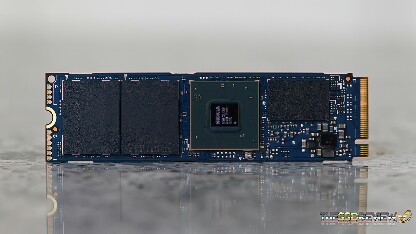
Under the label sits Phison's PS5016-E16 controller, an eight-channel PCIe 4.0 x4 NVMe 1.3 design built on TSMC's 28nm process. The E16 is the same silicon Corsair deployed in the MP600, though here it is paired with Micron's 96-layer 3D QLC NAND rather than TLC. A 4 Gb Nanya DDR3L DRAM chip handles the flash translation layer, running at half the typical DRAM-to-NAND ratio, which suggests some FTL table compression or metadata prioritization under the hood.
The 1 TB variant is the entry point of the MP400 line, which also spans 2 TB, 4 TB, and a rare 8 TB. The 1 TB and 2 TB models use the Phison E16 on PCIe 4.0, while the 4 TB and 8 TB switch to the Phison E12S on PCIe 3.0 with higher IOPS ratings. The 1 TB specifically drops to 1,880 MB/s sequential writes and 190K/470K random IOPS, well below the 2 TB's 3,000 MB/s and 380K/560K figures. Both the 1 TB and 2 TB use a single-sided PCB, making them compatible with thin laptops and the PS5 (with a heatsink). The 4 TB and 8 TB are double-sided.
The MP400 competes with other QLC drives like the Sabrent Rocket Q and the Crucial P3. Against TLC-based PCIe 3.0 drives like the WD Blue SN570 or Samsung 970 EVO Plus, the MP400 matches burst read speed but falls behind on sustained writes and endurance per GB. It does not support AES 256 hardware encryption, unlike Corsair's own MP510.
Storage Comparisons:
Force MP400 Performance & Benchmarks
Corsair rates the Force MP400 1 TB at 3,480 MB/s sequential read and 1,880 MB/s sequential write. Random performance comes in at up to 190,000 read IOPS and 470,000 write IOPS. These are burst figures captured through the drive's dynamic SLC cache, which spans roughly one-quarter of the available NAND space.
Corsair Force MP400 1 TB vs M.2 4.0 x 4 peers
Switch between sequential throughput and random IOPS to see how this drive stacks up against other M.2 4.0 x 4 SSDs in our database. The highlighted bar is the drive on this page — click any other bar to open that drive.
- Patriot Viper PV593 1 TB: 14,500 MB/s read, 14,000 MB/s write
- Patriot Viper PV593 2 TB: 14,500 MB/s read, 14,000 MB/s write
- Patriot Viper PV593 4 TB: 14,500 MB/s read, 14,000 MB/s write
- Patriot Viper PV573 2 TB: 14,000 MB/s read, 12,000 MB/s write
- Corsair Force MP400 1 TB (this drive): 3,480 MB/s read, 1,880 MB/s write
On the 1 TB model the SLC cache covers about 250 GB of writes. Once that buffer fills, write speeds drop to the native QLC write speed, which independent reviewers consistently find falls to around 80 to 160 MB/s depending on the workload composition. For a boot drive or game library where sustained writes rarely exceed a few dozen gigabytes, the cache hides the QLC penalty effectively. For anyone regularly moving large video files or disk images exceeding 250 GB, the post-cache slowdown becomes very noticeable. The E16 controller keeps random read responsiveness competitive with TLC alternatives, so OS and application loading feel identical to faster-rated TLC drives in everyday desktop use. The QLC penalty is primarily a sustained-write concern, not a read-performance issue.
Corsair Force MP400 vs Competitors
See how the Force MP400 stacks up against other M.2 4.0 x 4 drives in our database:
Compare with rival drives:
Endurance, TBW & Warranty
Corsair backs the Force MP400 1 TB with a five-year limited warranty, terminated by either the warranty period or 200 TBW of writes, whichever comes first. The 200 TBW endurance rating is modest: at a typical 20 GB of writes per day, the drive would take over 27 years to exhaust its rated write budget, which is comfortable for a consumer gaming or general-use scenario. For heavier workloads involving frequent large file transfers, the budget tightens considerably compared to TLC drives in the same capacity class, which often carry 600 TBW ratings. The MP400 includes Phison's SmartECC third-generation LDPC error correction, SmartRefresh for periodic block refresh, and end-to-end data protection. The drive also ships factory-overprovisioned by approximately 9 percent, which helps maintain consistent performance and reliability over its service life.
Corsair Force MP400 1 TB Specifications
| Category | Value |
|---|---|
| Capacity [?] | 1 TB |
| Interface [?] | M.2 4.0 x 4 |
| Controller [?] | Phison E16 |
| Memory type [?] | Micron 96L QLC |
| DRAM [?] | DDR3L |
| Read speed (MB/s) [?] | 3480 |
| Write speed (MB/s) [?] | 1880 |
| Read IOPS [?] | 190000 |
| Write IOPS [?] | 470000 |
| Endurance (TBW) [?] | 200 |
| MTBF (million hours) [?] | 1.8 |
| Warranty (years) [?] | 5 |
Verdict: Is the Force MP400 Worth It in 2026?
Gamers and general desktop users who want a responsive NVMe boot drive with room for a large game library will find the Corsair Force MP400 1 TB serviceable, especially where the PCIe 4.0 interface is needed. Anyone doing frequent large-file workloads like video editing or disk imaging should skip it in favor of a TLC drive such as the Samsung 970 EVO Plus or WD Blue SN570, both of which sustain writes far better after the SLC cache fills. The MP400 1 TB is a capable QLC NVMe with competitive burst reads, but its low write endurance and steep post-cache slowdown make it a situational pick rather than a universal recommendation.
+ Pros
- 3,480 MB/s sequential read speed
- Single-sided M.2 2280 PCB design
- PCIe 4.0 x4 backwards-compatible to 3.0
- Available up to 8 TB in the series
- 5-year warranty included
- Phison E16 with DRAM cache buffer
- Cons
- Only 200 TBW endurance rating
- 1,880 MB/s writes well below 2 TB model
- QLC slowdown after SLC cache fills
- No AES 256 hardware encryption
- 190K random read IOPS below TLC rivals
Buy this or similar SSD Storage:



Video Review
Corsair MP400 Review - Up to 8TB of FAST SSD - TechteamGB