PCIe 5.0 Performance Built for Thin Laptops and Compact Workstations (2026)
Quick answer
The Corsair MP700 Micro M.2 2242 2TB is a well-targeted drive for a specific need: bringing PCIe 5.0 NVMe performance to a thin laptop, mini PC, or compact workstation that has a 2242 slot rather than a standard 2280 slot.
Read: 10000 MB/s Write: 8500 MB/s Endurance: 1200 TBW Warranty: 5 years Interface: M.2 5.0
The Corsair MP700 Micro M.2 2242 2TB brings PCIe 5.0 x4 NVMe performance to the 22x42mm short-slot market, reaching 10,000 MB/s sequential reads where most 2242 drives top out below 7,000 MB/s.
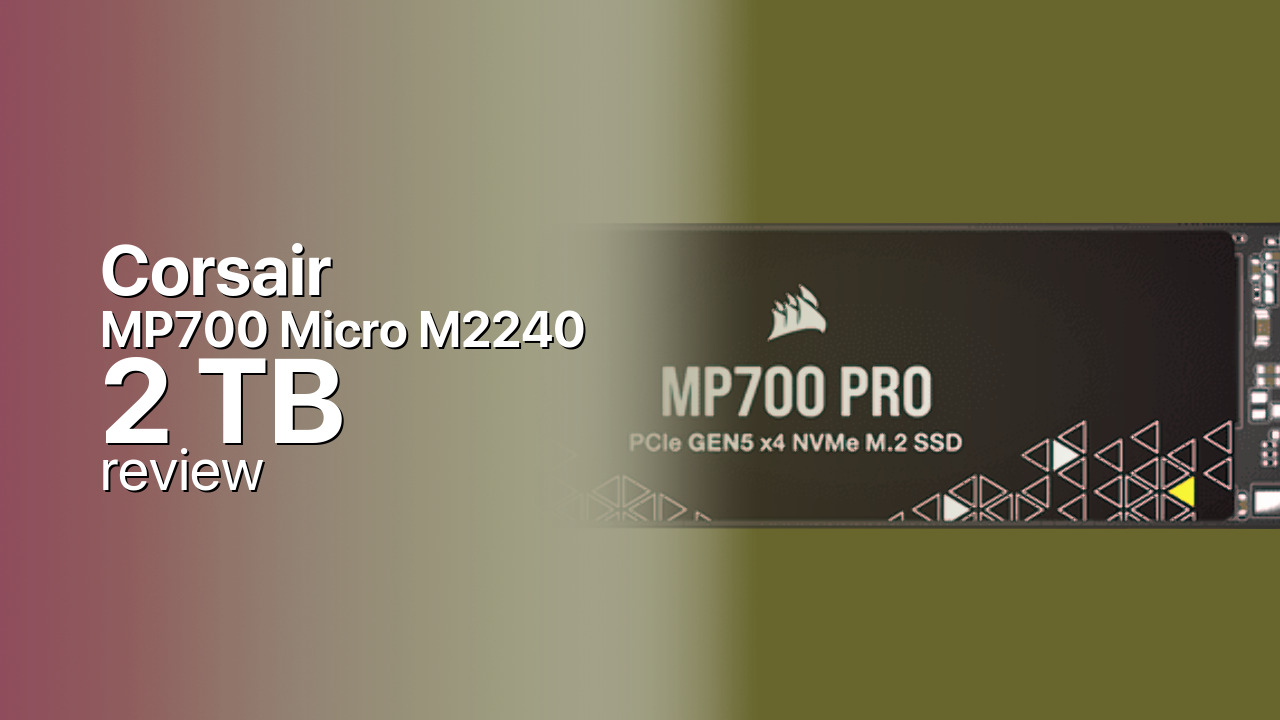
Controller & Memory
The MP700 Micro's defining feature is its M.2 2242 form factor — 22mm wide and 42mm long, compared to the standard 80mm of a 2280 drive. This shorter length matters in thin-and-light laptops, mini PCs, and compact workstations from Lenovo, HP, Dell, and Acer that ship with 2242 slots rather than full-length 2280 slots. The drive's single-sided PCB design also keeps it within the thickness constraints of ultra-slim chassis where double-sided modules would not seat properly.
The controller is the Phison PS5031-E31T, a 4-channel DRAMless architecture built on a 7nm process. In place of dedicated DRAM, it uses Host Memory Buffer technology, borrowing a portion of system RAM for the flash translation layer. This eliminates the dedicated DRAM chip — freeing board space critical in the 2242 footprint — at the cost of a slight performance ceiling compared to DRAM-equipped designs. For the workloads that populate 2242 slots (OS boots, application launches, everyday file transfers), HMB delivers results nearly indistinguishable from DRAM-based drives.
NAND is Kioxia's 218-layer BiCS8 3D TLC, the same generation used across most premium PCIe 5.0 drives shipping in 2025. At 2TB the drive achieves its full rated speeds; a larger NAND pool means more parallelism across the four controller channels.
The MP700 Micro is not the right drive for the Steam Deck (M.2 2230 slot) or the ASUS ROG Ally (also 2230). It also does not fit the PS5 expansion bay, which requires a 2280 module. If you need a PCIe 5.0 upgrade for a full-size desktop or PS5, the Corsair MP700 Pro XT 2TB in standard 2280 is the correct choice from the same lineup. The MP700 Micro serves one specific use case well: a thin-laptop or compact-system upgrade where only a 2242 slot is available and maximum PCIe 5.0 throughput is wanted.
Storage Comparisons:
MP700 Micro M2240 Performance & Benchmarks
Corsair rates the MP700 Micro 2TB at 10,000 MB/s sequential reads and 8,500 MB/s sequential writes, with random performance around 1,300,000 read IOPS and 1,400,000 write IOPS. These are the peak specifications under a PCIe 5.0 x4 host with HMB enabled.
Corsair MP700 Micro M2240 2 TB vs M.2 5.0 peers
Switch between sequential throughput and random IOPS to see how this drive stacks up against other M.2 5.0 SSDs in our database. The highlighted bar is the drive on this page — click any other bar to open that drive.
- Corsair MP700 Pro XT 1 TB: 14,900 MB/s read, 14,200 MB/s write
- Corsair MP700 Pro XT 2 TB: 14,900 MB/s read, 14,500 MB/s write
- Corsair MP700 Pro XT 4 TB: 14,900 MB/s read, 14,400 MB/s write
- Crucial T710 1 TB: 14,900 MB/s read, 13,800 MB/s write
- Corsair MP700 Micro M2240 2 TB (this drive): 10,000 MB/s read, 8,500 MB/s write
The 4-channel Phison E31T architecture accounts for the gap versus full-sized 2280 PCIe 5.0 drives. An 8-channel controller like the Phison E26 or E28 found in the Corsair MP700 Pro XT can push above 14,000 MB/s reads; the E31T tops out around 10,000 MB/s reads because it has half the channel count feeding data to the host. For the devices this drive targets, that distinction rarely matters: a thin Lenovo ThinkPad or HP EliteBook with a 2242 slot is unlikely to have sustained sequential workloads that would reveal the gap over a PCIe 4.0 predecessor.
Under sustained heavy sequential writes exceeding the SLC write cache, the drive slows to roughly 1,000 to 1,500 MB/s as it writes directly to TLC cells. This is consistent with all TLC NAND drives and relevant only when writing hundreds of gigabytes in a single session. Everyday laptop workloads rarely exhaust the cache.
Active power draw is rated at 5.9 W, lower than most 2280 PCIe 5.0 SSDs. For battery-powered thin laptops, that efficiency gap can contribute meaningfully to runtime compared to a full-wattage 2280 drive in an adapter.
Corsair MP700 Micro M2240 vs Competitors
See how the MP700 Micro M2240 stacks up against other M.2 5.0 drives in our database:
Compare with rival drives:
Endurance, TBW & Warranty
Corsair covers the MP700 Micro 2TB with a five-year limited warranty and an endurance rating of 1,200 TBW. At 1,200 TBW, the drive is rated for up to 240 TB of writes per year over the warranty period. A typical laptop user writing 20 to 40 GB per day would accumulate roughly 7 to 15 TB per year — well under a tenth of the annual allowance. Even a content creator writing 100 GB per day would reach the TBW limit in approximately 33 years, meaning the five-year time limit is the governing factor for virtually all real-world use. MTBF is rated at 1.5 million hours, a fleet-level reliability statistic standard across the industry.
Corsair MP700 Micro M2240 2 TB Specifications
| Category | Value |
|---|---|
| Capacity [?] | 2 TB |
| Interface [?] | M.2 5.0 |
| Controller [?] | Phison PS5031-E31T 4 channel |
| Memory type [?] | Kioxia BiCS8 TLC |
| DRAM [?] | HMB |
| Read speed (MB/s) [?] | 10000 |
| Write speed (MB/s) [?] | 8500 |
| Read IOPS [?] | 1300000 |
| Write IOPS [?] | 1400000 |
| Endurance (TBW) [?] | 1200 |
| MTBF (million hours) [?] | 1500000 |
| Warranty (years) [?] | 5 |
Verdict: Is the MP700 Micro M2240 Worth It in 2026?
The Corsair MP700 Micro M.2 2242 2TB is a well-targeted drive for a specific need: bringing PCIe 5.0 NVMe performance to a thin laptop, mini PC, or compact workstation that has a 2242 slot rather than a standard 2280 slot. With 10,000 MB/s reads, single-sided construction, and Kioxia's latest 218-layer TLC NAND, it is the fastest 2TB option available in the 42mm length category.
Buyers who should look elsewhere: Steam Deck and ASUS ROG Ally owners (those devices use 2230 slots), PS5 upgraders (the console requires 2280), and desktop users who want maximum PCIe 5.0 throughput (the Corsair MP700 Pro XT 2TB in 2280 provides 8-channel E28 performance and heatsink options). The 4-channel E31T and HMB architecture are trade-offs worth accepting when the form factor constraint is real — and unnecessary compromises when it is not.
+ Pros
- M.2 2242 form factor fits thin laptops, mini PCs, and compact workstations where 2280 drives cannot
- 10,000 MB/s sequential reads — fastest PCIe 5.0 performance available in the 2242 length
- Single-sided PCB fits ultra-slim chassis where double-sided drives do not seat
- Kioxia 218-layer BiCS8 3D TLC NAND — current-generation flash
- 1,200 TBW endurance with a five-year warranty
- 5.9 W active draw — lower power than full-size PCIe 5.0 drives
- Cons
- 4-channel Phison E31T tops out ~10,000 MB/s reads vs 14,000+ MB/s on 8-channel 2280 PCIe 5.0 drives
- DRAMless HMB design: random I/O performance depends partially on system RAM availability and speed
- Does not fit Steam Deck (2230 slot), ROG Ally (2230 slot), or PS5 (requires 2280)
- SLC cache exhaustion under sustained heavy writes drops speed to 1,000-1,500 MB/s
- 2242 PCIe 5.0 host support is uncommon — verify your device slot before purchasing
Buy this or similar SSD Storage:



Video Review
Don’t Forget This NVMe Install Step!