HP EX920 1TB Review — A Classic PCIe 3.0 NVMe SSD (2026)
Quick answer
The HP EX920 1 TB is a smart buy for budget-conscious builders who want a PCIe 3.0 NVMe drive with a proper DRAM cache and strong sustained write performance from the used or NOS market.
Read: 3200 MB/s Write: 1800 MB/s Endurance: 650 TBW Warranty: 5 years Interface: M.2 3.0 x 4
The HP EX920 1 TB remains one of the few PCIe 3.0 NVMe drives whose massive SLC cache and real-world throughput still hold up against more modern DRAM-less designs.
Controller & Memory
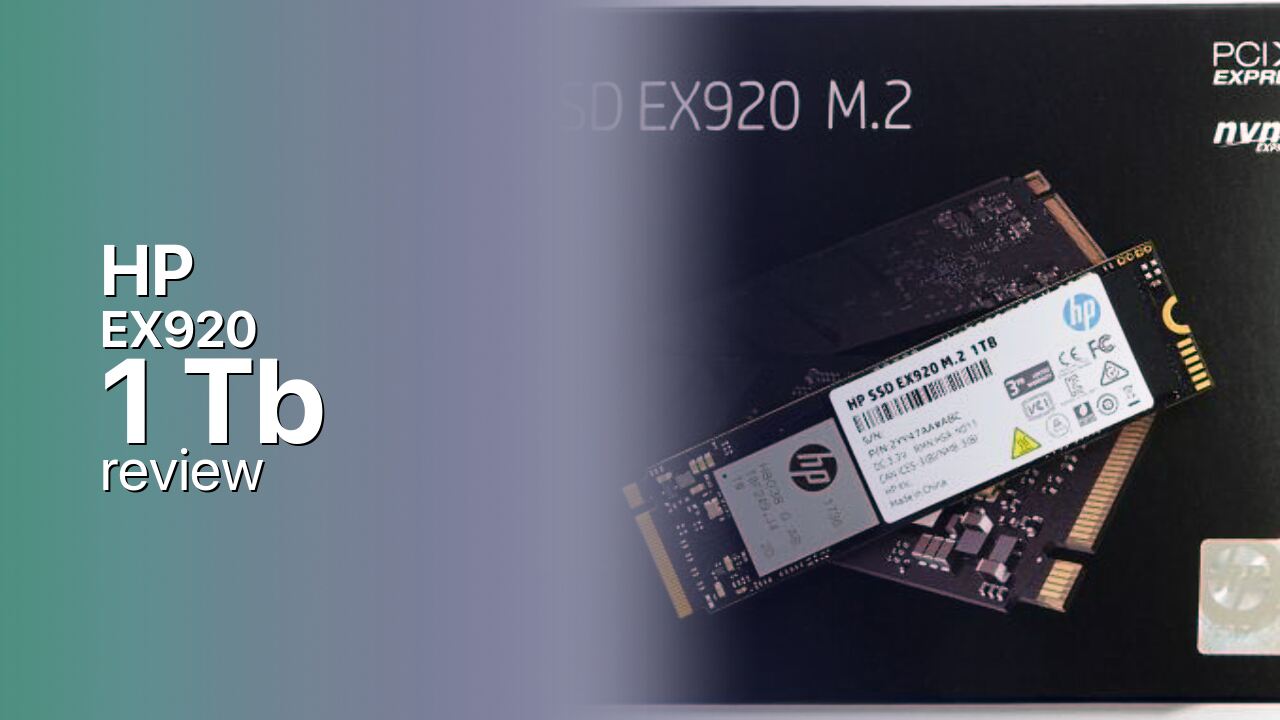
The HP EX920 pairs a Silicon Motion SM2262 controller with Micron 64-layer 3D TLC NAND and 1 GB of Nanya DDR3 DRAM across two 512 MB chips. The SM2262 is a dual-core, four-channel design that also powers the Intel 760p and ADATA SX8200, though HP's firmware tuning and NAND selection give the EX920 a distinctive performance profile. The drive sits on a double-sided M.2 2280 PCB, which is worth noting for ultrabook users — some thin laptops cannot accommodate dual-sided SSDs. The EX920 was manufactured by Biwin under HP's brand license rather than by HP Inc. itself, and it launched as a mainstream PCIe 3.0 contender targeting the same slot occupied by the Samsung 970 EVO and WD Black SN750.
HP positioned the EX920 as a value-oriented drive that punched above its weight class, and the 1 TB variant delivers exactly that. At launch it was one of the most affordable NVMe SSDs with a dedicated DRAM cache, and the performance numbers backed up the price tag — 3,200 MB/s sequential reads and 1,800 MB/s sequential writes, with an SLC cache large enough to absorb sustained transfers exceeding 100 GB before dropping to native TLC speed. That cache behavior is the EX920's signature strength: where most budget NVMe drives collapse to a few hundred MB/s once the cache fills, the EX920 holds roughly 875 MB/s in direct-to-TLC mode, which is faster than many SATA SSDs can manage at peak.
The 1 TB variant is the sweet spot of the lineup. HP also offered 256 GB and 512 GB capacities, both with lower write speeds and reduced TBW ratings. The smaller capacities were noticeably slower in sustained writes — a pattern common across the SM2262 family — making the 1 TB the only variant worth seeking today. The EX920 has been discontinued and succeeded by the EX950 and later the FX series, but used and NOS 1 TB units still circulate at prices that make them an interesting budget option for anyone who needs a reliable PCIe 3.0 drive with a full DRAM buffer and proven endurance. It competes most directly with the Samsung 970 EVO Plus, which is faster but pricier, and the WD Blue SN570, which is DRAM-less with slower sustained writes.
Storage Comparisons:
EX920 Performance & Benchmarks
The HP EX920 1 TB is rated for 3,200 MB/s sequential reads and 1,800 MB/s sequential writes, with random performance of up to 350,000 IOPS reads and 250,000 IOPS writes. These numbers sit near the ceiling for PCIe 3.0 x4, and independent reviewers consistently found the drive hitting its rated figures in sequential benchmarks. What separates the EX920 from many budget NVMe drives is its SLC caching behavior: the drive maintains a dynamic cache that held roughly 1,700 to 1,800 MB/s writes for transfers exceeding 100 GB in testing, far more than the typical 10 to 30 GB found on DRAM-less alternatives. Once the cache filled, the EX920 settled at approximately 875 MB/s in direct-to-TLC mode, with a brief but notable dip to roughly 173 MB/s observed when the drive approached half capacity — a quirk of the SM2262's garbage-collection strategy under sustained load.
HP EX920 1 TB vs M.2 3.0 x 4 peers
Switch between sequential throughput and random IOPS to see how this drive stacks up against other M.2 3.0 x 4 SSDs in our database. The highlighted bar is the drive on this page — click any other bar to open that drive.
- ADATA SX 8800 Pro 512 GB: 3,500 MB/s read, 2,700 MB/s write
- ADATA SX 8800 Pro 1 TB: 3,500 MB/s read, 2,700 MB/s write
- ADATA XPG Spectrix S40G RGB 256 GB: 3,500 MB/s read, 3,000 MB/s write
- ADATA XPG Spectrix S40G RGB 512 GB: 3,500 MB/s read, 3,000 MB/s write
- HP EX920 1 TB (this drive): 3,200 MB/s read, 1,800 MB/s write
In real-world throughput tests, the EX920 punched well above its price class. PCMark 8 storage scores placed it among the fastest TLC SSDs of its generation, and it matched or beat the Samsung 960 PRO — a significantly more expensive MLC drive — in game-load and photo-transfer workloads. These gains come from the combination of a large SLC buffer and the SM2262's aggressive read-ahead algorithms, which benefit bursty consumer workloads more than raw sequential throughput would suggest. For gaming, boot-drive use, and general desktop work, the EX920 remains responsive even by modern standards, though it cannot match PCIe 4.0 drives in DirectStorage scenarios. Thermally, the drive can reach the mid-70s Celsius under sustained load without a heatsink — warm but within spec for a PCIe 3.0 controller.
HP EX920 vs Competitors
See how the EX920 stacks up against other M.2 3.0 x 4 drives in our database:
Compare with rival drives:
Endurance, TBW & Warranty
HP backs the EX920 1 TB with a 5-year limited warranty and an endurance rating of 650 TBW. The warranty was originally 3 years at launch but HP upgraded it to 5 years partway through the product lifecycle, which entitles existing owners to the longer coverage period. At 650 TBW, the 1 TB EX920 is rated to absorb roughly 356 GB of writes per day for five years — well beyond typical consumer workloads, which rarely exceed 20 to 50 GB per day. At a 30 GB/day pace the endurance headroom stretches beyond 50 years, making write exhaustion a non-issue for desktop and gaming use. The MTBF is rated at 2 million hours, a standard population statistic for NVMe SSDs that reflects expected failure rates across a large sample rather than an individual drive's lifespan. HP offers RMA handling through its standard support channel, though the lack of an SSD toolbox or management utility is a small practical inconvenience compared to Samsung Magician or WD Dashboard.
HP EX920 1 TB Specifications
| Category | Value |
|---|---|
| Capacity [?] | 1 TB |
| Interface [?] | M.2 3.0 x 4 |
| Controller [?] | Silicon Motion SM2262 |
| Memory type [?] | Micron TLC |
| DRAM [?] | Nanya DDR3 |
| Read speed (MB/s) [?] | 3200 |
| Write speed (MB/s) [?] | 1800 |
| Read IOPS [?] | 350000 |
| Write IOPS [?] | 250000 |
| Endurance (TBW) [?] | 650 |
| MTBF (million hours) [?] | 2 |
| Warranty (years) [?] | 5 |
Verdict: Is the EX920 Worth It in 2026?
The HP EX920 1 TB is a smart buy for budget-conscious builders who want a PCIe 3.0 NVMe drive with a proper DRAM cache and strong sustained write performance from the used or NOS market. The massive SLC cache is the headline feature — it handles large transfers without the speed cliff that plagues DRAM-less alternatives, and the 650 TBW endurance rating on a 5-year warranty is generous for a drive that now sells at used-market prices. Gamers, DIY upgraders, and anyone building a secondary PC on a PCIe 3.0 platform will find it responsive and reliable. Skip the EX920 if you need PCIe 4.0 bandwidth for DirectStorage or PS5 use — the 3,200 MB/s ceiling is a hard limit. For a new-drive alternative at a similar budget, the WD Blue SN580 offers PCIe 4.0 speeds and HMB-based DRAM emulation without the used-market uncertainty, while the Samsung 970 EVO Plus delivers slightly higher throughput and better software support at a premium. The EX920's only real flaw is that it launched eight years ago and finding one with low write-hours takes patience.
+ Pros
- 3,200 MB/s sequential reads at PCIe 3.0 ceiling
- Massive SLC cache sustains writes beyond 100 GB
- 650 TBW endurance with 5-year warranty
- 1 GB DDR3 DRAM buffer for consistent random I/O
- Surprisingly strong real-world gaming and photo throughput
- Used-market pricing makes it a compelling budget option
- Cons
- Double-sided PCB may not fit all thin laptops
- Brief write-speed dip when drive nears half capacity
- No SSD management software or toolbox
- PCIe 3.0 only — no PS5 or DirectStorage compatibility
- Discontinued; limited to used and NOS stock
Buy this or similar SSD Storage:



Video Review
HP EX920 M.2 NVME in Lian Li PC-011 Dynamic - Install & Review