Kioxia XG5-P 1TB SSD — In-Depth Review & Specs (2026)
Quick answer
The Kioxia XG5-P 1TB is a well-engineered PCIe 3.0 OEM SSD that has aged gracefully.
Read: 3000 MB/s Write: 2200 MB/s Endurance: 747 TBW Warranty: 3 years Interface: M.2 3.0 x 4
The Kioxia XG5-P 1TB — originally branded as Toshiba before the storage division rebranded to Kioxia in 2019 — is a performance-oriented OEM PCIe 3.0 NVMe SSD from the 2017–2018 era. It pairs Toshiba's in-house TC58NCP090GSD 4-channel controller with the company's first-generation 64-layer BiCS3 3D TLC NAND and a DDR3 DRAM buffer. Rated at 3,000 MB/s sequential read and 2,200 MB/s write, it was near the top of the Gen3 performance tier at launch and remains a competent budget upgrade option when pulled from decommissioned OEM systems.
Controller & Memory
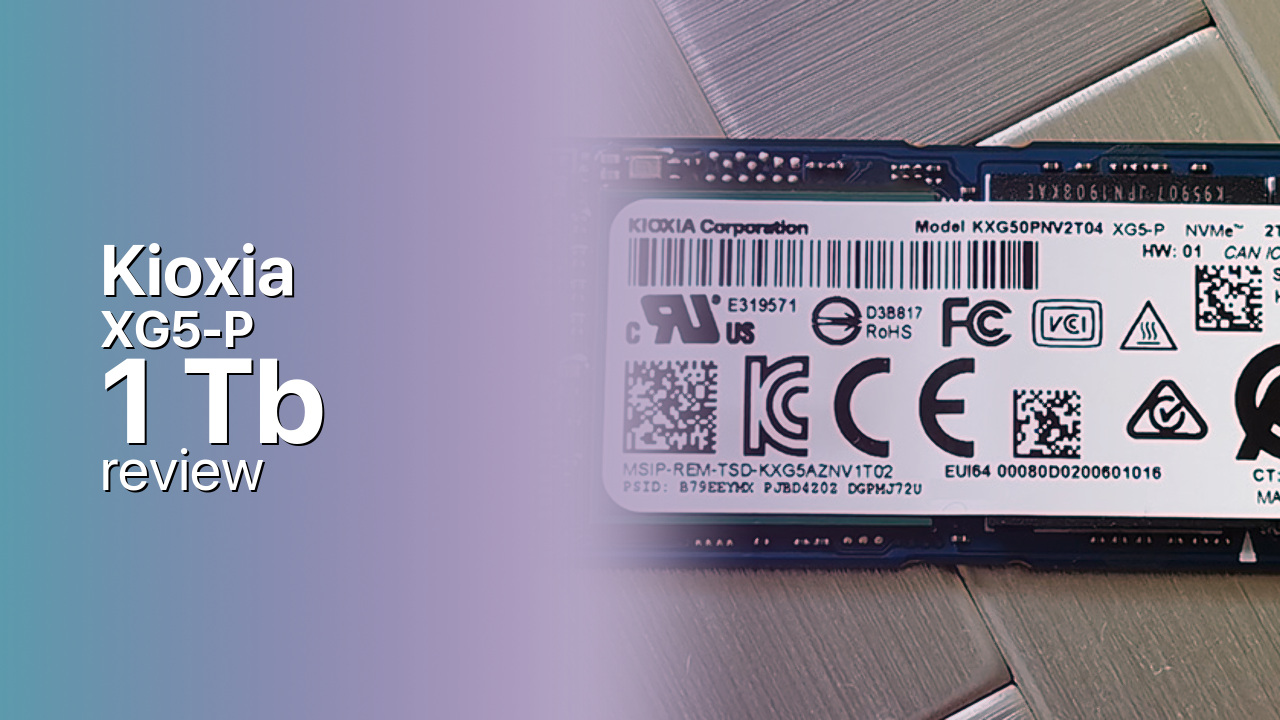
The XG5-P was Toshiba's performance-tier OEM SSD, sitting above the standard XG5 in the product stack. It uses Toshiba's proprietary TC58NCP090GSD controller — a 4-channel, DRAM-based design built in-house rather than sourced from Phison or Silicon Motion. This controller is paired with Toshiba's BiCS3 64-layer 3D TLC NAND, the company's first generation of vertically-stacked flash. A DDR3 DRAM chip (typically 512 MB or 1 GB, depending on capacity) caches the flash translation layer mapping table for consistent random I/O latency.
The drive is a single-sided M.2 2280 card, measuring just 2.23 mm thick — slim enough for the tightest ultrabook M.2 slots. It speaks the NVMe 1.2.1 protocol over a PCIe 3.0 x4 link. As an OEM product, the XG5-P was never sold at retail; it shipped pre-installed in laptops and desktops from Dell, HP, Lenovo, and other major system builders. In 2026, units are commonly found on the secondary market as pulls from decommissioned corporate machines.
The Kioxia/Toshiba branding can cause confusion: drives manufactured before October 2019 carry Toshiba labeling, while later production bears the Kioxia name. The underlying hardware is identical. The 1TB model provides ample capacity for a primary boot drive with room for applications and a moderate media library. Toshiba's in-house controller and NAND pairing gives the XG5-P a level of vertical integration that few competing OEM SSDs can match.
Storage Comparisons:
XG5-P Performance & Benchmarks
Sequential performance tops out at 3,000 MB/s read and 2,200 MB/s write — within a few percent of the PCIe 3.0 x4 practical ceiling. Real-world large-file copies on a modern platform land around 2,800–2,900 MB/s read and 1,900–2,000 MB/s write. For a drive designed in 2017, these numbers hold up remarkably well: they are roughly 5–6x faster than any SATA SSD and entirely adequate for a responsive Windows 11 or Linux daily driver in 2026.
Kioxia XG5-P 1 TB vs M.2 3.0 x 4 peers
Switch between sequential throughput and random IOPS to see how this drive stacks up against other M.2 3.0 x 4 SSDs in our database. The highlighted bar is the drive on this page — click any other bar to open that drive.
- ADATA SX 8800 Pro 512 GB: 3,500 MB/s read, 2,700 MB/s write
- ADATA SX 8800 Pro 1 TB: 3,500 MB/s read, 2,700 MB/s write
- ADATA XPG Spectrix S40G RGB 256 GB: 3,500 MB/s read, 3,000 MB/s write
- ADATA XPG Spectrix S40G RGB 512 GB: 3,500 MB/s read, 3,000 MB/s write
- Kioxia XG5-P 1 TB (this drive): 3,000 MB/s read, 2,200 MB/s write
Random performance is rated at up to 320,000 IOPS read and 265,000 IOPS write at the series level. The 1TB model, with more NAND dies for parallel operations, sits at the high end of this range. In real-world use, the DRAM buffer keeps random I/O latency consistent under mixed workloads — an advantage over DRAM-less designs that can stutter under heavy multitasking. PCMark 10 storage scores place the XG5-P in the upper half of PCIe 3.0 drives, trading blows with the Samsung PM981 and WD Black SN700 (2018) of the same era.
The SLC write cache on the 1TB model is dynamic, typically allocating 20–30 GB of SLC-configured NAND before writes spill to native TLC at roughly 600–800 MB/s. For everyday use, the cache is sufficient; only sustained writes exceeding 30 GB in a single burst will encounter the post-cache speed. Power consumption peaks at approximately 5.5 W under load and idles under 50 mW with NVMe power states enabled — excellent for a DRAM-equipped Gen3 drive. Thermal performance is well-managed by the integrated thermal throttle, with temperatures rarely exceeding 70°C in a typical laptop installation.
Kioxia XG5-P vs Competitors
See how the XG5-P stacks up against other M.2 3.0 x 4 drives in our database:
Compare with rival drives:
Endurance, TBW & Warranty
As an OEM product, the XG5-P carries no direct end-user warranty from Kioxia. Warranty coverage is provided through the system manufacturer (Dell, HP, Lenovo, etc.) that originally shipped the drive. Drives purchased on the secondary market as pulls or open-box units should be treated as warranty-free. Always confirm return policies with the seller before purchasing an OEM SSD.
Kioxia XG5-P 1 TB Specifications
| Category | Value |
|---|---|
| Capacity [?] | 1 TB |
| Interface [?] | M.2 3.0 x 4 |
| Controller [?] | Toshiba TC58NCP090GSD |
| Memory type [?] | Toshiba 64L BiCS3 TLC |
| DRAM [?] | DDR3 RAM |
| Read speed (MB/s) [?] | 3000 |
| Write speed (MB/s) [?] | 2200 |
| Read IOPS [?] | 320000 |
| Write IOPS [?] | 265000 |
| Endurance (TBW) [?] | 747 |
| MTBF (million hours) [?] | 1.5 |
| Warranty (years) [?] | 3 |
Verdict: Is the XG5-P Worth It in 2026?
The Kioxia XG5-P 1TB is a well-engineered PCIe 3.0 OEM SSD that has aged gracefully. Toshiba's in-house controller and BiCS3 64L TLC deliver solid Gen3 performance with DRAM-backed consistency that budget DRAM-less drives cannot match. At its current secondary-market pricing, the XG5-P represents a compelling value for breathing new life into an older laptop or desktop that only supports PCIe 3.0. The main caveats are the lack of end-user warranty and the gamble inherent in buying a used drive of unknown provenance. If you can find one with low hours and a reasonable return window, it is a dependable, efficient 1TB NVMe drive that still gets the job done.
+ Pros
- Toshiba in-house controller and NAND — vertically integrated design
- DDR3 DRAM buffer for consistent random I/O latency
- 3,000 MB/s reads — near the PCIe 3.0 x4 ceiling
- Single-sided 2.23 mm M.2 2280 — fits any ultrabook slot
- Excellent idle power consumption with NVMe power states
- Cons
- OEM product — no direct end-user warranty from Kioxia
- PCIe 3.0 — half the bandwidth of entry-level Gen4 drives
- Unknown usage history when buying on secondary market
- SLC cache is modest (~20-30 GB) by modern standards
- Limited firmware update availability for end users
Buy this or similar SSD Storage:



Video Review
SSD KIOXIA XG6 512GB KXG60ZNV512GCJYLGA