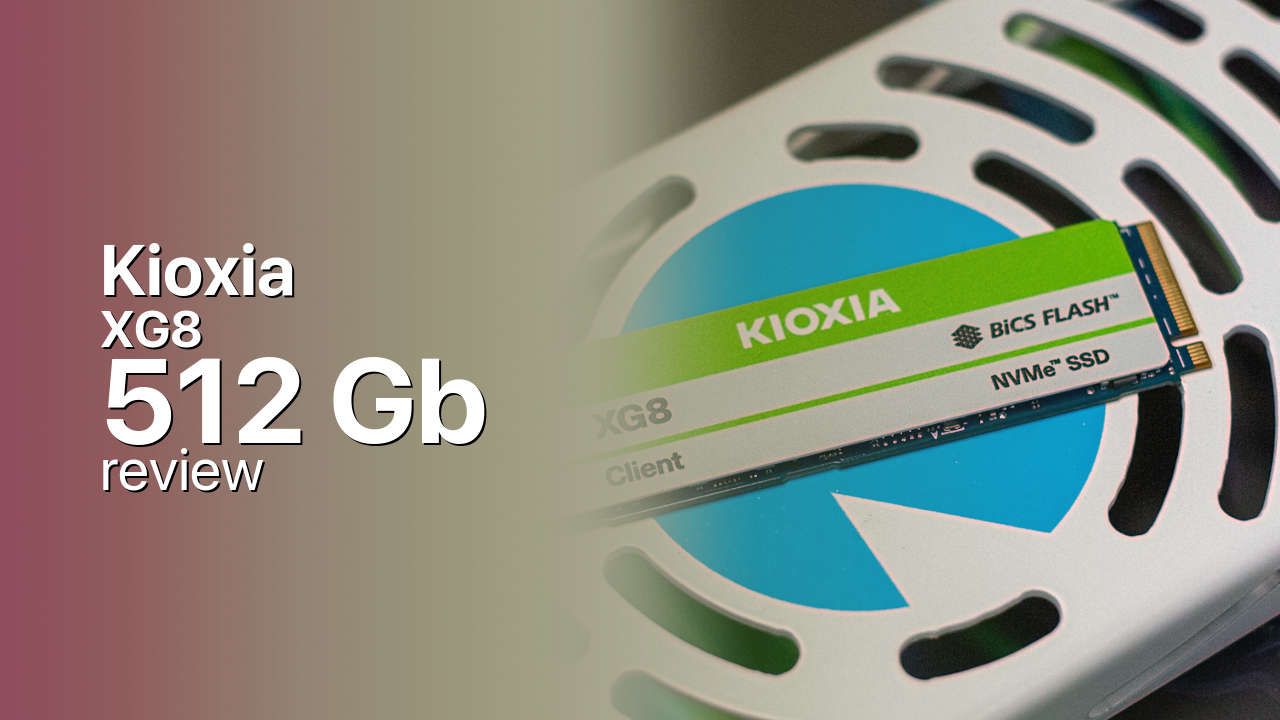
Kioxia XG8 512GB Review — Fast OEM PCIe 4.0 NVMe SSD (2026)
Quick answer
The Kioxia XG8 512GB is a fast and power-efficient OEM PCIe 4.0 SSD that showcases Kioxia's vertical integration — proprietary controller, in-house BiCS5 TLC NAND, and LPDDR4 caching all designed under one roof.
Read: 7000 MB/s Write: 5000 MB/s Endurance: 300 TBW Warranty: 5 years Interface: M.2 4.0 x 4
The Kioxia XG8 512GB is a high-performance OEM PCIe Gen4 NVMe SSD featuring Kioxia proprietary controller and 112-layer BiCS5 TLC NAND for 7000 MB/s sequential reads.
Controller & Memory
Kioxia — the company formerly known as Toshiba Memory and the original inventor of flash memory — designs and manufactures its own SSD controllers alongside its NAND flash, making it one of the few vertically integrated storage companies in the world. The XG8 is the company's PCIe 4.0 client SSD, aimed at OEM integration in laptops and pre-built desktops rather than retail sale. The 512 GB model uses Kioxia's own TC58NC0L1XGSD controller paired with 112-layer fifth-generation BiCS FLASH 3D TLC NAND and an LPDDR4 DRAM cache buffer.
The controller is a Kioxia in-house design, which gives the company full control over firmware optimization, error correction algorithms, and power management — advantages that third-party controller users cannot match. The BiCS5 112-layer TLC NAND is Kioxia's fifth-generation 3D flash, offering improved bit density and power efficiency over the 96-layer BiCS4 that preceded it. Rated sequential reads of 7,000 MB/s place the XG8 at the PCIe 4.0 ceiling, matching drives based on the Phison E18. The 512 GB model writes at 5,000 MB/s — lower than the 1 TB variant's 5,800 MB/s, as is typical when smaller capacities have fewer NAND dies for parallel writes.
Random 4K performance reaches 750,000 read IOPS and 600,000 write IOPS on the 512 GB model, which is strong for a client SSD. The LPDDR4 DRAM cache is a power-conscious choice appropriate for laptop integration — LPDDR4 draws less power than standard DDR4 at the cost of slightly lower bandwidth, but for SSD address translation the difference is negligible.
As an OEM drive, the XG8 is not typically sold through retail channels. It ships pre-installed in laptops from manufacturers like Dell, HP, and Lenovo, or is available through system integrators. This means warranty support flows through the system manufacturer rather than Kioxia directly, and retail packaging, heatsinks, and bundled software are not part of the product. Endurance and TBW figures are not consistently published by Kioxia for the XG8 in its public documentation.
Storage Comparisons:
XG8 Performance & Benchmarks
Sequential read performance hits 7,000 MB/s — the full PCIe 4.0 x4 ceiling — while the 512 GB model writes at 5,000 MB/s. The asymmetry between read and write speeds is normal for client SSDs, where read-heavy workloads (OS boot, application loading, game launching) matter more than sustained writes. The Kioxia in-house controller's firmware is tuned for the BiCS5 NAND it manages, giving it an optimization advantage over drives that pair third-party controllers with sourced NAND.
Kioxia XG8 512 GB vs M.2 4.0 x 4 peers
Switch between sequential throughput and random IOPS to see how this drive stacks up against other M.2 4.0 x 4 SSDs in our database. The highlighted bar is the drive on this page — click any other bar to open that drive.
- Patriot Viper PV593 1 TB: 14,500 MB/s read, 14,000 MB/s write
- Patriot Viper PV593 2 TB: 14,500 MB/s read, 14,000 MB/s write
- Patriot Viper PV593 4 TB: 14,500 MB/s read, 14,000 MB/s write
- Patriot Viper PV573 2 TB: 14,000 MB/s read, 12,000 MB/s write
- Kioxia XG8 512 GB (this drive): 7,000 MB/s read, 5,000 MB/s write
Random 4K performance of 750K read IOPS and 600K write IOPS ensures that everyday desktop tasks — file indexing, background application responsiveness, and multitasking — feel smooth and instantaneous. The LPDDR4 DRAM cache keeps the flash translation layer efficient, particularly important as the drive fills over its lifetime. Thermals on the XG8 are typical for a client SSD: it runs cooler than enthusiast drives like the E18-based offerings because the controller is designed for power-efficient laptop deployment rather than maximum sustained throughput. In a desktop build, a basic M.2 thermal plate is sufficient.
Kioxia XG8 vs Competitors
See how the XG8 stacks up against other M.2 4.0 x 4 drives in our database:
Compare with rival drives:
Endurance, TBW & Warranty
The Kioxia XG8 is an OEM drive, meaning warranty coverage is provided through the system manufacturer (Dell, HP, Lenovo, etc.) rather than Kioxia directly. Kioxia has not published detailed warranty terms or MTBF figures for the XG8 in its public documentation. Endurance ratings are stated as ranging from 300 to 2,400 TBW across the XG8 family, with the 512 GB model likely at the lower end of that range — approximately 300 TBW based on comparable 512 GB TLC drives. For typical laptop and desktop consumer use, this endurance level is more than adequate for the expected service life of the system. OEM drives like the XG8 are designed for the lifespan of the host system rather than long-term retail support.
Kioxia XG8 512 GB Specifications
| Category | Value |
|---|---|
| Capacity [?] | 512 GB |
| Interface [?] | M.2 4.0 x 4 |
| Controller [?] | Kioxia TC58NC0L1XGSD |
| Memory type [?] | Kioxia BICS5 TLC |
| DRAM [?] | LPDDR4 |
| Read speed (MB/s) [?] | 7000 |
| Write speed (MB/s) [?] | 5000 |
| Read IOPS [?] | 900000 |
| Write IOPS [?] | 620000 |
| Endurance (TBW) [?] | 300 |
| MTBF (million hours) [?] | 2000000 |
| Warranty (years) [?] | 5 |
Verdict: Is the XG8 Worth It in 2026?
The Kioxia XG8 512GB is a fast and power-efficient OEM PCIe 4.0 SSD that showcases Kioxia's vertical integration — proprietary controller, in-house BiCS5 TLC NAND, and LPDDR4 caching all designed under one roof. The 7,000 MB/s read speed matches flagship retail drives, and the controller's power efficiency makes it well-suited for laptop deployment. The main limitation is its OEM nature: warranty flows through the system manufacturer, endurance figures are not well-publicised, and the drive is not sold with retail packaging or accessories. For users whose systems ship with the XG8 pre-installed, it is an excellent client SSD.
+ Pros
- 7,000 MB/s read saturates PCIe 4.0 x4 bandwidth
- Kioxia in-house controller with BiCS5 112L TLC NAND
- LPDDR4 DRAM cache for power-efficient laptop use
- 750K read and 600K write random IOPS
- Vertically integrated design from flash inventor
- Cooler running than enthusiast PCIe 4.0 drives
- Cons
- OEM-only — not available through retail channels
- Warranty flows through system manufacturer
- Endurance figures not well-publicised
- 5,000 MB/s write lower than 1 TB variant
Buy this or similar SSD Storage:



Video Review
Tech Actu HARDWARE PC ( Nvidia Fait machine arrière toute )