Lenovo SL7000 50E 512 GB PCIe 5.0 SSD Review (2026)
Quick answer
The Lenovo SL7000 50E 512 GB makes sense for one specific buyer: someone building a system with a free PCIe 5.0 M.2 slot who wants Gen5 sequential bandwidth without committing to a 1 TB or 2 TB drive.
Read: 12400 MB/s Write: 12400 MB/s Warranty: 3 years Interface: M.2 5.0
The Lenovo SL7000 50E 512 GB is an entry-tier PCIe 5.0 NVMe built on Phison's E26 platform, offering flagship-class 12,400 MB/s reads in the smallest capacity Lenovo ships.
Controller & Memory
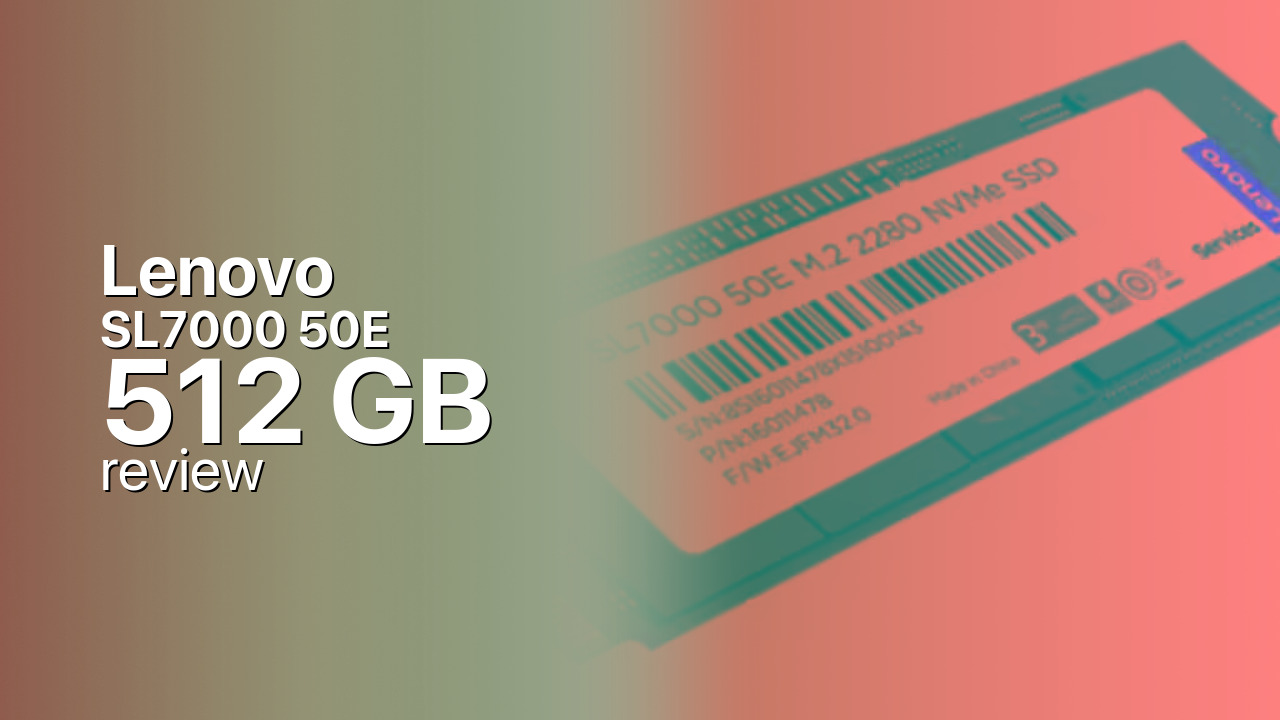
The Lenovo SL7000 50E 512 GB is the entry point of Lenovo's first consumer PCIe 5.0 lineup, and it is unusual simply for existing: most brands do not bother releasing a Gen5 drive below 1 TB. Lenovo does, and the SL7000 50E 512 GB uses the same Phison PS5026-E26 8-channel controller as the larger 1 TB, 2 TB and 4 TB siblings, paired with Micron 232-layer 3D TLC NAND running at 2,400 MT/s. It is a genuine third-party platform design rather than a bespoke Lenovo silicon, which means the hardware story is well understood even though Lenovo's own marketing is thin.
What sets the 512 GB apart from the rest of the family is capacity-specific economics. On a Phison E26 reference design the 512 GB variant typically has fewer NAND die packages, a smaller DRAM cache, lower write endurance, and often a lower sequential write rating than the flagship 2 TB or 4 TB. Lenovo advertises up to 12,400 MB/s sequential read and 12,400 MB/s sequential write across the marketing material, but the company has not published a per-capacity spec sheet, has not disclosed random IOPS figures, and has not published a TBW rating for the 512 GB. Buyers should treat the 12,400 MB/s read number as realistic for the platform but treat the symmetric 12,400 MB/s write claim with skepticism until an independent test surfaces for the 512 GB specifically.
The drive ships in a standard M.2 2280 single-sided form factor with no included heatsink. That is fine for most modern desktop motherboards, which now ship M.2 slots with their own thermal pads, but it means PS5 owners and compact ITX builders need to budget for a separate Gen5 heatsink. The SL7000 50E competes with other entry PCIe 5.0 E26 drives like the Crucial T700, the Teamgroup Cardea Z540 and the MSI Spatium M570. At 512 GB specifically, where most rivals do not even offer a part, it is one of the very few Gen5 options for buyers who want PCIe 5.0 bandwidth without paying for a 1 TB or 2 TB drive.
Storage Comparisons:
SL7000 50E Performance & Benchmarks
Lenovo rates the SL7000 50E at up to 12,400 MB/s sequential read and 12,400 MB/s sequential write, which is the standard Phison E26 + Micron 232L TLC ceiling also seen on the Crucial T700 and Teamgroup Cardea Z540. That number is quoted for the lineup as a whole; Lenovo has not disclosed a capacity-specific write rating for the 512 GB variant, and 512 GB E26 drives from other vendors frequently ship with a lower sequential write figure than their 2 TB siblings because of fewer parallel NAND die. Treat the symmetric 12,400 MB/s read and write claim as a best-case figure for the platform, not a guaranteed number on this capacity.
Lenovo SL7000 50E 512 GB vs M.2 5.0 peers
Switch between sequential throughput and random IOPS to see how this drive stacks up against other M.2 5.0 SSDs in our database. The highlighted bar is the drive on this page — click any other bar to open that drive.
- Corsair MP700 Pro XT 1 TB: 14,900 MB/s read, 14,200 MB/s write
- Corsair MP700 Pro XT 2 TB: 14,900 MB/s read, 14,500 MB/s write
- Corsair MP700 Pro XT 4 TB: 14,900 MB/s read, 14,400 MB/s write
- Crucial T710 1 TB: 14,900 MB/s read, 13,800 MB/s write
- Lenovo SL7000 50E 512 GB (this drive): 12,400 MB/s read, 12,400 MB/s write
Lenovo has not published random read or random write IOPS figures for the SL7000 50E at all. The Phison E26 reference platform typically lands around 1.0 to 1.5 million random read IOPS on the larger capacities, but those figures cannot be assumed for the 512 GB without independent testing. In real-world terms the headline benefit of PCIe 5.0 over PCIe 4.0 is large-file transfer throughput and DirectStorage-enabled game asset streaming, not perceptible game load time differences. For a 512 GB boot and game drive the SL7000 50E will feel identical to a fast PCIe 4.0 drive in everyday desktop use; the Gen5 advantage only materialises when shuffling tens of gigabytes of video, virtual machine images, or game libraries larger than the drive can actually hold. Independent benchmarks of the 512 GB capacity are scarce, so buyers should not assume review numbers from the 1 TB or 2 TB model carry over to this variant.
Lenovo SL7000 50E vs Competitors
See how the SL7000 50E stacks up against other M.2 5.0 drives in our database:
Compare with rival drives:
Endurance, TBW & Warranty
Lenovo backs the SL7000 50E with a three-year limited warranty across all capacities, including this 512 GB variant. That is shorter than the five-year coverage offered on most competing PCIe 5.0 drives like the Crucial T700, WD Black SN850X and Samsung 990 Pro, and it is the most meaningful trade-off on this drive versus the rest of the Gen5 market. The warranty is limited by either the three-year term or the drive's endurance rating, whichever comes first, which is standard for consumer NVMe. Lenovo has not published a TBW (terabytes written) endurance rating for the 512 GB SL7000 50E, so the exact write-coverage limit cannot be stated with confidence. As a rough rule of thumb, a 512 GB Phison E26 drive using Micron 232-layer TLC typically lands in the 300 to 450 TBW range, but that is a platform estimate rather than a Lenovo-confirmed number. For a typical mixed-use desktop workload of 20 to 40 GB of writes per day, even 300 TBW represents decades of headroom, so endurance is unlikely to be the binding constraint inside the three-year warranty window.
Lenovo SL7000 50E 512 GB Specifications
| Category | Value |
|---|---|
| Capacity [?] | 512 GB |
| Interface [?] | M.2 5.0 |
| Controller [?] | Phison PS5026-E26 8 Channel |
| Memory type [?] | Micron 232-L TLC |
| DRAM [?] | Yes |
| Read speed (MB/s) [?] | 12400 |
| Write speed (MB/s) [?] | 12400 |
| Read IOPS [?] | n/a |
| Write IOPS [?] | n/a |
| Endurance (TBW) [?] | |
| MTBF (million hours) [?] | 2000000 |
| Warranty (years) [?] | 3 |
Verdict: Is the SL7000 50E Worth It in 2026?
The Lenovo SL7000 50E 512 GB makes sense for one specific buyer: someone building a system with a free PCIe 5.0 M.2 slot who wants Gen5 sequential bandwidth without committing to a 1 TB or 2 TB drive. As one of the only Gen5 options at the 512 GB capacity, it earns its niche purely by existing. Everyone else should skip it. The three-year warranty is shorter than the five-year coverage on competing Gen5 drives, Lenovo has not published TBW or IOPS numbers, and the 512 GB capacity is too small to make meaningful use of PCIe 5.0 bandwidth for the large-file workflows where Gen5 actually wins. Buyers who can stretch to 1 TB should look at the Crucial T700 or the MSI Spatium M570, both of which offer longer warranties and published endurance ratings on the same Phison E26 platform.
+ Pros
- Genuine Phison E26 PCIe 5.0 platform
- 12,400 MB/s sequential read rating
- Micron 232-layer 3D TLC NAND
- M.2 2280 single-sided PCB fits most slots
- Rare 512 GB option in the Gen5 segment
- DDR4 DRAM cache onboard
- Cons
- Only a 3-year warranty, not 5
- Lenovo has not published 512 GB TBW
- Random IOPS figures not disclosed
- No heatsink included
- Symmetric write speed claim unverified at 512 GB
- 512 GB is small for Gen5 bandwidth
Buy this or similar SSD Storage:
Video Review
Best SSDs for PC & Playstation 5