Fanxiang S770 2TB Review — Full-Speed PCIe 4.0 NVMe with DRAM (2026)
Quick answer
Buy the Fanxiang S770 2 TB if you want the most performance per dollar in a PCIe 4.0 drive and you are comfortable treating it as a fast-but-disposable component — a game library drive, a scratch disk, or bulk storage where nothing on it is irreplaceable.
Read: 7300 MB/s Write: 6800 MB/s Endurance: 1400 TBW Warranty: 5 years Interface: M.2 4.0 x 4
The 2 TB Fanxiang S770 is the sweet spot of the lineup — it gets the full 6,800 MB/s write speed, double the DRAM, and the best endurance rating, but the same quality-control caveats follow it up the stack.
Controller & Memory
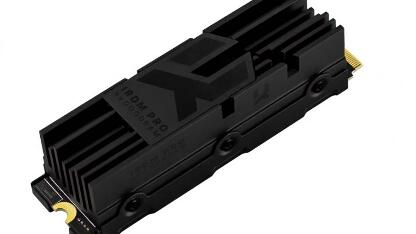
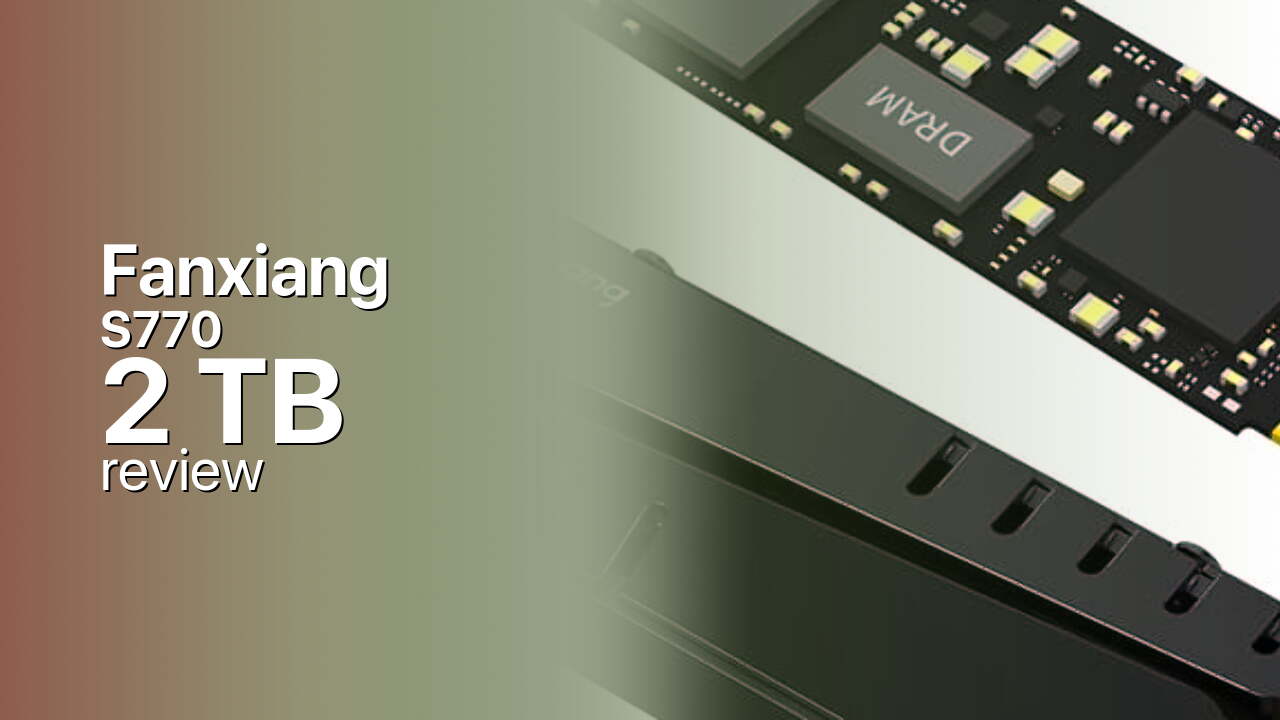
Inside the S770 2 TB, the InnoGrit IG5236 (Rainier) controller is paired with 2 GB of DDR4 DRAM and YMTC 128-layer TLC NAND built on the Xtacking 2.0 process. The controller is a quad-core ARM Cortex-R5 design fabbed on TSMC's 12 nm node, and it has shown itself to be a capable performer across several enthusiast drives. The PCB is double-sided, which is worth noting for laptop and PS5 users, though Fanxiang includes a heatsink, thermal pads, a screwdriver, and an M.2 screw in the retail box.
This 2 TB model is the strongest configuration in the S770 family. The 1 TB variant drops to 5,400 MB/s writes, and the 4 TB model — while capacious — has even less reviewer coverage and a higher likelihood of component substitutions based on user reports. At 2 TB you get the full 7,300 MB/s read and 6,800 MB/s write ratings, plus 1,400 TBW of endurance, which makes it the best value-per-gigabyte option in the stack.
It competes directly with drives like the Silicon Power US75, Team Group MP44L, and Lexar NM790 — all PCIe 4.0 drives in the mid-range tier with DRAM caches. The S770's advantage is aggressive pricing. The disadvantage, as with the entire Fanxiang lineup, is inconsistent component sourcing: TechPowerUp notes multiple unannounced hardware revisions with different NAND vendors, which means your unit may not match the one in any given review.
Storage Comparisons:
S770 Performance & Benchmarks
Rated sequential throughput is 7,300 MB/s reads and 6,800 MB/s writes over PCIe 4.0 x4, with random IOPS in the range of 860,000 reads and 675,000 writes. Those figures place the S770 2 TB among the faster PCIe 4.0 drives on the market, competitive with first-wave flagships that cost significantly more at launch. The 2 GB DRAM buffer gives the IG5236 controller room to handle larger mapping tables without hammering the NAND, which helps random I/O consistency under mixed workloads.
Fanxiang S770 2 TB vs M.2 4.0 x 4 peers
Switch between sequential throughput and random IOPS to see how this drive stacks up against other M.2 4.0 x 4 SSDs in our database. The highlighted bar is the drive on this page — click any other bar to open that drive.
- Patriot Viper PV593 1 TB: 14,500 MB/s read, 14,000 MB/s write
- Patriot Viper PV593 2 TB: 14,500 MB/s read, 14,000 MB/s write
- Patriot Viper PV593 4 TB: 14,500 MB/s read, 14,000 MB/s write
- Patriot Viper PV573 2 TB: 14,000 MB/s read, 12,000 MB/s write
- Fanxiang S770 2 TB (this drive): 7,300 MB/s read, 6,800 MB/s write
The drive uses a dynamic pseudo-SLC write cache to reach its rated speeds. Independent testing on the 1 TB variant showed a cache of roughly 340 GB; the 2 TB model should offer a proportionally larger cache, likely in the 600–700 GB range. Once the cache fills, writes fall back to native TLC speed, which is a fraction of the peak rating. For gaming, OS boot, and general productivity this is a non-issue — the cache recovers quickly and the vast majority of consumer transfers land well inside the cache window. Only buyers moving multiple hundreds of gigabytes in a single session will notice the post-cache drop.
Fanxiang S770 vs Competitors
See how the S770 stacks up against other M.2 4.0 x 4 drives in our database:
Compare with rival drives:
Endurance, TBW & Warranty
Fanxiang covers the S770 2 TB with a 5-year warranty limited by 1,400 TBW of endurance. At a heavy consumer write rate of 50 GB per day, that endurance budget stretches to roughly 77 years — the warranty clock will run out decades before the NAND wears out under normal use. The 2 million hour MTBF rating is present but, as with all SSD MTBF figures, it describes failure rates across a large population of drives rather than predicting any individual unit's lifespan. The real warranty question is whether Fanxiang will actually honour a claim: multiple user reports across Amazon and forums describe support tickets going unanswered, with buyers ultimately relying on retailer return windows rather than manufacturer RMA.
Fanxiang S770 2 TB Specifications
| Category | Value |
|---|---|
| Capacity [?] | 2 TB |
| Interface [?] | M.2 4.0 x 4 |
| Controller [?] | Innogrit IG5236 |
| Memory type [?] | YMTC 128-l TLC |
| DRAM [?] | Yes |
| Read speed (MB/s) [?] | 7300 |
| Write speed (MB/s) [?] | 6800 |
| Read IOPS [?] | 860000 |
| Write IOPS [?] | 675000 |
| Endurance (TBW) [?] | 1400 |
| MTBF (million hours) [?] | 2000000 |
| Warranty (years) [?] | 5 |
Verdict: Is the S770 Worth It in 2026?
Buy the Fanxiang S770 2 TB if you want the most performance per dollar in a PCIe 4.0 drive and you are comfortable treating it as a fast-but-disposable component — a game library drive, a scratch disk, or bulk storage where nothing on it is irreplaceable. It is not the right drive for your only boot drive with no backup strategy, and it is a poor fit if you expect a smooth warranty experience. The Silicon Power US75 or Lexar NM790 at 2 TB cost slightly more but come from companies with functioning support departments, and for most buyers that premium is worth paying.
+ Pros
- 7,300 MB/s reads and 6,800 MB/s writes — full-speed PCIe 4.0
- 2 GB DDR4 DRAM cache for consistent random I/O
- 1,400 TBW endurance rating on the 2 TB model
- Includes heatsink, thermal pads, screwdriver, and M.2 screw
- Strong value at current street pricing
- Cons
- Unannounced NAND and controller swaps between production batches
- Customer support repeatedly reported as unresponsive for warranty claims
- Double-sided PCB limits compatibility with some laptops and the PS5
- YMTC 128L NAND linked to data corruption in user forum reports
Buy this or similar SSD Storage:



Video Review
Fanxiang m.2 SSD - Worth it?