Lexar NM1090 Pro 4TB PCIe 5.0 NVMe SSD Review (2026)
Quick answer
The Lexar NM1090 Pro 4 TB is the top of the brand's PCIe 5.0 line, pairing the proven Silicon Motion SM2508 plus Micron 232-layer TLC platform with maximum 4 TB capacity, the full headline 14,000 MB/s read speed, around 2.1 million random read IOPS, a 2,800 TBW rating and a five-year warranty at a competitive price.
Read: 14000 MB/s Write: 12000 MB/s Endurance: 2800 TBW Warranty: 5 years Interface: M.2 5.0
The Lexar NM1090 Pro 4TB tops Lexar's PCIe 5.0 flagship line, pairing a Silicon Motion SM2508 controller with Micron 232-layer TLC for 14,000 MB/s reads and maximum capacity.
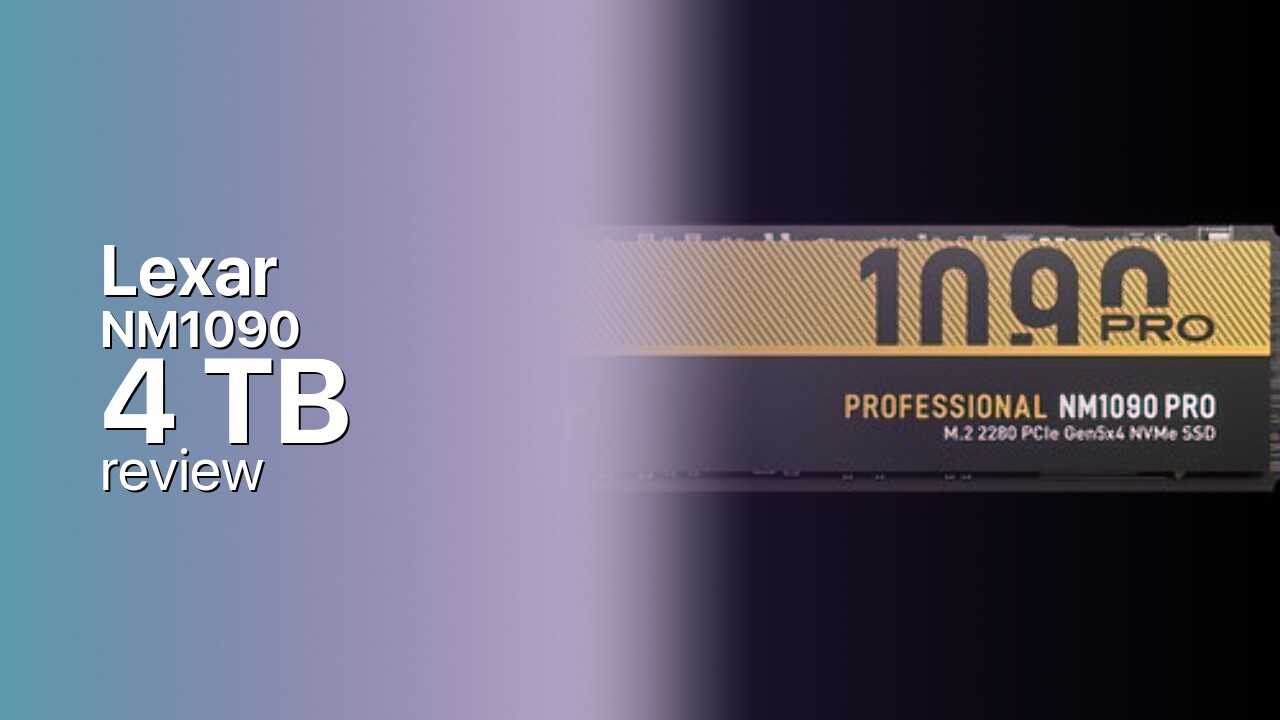
Controller & Memory
The Lexar NM1090 Pro is the brand's PCIe 5.0 flagship, and reviewers have singled it out as one of the more affordable ways onto the Gen5 platform without giving up the modern controller and NAND. The 4 TB model reviewed here is the largest widely available capacity of the range, and it pairs a Silicon Motion SM2508 8-channel controller with Micron 232-layer 3D TLC NAND and a DRAM cache. That is the same SM2508 plus Micron TLC recipe used by several well-regarded 2025 Gen5 drives, which makes the hardware story well understood even where Lexar's own marketing is thin.
The 4 TB gets the family's full headline sequential read speed and pairs it with maximum capacity. Lexar rates it at up to 14,000 MB/s sequential read and 12,000 MB/s sequential write, with around 2.1 million random read and 1.7 million random write IOPS, along with a 2,800 TBW endurance rating, a DRAM cache and a five-year warranty. The 4 TB's sequential write is slightly lower than the 2 TB's 13,000 MB/s, a common trait when a very large capacity has a different NAND package layout, but it still reaches the flagship read figure and carries the lineup's highest endurance. It is aimed at enthusiasts and content creators who want both top-tier throughput and a large capacity in a single M.2 slot.
The drive ships in a standard M.2 2280 form factor, with a heatsink or heatsink-plus-fan option on some SKUs. As a value-leaning Gen5 part it competes with other SM2508 and E26 flagships such as the Crucial T705, the Kioxia Exceria Pro G2 and the Netac NV150HK, all sharing broadly comparable hardware. For buyers who need maximum fast storage on the proven SM2508 platform, the NM1090 Pro 4 TB is the top of the line, with the usual note that most buyers are well served by the cheaper 2 TB sweet spot.
Storage Comparisons:
NM1090 Performance & Benchmarks
Lexar rates the NM1090 Pro 4 TB at up to 14,000 MB/s sequential read and 12,000 MB/s sequential write, with around 2,100,000 random read and 1,700,000 random write IOPS. Those are flagship PCIe 5.0 figures, with the 4 TB reaching the family's full headline read speed; its sequential write of 12,000 MB/s sits just under the 2 TB's 13,000 MB/s, a minor trade-off for the larger capacity. In day-to-day use that sequential headroom shows up when moving large files, game libraries, video projects or virtual machine images, and at 4 TB there is room to keep a large library of them on the fast tier. For ordinary booting and browsing the gap to a good PCIe 4.0 drive is smaller than the raw numbers suggest.
Lexar NM1090 4 TB vs M.2 5.0 peers
Switch between sequential throughput and random IOPS to see how this drive stacks up against other M.2 5.0 SSDs in our database. The highlighted bar is the drive on this page — click any other bar to open that drive.
- Corsair MP700 Pro XT 1 TB: 14,900 MB/s read, 14,200 MB/s write
- Corsair MP700 Pro XT 2 TB: 14,900 MB/s read, 14,500 MB/s write
- Corsair MP700 Pro XT 4 TB: 14,900 MB/s read, 14,400 MB/s write
- Crucial T710 1 TB: 14,900 MB/s read, 13,800 MB/s write
- Lexar NM1090 4 TB (this drive): 14,000 MB/s read, 12,000 MB/s write
Where Gen5 earns its keep is sustained throughput and high-queue-depth random performance, where the SM2508 controller and its roughly 2.1 million random read IOPS hold up well. The SM2508 is one of the more efficient PCIe 5.0 designs, which helps the NM1090 Pro hold its peak performance under sustained loads rather than throttling as aggressively as some early Gen5 parts. Independent reviewers confirm the NM1090 Pro reaches its advertised sequential figures and behaves as a solid, efficient flagship. For a 4 TB drive used for bulk fast storage plus a boot and game volume on a PCIe 5.0 platform, it delivers genuine flagship Gen5 performance with maximum capacity.
Lexar NM1090 vs Competitors
See how the NM1090 stacks up against other M.2 5.0 drives in our database:
Compare with rival drives:
Endurance, TBW & Warranty
Lexar backs the NM1090 Pro with a five-year limited warranty, and the 4 TB model carries a 2,800 TBW (terabytes written) endurance rating, the highest in the lineup. That matches other PCIe 5.0 flagships: 2,800 TBW works out to roughly 1,534 GB of writes every single day for five years, staggeringly more than a typical 20 to 50 GB daily consumer workload. At 50 GB of writes per day you would need around 153 years to exhaust the rated endurance, so the NAND will outlast the warranty term many times over and wear is simply not a concern, even on a 4 TB drive holding a large media library. The five-year term is the binding limit, and it matches the coverage on competing Gen5 drives. Lexar is an established brand with a global support and RMA network, which is reassuring on a 4 TB drive likely to accumulate a lot of data, so keep your proof of purchase and register the drive if prompted.
Lexar NM1090 4 TB Specifications
| Category | Value |
|---|---|
| Capacity [?] | 4 TB |
| Interface [?] | M.2 5.0 |
| Controller [?] | Silicon Motion SM2508 8 Channel |
| Memory type [?] | Micron 232-L TLC |
| DRAM [?] | Yes |
| Read speed (MB/s) [?] | 14000 |
| Write speed (MB/s) [?] | 12000 |
| Read IOPS [?] | 2100000 |
| Write IOPS [?] | 1700000 |
| Endurance (TBW) [?] | 2800 |
| MTBF (million hours) [?] | 1500000 |
| Warranty (years) [?] | 5 |
Verdict: Is the NM1090 Worth It in 2026?
The Lexar NM1090 Pro 4 TB is the top of the brand's PCIe 5.0 line, pairing the proven Silicon Motion SM2508 plus Micron 232-layer TLC platform with maximum 4 TB capacity, the full headline 14,000 MB/s read speed, around 2.1 million random read IOPS, a 2,800 TBW rating and a five-year warranty at a competitive price. Its strengths are flagship Gen5 performance and the largest capacity in the range in one drive. Its caveats are the usual Gen5 ones plus price: it needs a PCIe 5.0 platform to shine, it carries the lineup's highest cost, and most buyers are better served by the 2 TB sweet spot. Choose it if you need maximum fast storage plus top-tier throughput; skip it if your board only supports PCIe 4.0 or if 2 TB is enough.
+ Pros
- PCIe 5.0 Silicon Motion SM2508 platform
- Flagship 14,000 MB/s sequential read
- Maximum 4 TB capacity in a single M.2 slot
- Micron 232-layer 3D TLC with DRAM cache
- 2,800 TBW endurance rating
- 5-year warranty
- Cons
- Highest price in the NM1090 Pro lineup
- Needs a PCIe 5.0 platform to justify the speed
- Sequential write slightly lower than the 2 TB model
- No heatsink on the base SKU
Buy this or similar SSD Storage:
Video Review
Lexar NM1090 Pro 2TB | 6 Reasons NOT to Buy 🚫💾