Lite-On MU X1 512GB SSD — In-Depth Review & Specs (2026)
Quick answer
The Lite-On MU X1 512GB represents excellent value on the used market for buyers who understand the OEM trade-off: no warranty, no firmware updates, but a proven Phison E12 platform with DDR4 DRAM at a fraction of the cost of a retail equivalent.
Read: 3400 MB/s Write: 3000 MB/s Endurance: 1100 TBW Warranty: 3 years Interface: M.2 3.0 x 4
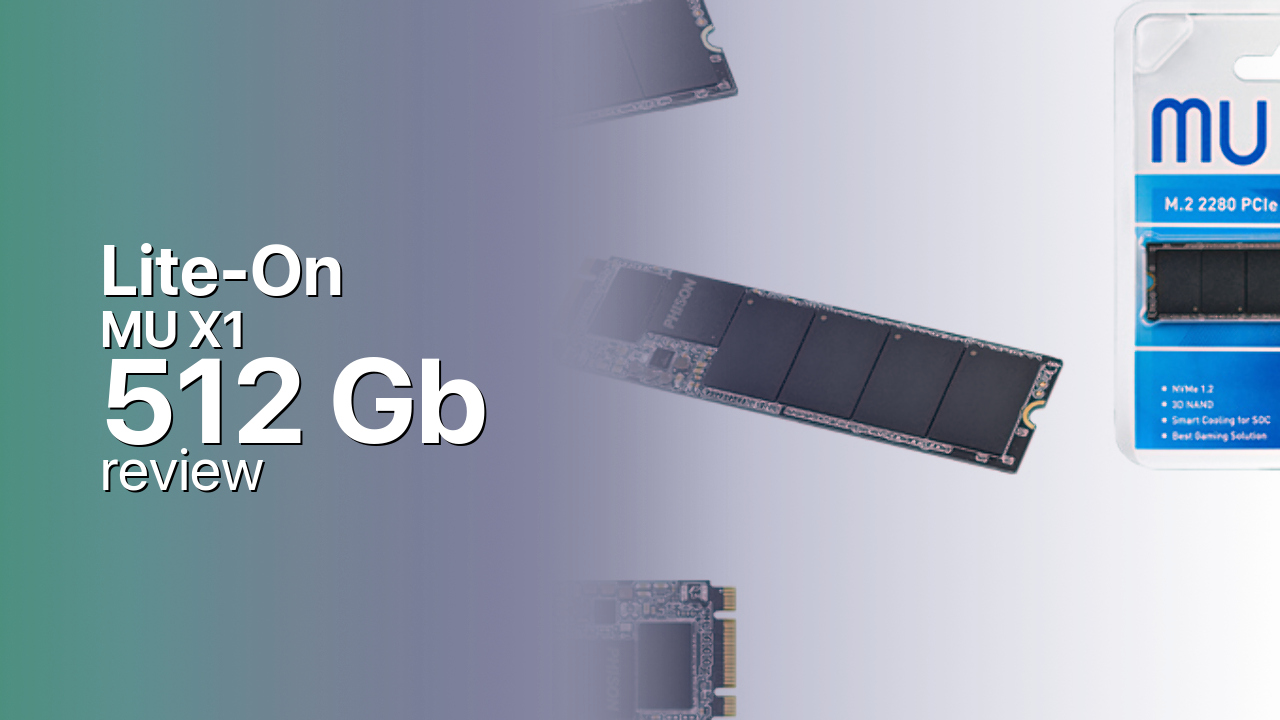
The Lite-On MU X1 512GB is the mid-capacity variant of Lite-On's Phison E12-based OEM NVMe SSD line. It uses the same PS5012-E12 8-channel controller with dedicated DDR4 DRAM as the 256GB model, but the larger capacity brings more NAND dies, a deeper SLC cache, and enough space to serve as a practical standalone system drive. Commonly found as pulls from decommissioned Dell, HP, and Lenovo systems, the MU X1 512GB is one of the more affordable ways to add DRAM-equipped NVMe storage to a PCIe 3.0 system.
Controller & Memory
The Phison PS5012-E12 is a mature PCIe 3.0 x4 controller with eight NAND channels and a dedicated DDR4 DRAM buffer. It was Phison's flagship Gen3 controller, competing head-to-head with the Silicon Motion SM2262EN before both were superseded by Gen4 designs. The E12 uses a 28nm fabrication process and supports NVMe 1.3. Lite-On pairs the controller with 3D TLC NAND and a 512 MB–1 GB DDR4 DRAM chip (typically Nanya or SK Hynix).
Lite-On is a Taiwanese OEM powerhouse — their SSDs ship inside laptops and desktops from virtually every major PC brand. The MU X1 has no retail presence, no direct end-user warranty from Lite-On, and no publicly distributed firmware updates. On the secondary market, these drives are priced as commodity pulls and represent strong value for budget builds and system upgrades.
At 512 GB, the MU X1 provides enough capacity for Windows or Linux, a full suite of applications, and a small-to-medium game library. The rated specs of 3,400/3,000 MB/s and 1,100 TBW endurance appear to be platform-level or higher-capacity ratings rather than 512GB-specific numbers. Real-world endurance for a 512GB E12 drive is typically in the 400–800 TBW range, and sequential writes may fall short of the 3,000 MB/s ceiling depending on the specific NAND configuration.
Storage Comparisons:
MU X1 Performance & Benchmarks
When fully populated across all eight NAND channels with enough dies, the Phison E12 can reach 3,400 MB/s read and 3,000 MB/s write. At 512 GB, real-world sequential performance typically lands around 3,000–3,400 MB/s read and 2,000–2,800 MB/s write depending on the NAND configuration and firmware. The DDR4 DRAM buffer ensures consistent random I/O latency, with typical 4K results in the 250,000–350,000 IOPS range — competitive with retail drives like the Sabrent Rocket (E12) and Silicon Power P34A80.
Lite-On MU X1 512 GB vs M.2 3.0 x 4 peers
Switch between sequential throughput and random IOPS to see how this drive stacks up against other M.2 3.0 x 4 SSDs in our database. The highlighted bar is the drive on this page — click any other bar to open that drive.
- ADATA SX 8800 Pro 512 GB: 3,500 MB/s read, 2,700 MB/s write
- ADATA SX 8800 Pro 1 TB: 3,500 MB/s read, 2,700 MB/s write
- ADATA XPG Spectrix S40G RGB 256 GB: 3,500 MB/s read, 3,000 MB/s write
- ADATA XPG Spectrix S40G RGB 512 GB: 3,500 MB/s read, 3,000 MB/s write
- Lite-On MU X1 512 GB (this drive): 3,400 MB/s read, 3,000 MB/s write
The SLC write cache on the 512GB model spans roughly 25–50 GB before writes drop to native TLC at 500–700 MB/s. For everyday OS and application workloads, this cache depth is adequate. The DRAM buffer gives the MU X1 a tangible advantage over DRAM-less alternatives when multitasking or running mixed read/write workloads — application launches remain snappy even when background tasks are writing to the drive. Thermal performance is moderate: the 28nm E12 controller reaches 65–72°C under sustained load without a heatsink. A basic motherboard M.2 heat spreader is recommended for desktop use. Power consumption peaks at roughly 5–6 W under load and idles under 100 mW.
Lite-On MU X1 vs Competitors
See how the MU X1 stacks up against other M.2 3.0 x 4 drives in our database:
Compare with rival drives:
Endurance, TBW & Warranty
The MU X1 is an OEM product with no direct end-user warranty from Lite-On. Original warranty coverage was through the system manufacturer. Secondary-market purchases are effectively warranty-free — confirm the seller's return policy before buying.
Lite-On MU X1 512 GB Specifications
| Category | Value |
|---|---|
| Capacity [?] | 512 GB |
| Interface [?] | M.2 3.0 x 4 |
| Controller [?] | Phison PS5012-E12 |
| Memory type [?] | Toshiba 3D TLC |
| DRAM [?] | DDR4 |
| Read speed (MB/s) [?] | 3400 |
| Write speed (MB/s) [?] | 3000 |
| Read IOPS [?] | 440000 |
| Write IOPS [?] | 380000 |
| Endurance (TBW) [?] | 1100 |
| MTBF (million hours) [?] | 1.5 |
| Warranty (years) [?] | 3 |
Verdict: Is the MU X1 Worth It in 2026?
The Lite-On MU X1 512GB represents excellent value on the used market for buyers who understand the OEM trade-off: no warranty, no firmware updates, but a proven Phison E12 platform with DDR4 DRAM at a fraction of the cost of a retail equivalent. The 512 GB capacity is practical for a standalone system drive, and the DRAM buffer provides responsiveness that budget DRAM-less NVMe drives cannot match. For breathing new life into an older PCIe 3.0 laptop or building an ultra-budget desktop, a low-hours MU X1 is one of the best performance-per-dollar options available — just check the S.M.A.R.T. data before buying.
+ Pros
- Phison E12 with DDR4 DRAM — consistent mixed-workload performance
- 512 GB — practical capacity for a standalone system drive
- Very low cost on the secondary market
- Single-sided M.2 2280 — universal compatibility
- Mature platform with stable, well-tested firmware
- Cons
- OEM product — no end-user warranty or firmware support
- Rated endurance (1,100 TBW) likely reflects platform max, not 512GB rating
- 28nm controller runs warm under sustained load
- Unknown usage history on secondary market
- Write speed may not reach rated 3,000 MB/s at this capacity
Buy this or similar SSD Storage:



Video Review
Lite-On MU X1 - najbardziej opłacalny dysk M.2 Nvme? Test + porównanie