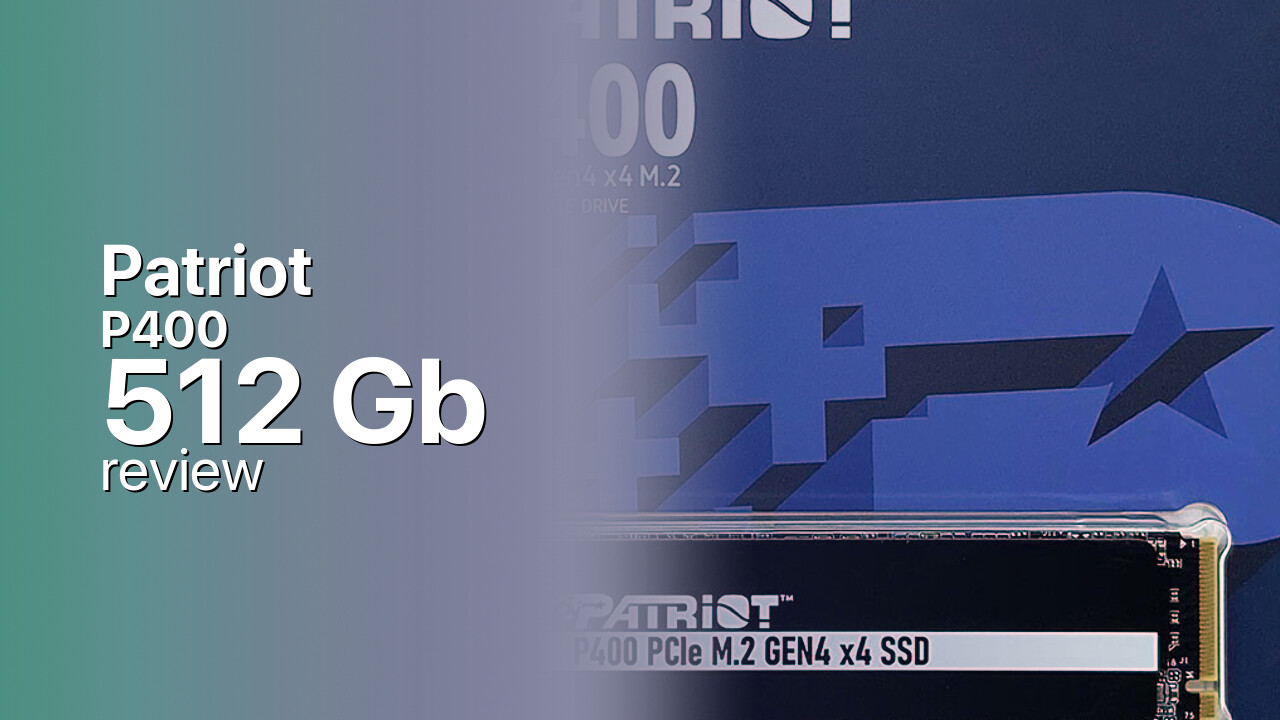
Patriot P400 512 GB: a budget PCIe 4.0 NVMe SSD (2026)
Quick answer
Buy the Patriot P400 512 GB as a budget boot or everyday drive for a PCIe 4.0 desktop or laptop where the goal is Gen4 read throughput and enough space for the OS plus a few apps, not benchmark records.
Read: 5000 MB/s Write: 3300 MB/s Endurance: 400 TBW Warranty: 3 years Interface: M.2 4.0 x 4
The Patriot P400 512 GB is a budget DRAM-less PCIe Gen4 NVMe drive built on the Innogrit IG5220 controller, delivering 5,000 MB/s reads at the entry capacity of the P400 line.
Controller & Memory
The Patriot P400 512 GB is the entry capacity of Patriot's value-tier PCIe 4.0 line, sitting below the RGB Viper VPR400 in the company's stack. Inside is a familiar budget-Gen4 recipe: Innogrit's IG5220 controller, a DRAM-less four-lane PCIe 4.0 design that leans on the host platform's memory through HMB (Host Memory Buffer) with no DRAM chip of its own, paired with Micron 3D TLC NAND. Patriot rates this 512 GB variant at 5,000 MB/s sequential reads and 3,300 MB/s writes, with random performance up to 620,000 read and 550,000 write IOPS. Those are mid-tier Gen4 numbers, above bottom-shelf DRAM-less parts like the Kingston NV2 but well under the 7,000 MB/s Phison E18 flagship ceiling.
The P400 family spans 512 GB, 1 TB and 2 TB, and as usual the write speed and endurance scale with capacity. This 512 GB model is the slowest writer at 3,300 MB/s against 4,800 MB/s on the 1 TB, and its endurance lands at 400 TBW versus 800 TBW on the 1 TB, holding a steady 800 TBW per terabyte across the line. The read speed stays at 5,000 MB/s on every capacity, so the 512 GB sacrifices write headroom and endurance, not read throughput. For a boot drive or light game library that trade is fine; for sustained large-file work the smaller NAND pool shows up as lower writes once the pseudo-SLC cache fills.
Compatibility is straightforward on the desktop side: any PCIe 4.0 or PCIe 5.0 M.2 slot runs the Patriot P400 512 GB at full speed, and it drops into a PCIe 3.0 slot at PCIe 3.0 rates. Most modern laptops accept it too, provided they take an M.2 2280 NVMe. The PS5 is a weaker fit, since Sony recommends a PCIe 4.0 NVMe with at least 5,500 MB/s reads and the P400's 5,000 MB/s falls short, while 512 GB is also tight for a modern console library. The P400 ships with only a thin graphene heatshield label rather than a real heatsink, so PS5 use or heavy sustained writes call for an add-on cooler. Direct rivals include the Kingston NV2 500 GB, which the P400 beats on both read and write speed, the WD Blue SN580 500 GB, and Patriot's own Viper VPR400 sibling on the same IG5220 silicon.
Storage Comparisons:
P400 Performance & Benchmarks
On the 512 GB P400, Patriot rates sequential reads at 5,000 MB/s and writes at 3,300 MB/s over a PCIe 4.0 x4 link, with random performance up to 620,000 read IOPS and 550,000 write IOPS. Those are solid mid-tier Gen4 figures, well clear of SATA and PCIe 3.0 drives, and they put the P400 ahead of bottom-shelf DRAM-less options like the Kingston NV2 on both read and write throughput.
Patriot P400 512 GB vs M.2 4.0 x 4 peers
Switch between sequential throughput and random IOPS to see how this drive stacks up against other M.2 4.0 x 4 SSDs in our database. The highlighted bar is the drive on this page — click any other bar to open that drive.
- Patriot Viper PV593 1 TB: 14,500 MB/s read, 14,000 MB/s write
- Patriot Viper PV593 2 TB: 14,500 MB/s read, 14,000 MB/s write
- Patriot Viper PV593 4 TB: 14,500 MB/s read, 14,000 MB/s write
- Patriot Viper PV573 2 TB: 14,000 MB/s read, 12,000 MB/s write
- Patriot P400 512 GB (this drive): 5,000 MB/s read, 3,300 MB/s write
The DRAM-less IG5220 design is the defining trade-off here. With no onboard DRAM, the controller maps the flash translation layer into a slice of host memory through HMB, which keeps cost, footprint and idle power down (Lanoc measured 0.38W idle) but costs some random-I/O latency versus a DRAM-equipped drive under heavy mixed workloads. For everyday desktop use, game loading and OS boot, the difference is barely perceptible, and the 5,000 MB/s read rate translates into snappy application launches and short level loads. Where DRAM-less designs show their hand is long sustained writing: once the pseudo-SLC cache fills, writes settle to the native TLC rate, and the 512 GB's smaller NAND pool means that cache empties and transitions sooner than on the 1 TB or 2 TB. Reviewers testing the closely related 1 TB P400 found it competitive within its tier rather than class-leading, and the 512 GB behaves the same with a modest write penalty for the capacity. For a boot or game drive the P400 delivers its rated reads in practice; for a video scratch disk, a DRAM-equipped Gen4 drive is the better call.
Patriot P400 vs Competitors
See how the P400 stacks up against other M.2 4.0 x 4 drives in our database:
Compare with rival drives:
Endurance, TBW & Warranty
Patriot backs the P400 512 GB with a three-year limited warranty, ending early if the 400 TBW endurance rating is exceeded, whichever comes first. That 400 TBW figure scales linearly from the 1 TB model's 800 TBW, both holding roughly 800 TBW per terabyte, and it is the lowest endurance in the P400 line simply because the 512 GB holds half the flash. At a typical consumer write workload of 20 GB per day, 400 TBW translates to roughly 55 years before the NAND is rated to wear out, so in practice the three-year term expires long before the flash does. Patriot also lists the drive at around 1.5 to 2 million hours MTBF depending on the spec sheet, but treat that as a population-reliability statistic: it describes expected failures across a large fleet of drives, not a guarantee that any single unit will run for that long. RMA is handled through Patriot directly or the retailer of purchase.
Patriot P400 512 GB Specifications
| Category | Value |
|---|---|
| Capacity [?] | 512 GB |
| Interface [?] | M.2 4.0 x 4 |
| Controller [?] | Innogrit Rainier IG5220 |
| Memory type [?] | Micron 3D TLC |
| DRAM [?] | HMB |
| Read speed (MB/s) [?] | 5000 |
| Write speed (MB/s) [?] | 3300 |
| Read IOPS [?] | 620000 |
| Write IOPS [?] | 550000 |
| Endurance (TBW) [?] | 400 |
| MTBF (million hours) [?] | 1500000 |
| Warranty (years) [?] | 3 |
Verdict: Is the P400 Worth It in 2026?
Buy the Patriot P400 512 GB as a budget boot or everyday drive for a PCIe 4.0 desktop or laptop where the goal is Gen4 read throughput and enough space for the OS plus a few apps, not benchmark records. Skip it for a PS5, since the 5,000 MB/s read rate is below Sony's 5,500 MB/s recommendation, there is no real heatsink in the box, and 512 GB is tight for a modern console library; skip it too for sustained write-heavy work, where the DRAM-less IG5220 and small SLC cache trail DRAM-equipped Gen4 drives. The closest alternative is the WD Blue SN580 500 GB, another DRAM-less Gen4 part, or Patriot's own Viper VPR400 if RGB lighting matters. We rate the P400 512 GB a competent, honest budget Gen4 drive that earns its place as a read-focused boot drive, provided the workload is reads and everyday apps rather than heavy sustained writes.
+ Pros
- 5,000 MB/s sequential reads on PCIe 4.0
- 400 TBW endurance, 3-year warranty
- Innogrit IG5220 with HMB keeps cost down
- Beats Kingston NV2 on read and write
- Low 0.38W idle power suits laptops
- Micron 3D TLC NAND
- Cons
- DRAM-less, no onboard DRAM cache
- 3,300 MB/s writes, below Gen4 ceiling
- 512 GB tight for modern game libraries
- Below PS5's 5,500 MB/s read minimum
- No real heatsink, only graphene label
Buy this or similar SSD Storage:



Video Review
Patriot P400 512GB Internal SSD - NVMe PCIe M.2 Gen4 x 4 - Low-Power Consumption Solid State Review