Pioneer APS-SE20Q 2TB — High-Capacity Budget NVMe SSD (2026)
Quick answer
The Pioneer APS-SE20Q 2TB is the strongest version of this platform, with the largest SLC cache headroom and the most consistent sustained-write performance in the lineup.
Read: 3400 MB/s Write: 3000 MB/s Endurance: 200 TBW Warranty: 3 years Interface: M.2 3.0 x 4
The Pioneer APS-SE20Q 2TB is the flagship of Pioneer's first QLC NVMe lineup, combining a Phison E12S controller with Micron 96-layer QLC NAND and 512 MB of DRAM in a single-sided M.2 2280 form factor.
Controller & Memory
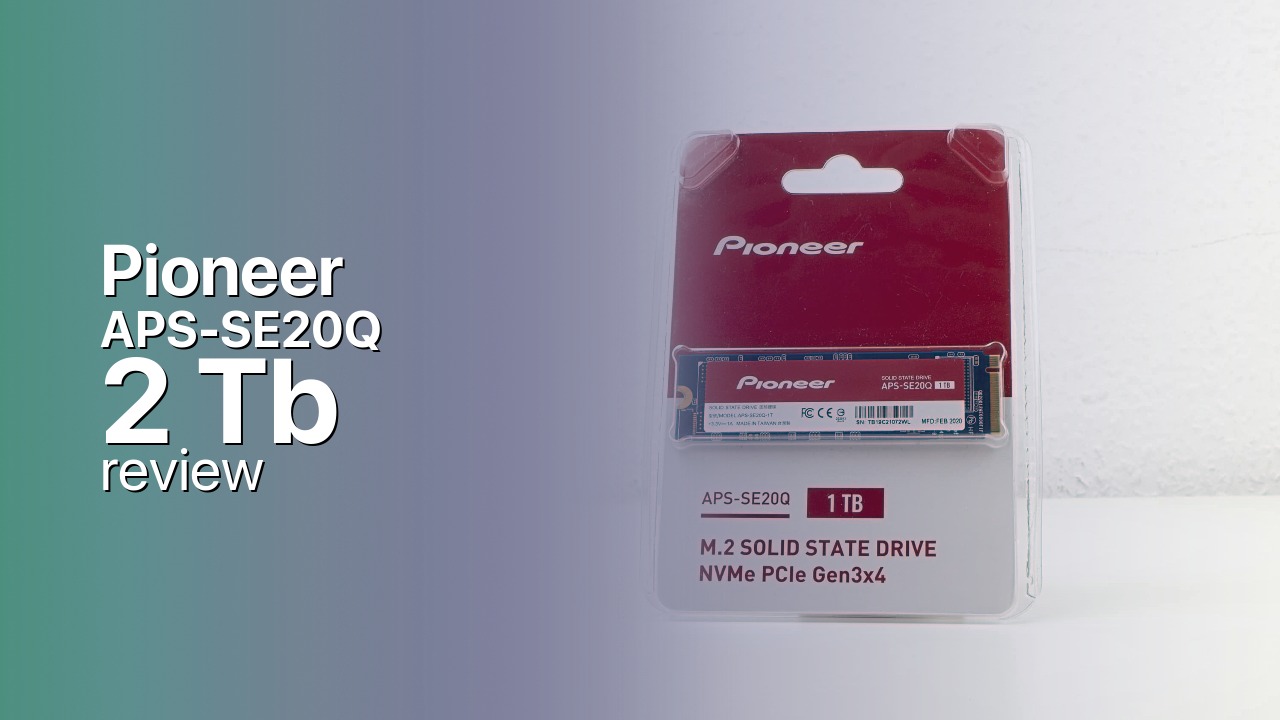
The APS-SE20Q is Pioneer's debut QLC SSD, and the 2TB model is where the platform makes the most sense. With 2 TB of Micron 96-layer 3D QLC NAND managed by a Phison PS5012-E12S-32 controller and backed by 512 MB of DDR3 DRAM, the drive targets users who need substantial NVMe storage without paying TLC prices. The 2TB capacity provides the most spare area in the lineup for the SLC cache and background garbage collection, which helps sustain write performance as the drive fills.
The single-sided 1.35 mm PCB is a standout physical feature. Most 2TB M.2 drives are double-sided, which can cause clearance issues in ultrabooks and some ITX motherboards. The APS-SE20Q avoids this entirely. It runs NVMe 1.3 over PCIe 3.0 x4 and includes ECC error correction, static and dynamic wear leveling, and thermal throttling at approximately 80°C.
Pioneer sells the APS-SE20Q in 500GB, 1TB, and 2TB capacities. The 2TB model is the best-performing variant in the range — not because the controller or NAND changes, but because the larger capacity provides more room for the SLC cache to operate and more overprovisioning for garbage collection. For users building a large game library or working with moderately sized media projects, the 2TB hits a practical sweet spot.
The main competitors are the Intel 660p 2TB and Crucial P1 2TB, both using the same Phison E12 QLC platform. Those drives offer 400 TBW endurance and 5-year warranties, making them stronger on paper. The WD Blue SN570 2TB is a TLC alternative with a DRAM-less HMB design that trades dedicated cache for a lower price.
Storage Comparisons:
APS-SE20Q Performance & Benchmarks
Pioneer rates the APS-SE20Q 2TB at up to 3,400 MB/s sequential reads and 3,000 MB/s sequential writes, with random reads up to 650,000 IOPS. Independent testing by Allround-PC on the 2TB model showed the drive actually exceeding its ratings — sequential reads reached 3,462 MB/s and writes hit 3,052 MB/s, both slightly above spec.
Pioneer APS-SE20Q 2 TB vs M.2 3.0 x 4 peers
Switch between sequential throughput and random IOPS to see how this drive stacks up against other M.2 3.0 x 4 SSDs in our database. The highlighted bar is the drive on this page — click any other bar to open that drive.
- ADATA SX 8800 Pro 512 GB: 3,500 MB/s read, 2,700 MB/s write
- ADATA SX 8800 Pro 1 TB: 3,500 MB/s read, 2,700 MB/s write
- ADATA XPG Spectrix S40G RGB 256 GB: 3,500 MB/s read, 3,000 MB/s write
- ADATA XPG Spectrix S40G RGB 512 GB: 3,500 MB/s read, 3,000 MB/s write
- Pioneer APS-SE20Q 2 TB (this drive): 3,400 MB/s read, 3,000 MB/s write
Random-access performance is consistently strong. Allround-PC noted that the drive delivered stable results across different block sizes, with write performance in particular benefiting from a well-implemented SLC cache. In real-world file-copy tests using a RAM disk as the source, the 2TB model posted excellent transfer rates for both large ISO images and mixed game-folder transfers. The larger capacity means the SLC cache has more room to breathe, so the performance drop after cache exhaustion is less dramatic than on the 500GB variant.
With only 10 GB of free space remaining — simulating a nearly full drive — performance remains relatively stable as long as the workload stays within reasonable bounds. Under sustained heavy writes without a heatsink, the controller reaches 80°C and thermal throttling engages. A motherboard heatsink or thermal pad is recommended for users who regularly move large files.
Pioneer APS-SE20Q vs Competitors
See how the APS-SE20Q stacks up against other M.2 3.0 x 4 drives in our database:
Compare with rival drives:
Endurance, TBW & Warranty
Pioneer backs the APS-SE20Q 2TB with a 3-year limited warranty capped at 200 TBW. The allround-pc review specifically noted the 200 TBW figure applies to the 2TB model — roughly half the 400 TBW that competitors like the Intel 660p and Crucial P1 offer at the same capacity. At 200 TBW, a user writing 30 GB per day would take about 18 years to reach the endurance limit, so for typical consumer use the TBW is not a practical concern. The 3-year warranty window is the more binding limitation. Pioneer's regional support infrastructure is also less established than Intel's or Crucial's, which is worth considering for RMA peace of mind.
Pioneer APS-SE20Q 2 TB Specifications
| Category | Value |
|---|---|
| Capacity [?] | 2 TB |
| Interface [?] | M.2 3.0 x 4 |
| Controller [?] | Phison PS5012-E12S-32 |
| Memory type [?] | Micron 3D QLC |
| DRAM [?] | 512 MB DDR3 |
| Read speed (MB/s) [?] | 3400 |
| Write speed (MB/s) [?] | 3000 |
| Read IOPS [?] | 650000 |
| Write IOPS [?] | 350000 |
| Endurance (TBW) [?] | 200 |
| MTBF (million hours) [?] | 1500000 |
| Warranty (years) [?] | 3 |
Verdict: Is the APS-SE20Q Worth It in 2026?
The Pioneer APS-SE20Q 2TB is the strongest version of this platform, with the largest SLC cache headroom and the most consistent sustained-write performance in the lineup. It is a good fit for budget builders who need 2 TB of NVMe storage for a game library or general-purpose drive and can accept the lower endurance and shorter warranty. If warranty length and TBW are priorities, the Intel 660p 2TB is the safer alternative. If the APS-SE20Q 2TB is priced competitively in your region, it is a solid value.
+ Pros
- Exceeds rated 3,400/3,000 MB/s sequential speeds
- Dedicated 512 MB DDR3 DRAM cache
- Single-sided 1.35 mm PCB — fits ultrabooks
- Well-tuned SLC cache with large 2TB overhead
- Consistent random-access performance across block sizes
- Cons
- 200 TBW — half the endurance of Intel 660p 2TB
- 3-year warranty (competitors offer 5)
- QLC NAND limits sustained write throughput
- Thermal throttling at 80°C without heatsink
- Limited regional availability and Pioneer support network
Buy this or similar SSD Storage:



Video Review
Pioneer APS-SE20G-2T (2TB NVME SSD) | ThermalRight M.2 NVME Heatsink