Sabrent Rocket 4 Plus 8TB Review — The Highest-Capacity Consumer M.2 NVMe SSD (2026)
Quick answer
The Sabrent Rocket 4 Plus 8 TB is a purpose-built drive for a narrow audience: professionals and enthusiasts who need 8 TB of fast NVMe storage on a single M.2 slot and are willing to pay a significant premium for the density.
Read: 7000 MB/s Write: 6000 MB/s Endurance: 5600 TBW Warranty: 5 years Interface: M.2 4.0 x 4
The Sabrent Rocket 4 Plus 8 TB is the drive you buy when four terabytes is not enough — it crams 8 TB of TLC NAND onto a single double-sided M.2 2280 PCB using a unique NAND configuration that no other Phison E18 drive at this capacity replicates.
Controller & Memory
The Sabrent Rocket 4 Plus 8 TB builds on the Phison PS5018-E18 controller — an eight-channel, quad-core ARM Cortex-R5 design on TSMC 12nm — but deviates from the standard E18 playbook in one critical area: NAND selection. While the 1 TB through 4 TB Rocket 4 Plus variants use Micron 176-layer B47R TLC, the 8 TB model switches to Kioxia BiCS5 112-layer TLC. The reason is PCB real estate — fitting 8 TB of NAND into a single M.2 2280 stick requires 64 individual 128 GB Kioxia packages arranged on both sides of the PCB, and the higher-density BiCS5 packages made this possible where Micron B47R could not. The trade-off is performance: BiCS5 is a generation older than B47R, and the firmware was not fully optimized for the high die count, meaning the 8 TB model is actually slower than the 4 TB variant in many workloads despite sharing the same controller.
The drive includes 2 GB of SK Hynix DDR4-3200 DRAM as a cache buffer and supports the full NVMe 1.4 feature set including TRIM, SMART, and secure erase. It is available both as a bare drive and with a custom heatsink SKU designed specifically for the PlayStation 5, which Sabrent released after Sony's September 2023 firmware update raised the M.2 expansion bay's capacity limit from 4 TB to 8 TB. The PS5 heatsink variant replaces the console's expansion bay cover with a custom cooling plate — an unusual design choice that reflects the thermal challenge of keeping an 8 TB double-sided Gen4 drive cool inside a sealed console. Sabrent requires product registration within 90 days of purchase to activate the full 5-year warranty; unregistered drives carry only a 1-year warranty.
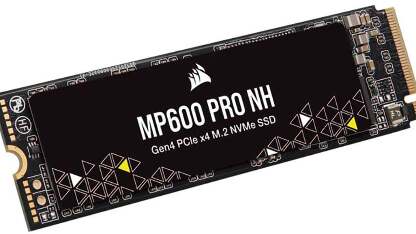
At launch, the Rocket 4 Plus 8 TB was priced at roughly $1,500, making it a niche product for content creators, media hoarders, and anyone who absolutely needed maximum single-slot capacity without resorting to slower SATA or external solutions. Current pricing has settled closer to $1,000. The drive competes most directly with the Corsair MP600 PRO NH 8 TB (same Phison E18 and BiCS5 platform, nearly identical specs) and the WD Black SN850X 8 TB (WD in-house controller, slightly faster at 7,200/6,600 MB/s). Among these, the Sabrent tends to be slightly more expensive than the Corsair equivalent and slightly slower than the WD. The Rocket 4 Plus 8 TB's unique selling point is that it was the first 8 TB consumer M.2 NVMe SSD to market, beating Corsair and WD by months.
Storage Comparisons:
Rocket 4 Plus Performance & Benchmarks
The Sabrent Rocket 4 Plus 8 TB is rated for 7,000 MB/s sequential reads and 6,000 MB/s sequential writes, with random performance of up to 700,000 IOPS reads and 1,000,000 IOPS writes. These figures are notably lower than the 4 TB variant's 7,100/6,600 MB/s ratings — a consequence of the Kioxia BiCS5 NAND's slower interface speed and firmware that was not fully tuned for the 64-die configuration. Independent reviewers at StorageReview and Tom's Hardware confirmed the performance gap, with the 8 TB model falling roughly 10 to 15 percent behind the 4 TB in some sequential and mixed workloads, and dropping more aggressively under sustained heavy writes.
Sabrent Rocket 4 Plus 8 TB vs M.2 4.0 x 4 peers
Switch between sequential throughput and random IOPS to see how this drive stacks up against other M.2 4.0 x 4 SSDs in our database. The highlighted bar is the drive on this page — click any other bar to open that drive.
- Patriot Viper PV593 1 TB: 14,500 MB/s read, 14,000 MB/s write
- Patriot Viper PV593 2 TB: 14,500 MB/s read, 14,000 MB/s write
- Patriot Viper PV593 4 TB: 14,500 MB/s read, 14,000 MB/s write
- Patriot Viper PV573 2 TB: 14,000 MB/s read, 12,000 MB/s write
- Sabrent Rocket 4 Plus 8 TB (this drive): 7,000 MB/s read, 6,000 MB/s write
In real-world use, the Rocket 4 Plus 8 TB sustains approximately 5,000 to 5,300 MB/s sequential writes in large transfers before any thermal or cache limitations appear — still an enormous amount of throughput that exceeds what most PCIe 3.0 drives can manage at peak. The Phison E18's dynamic pSLC cache is generously sized given the sheer volume of NAND available, and the drive maintains strong post-cache write speeds north of 1,500 MB/s in direct-to-TLC mode. Thermally, the 8 TB model runs surprisingly cool for its density. Neowin measured peak temperatures of 50 to 56 degrees Celsius under sustained sequential load, well below the E18's 84-degree throttle point, and observed no performance drop from thermal throttling during their test suite. This is partly due to the BiCS5 NAND's lower power draw per die compared to B47R and partly due to Sabrent's PCB design spreading heat across both sides of the board.
For the PS5, the 8 TB Rocket 4 Plus with the PS5-specific heatsink returns approximately 6,200 to 6,500 MB/s in the console's built-in speed test — comfortably above Sony's 5,500 MB/s minimum. The custom cooling plate design is effective but means the PS5's expansion bay cover must be removed and replaced with Sabrent's plate, which changes the console's appearance. For PC gaming, the 8 TB capacity is overkill for most users — a 2 TB or 4 TB drive costs far less per gigabyte and performs better — but for content creators managing large raw video libraries, 3D asset collections, or research datasets, the ability to keep everything on a single fast NVMe volume without spanning across multiple drives is the entire point.
Sabrent Rocket 4 Plus vs Competitors
See how the Rocket 4 Plus stacks up against other M.2 4.0 x 4 drives in our database:
Compare with rival drives:
Endurance, TBW & Warranty
Sabrent backs the Rocket 4 Plus 8 TB with a 5-year limited warranty conditional on product registration within 90 days of purchase, reverting to a 1-year warranty for unregistered drives. The endurance rating is 5,600 TBW — double the 4 TB variant's 2,800 TBW and among the highest total TBW figures available on any consumer SSD. At 5,600 TBW, the drive is rated to absorb approximately 3 TB of writes per day for the full warranty period, which exceeds even professional video editing and data processing workloads. At a typical 30 GB/day consumer pace, endurance extends beyond 500 years. The TBW scales linearly across the lineup: 700 TBW for 1 TB, 1,400 TBW for 2 TB, and 2,800 TBW for 4 TB. The MTBF, while not prominently published by Sabrent, is rated at 1.6 million hours, consistent with other Phison E18 implementations. Sabrent provides the Rocket Control Panel software for drive health monitoring and firmware updates, though reviewers have noted it is aesthetically basic compared to Samsung Magician or WD Dashboard. The Rocket 4 Plus does not include hardware-based AES-256 encryption, a limitation shared across the Phison E18 platform.
Sabrent Rocket 4 Plus 8 TB Specifications
| Category | Value |
|---|---|
| Capacity [?] | 8 TB |
| Interface [?] | M.2 4.0 x 4 |
| Controller [?] | Phison PS5018-E18 |
| Memory type [?] | Kioxia BiCS5 112L TLC |
| DRAM [?] | SK Hynix DDR4 Cache |
| Read speed (MB/s) [?] | 7000 |
| Write speed (MB/s) [?] | 6000 |
| Read IOPS [?] | 710000 |
| Write IOPS [?] | 1000000 |
| Endurance (TBW) [?] | 5600 |
| MTBF (million hours) [?] | 1600000 |
| Warranty (years) [?] | 5 |
Verdict: Is the Rocket 4 Plus Worth It in 2026?
The Sabrent Rocket 4 Plus 8 TB is a purpose-built drive for a narrow audience: professionals and enthusiasts who need 8 TB of fast NVMe storage on a single M.2 slot and are willing to pay a significant premium for the density. Content creators managing 8K raw footage, researchers working with large datasets, and gamers who refuse to uninstall anything will find the capacity liberating. The TLC NAND and 5,600 TBW endurance ensure the drive handles write-heavy workloads without the speed cliffs that plague QLC alternatives. Skip it if capacity per dollar is your primary concern — two 4 TB drives in RAID cost less and perform faster — or if you want the best possible Gen4 performance, in which case the 4 TB Rocket 4 Plus or the WD Black SN850X 8 TB are better tuned. The Rocket 4 Plus 8 TB's legacy is that it proved 8 TB was possible on a consumer M.2 form factor; the fact that it is now one of three such drives on the market is a testament to that achievement.
+ Pros
- 8 TB of TLC NAND on a single M.2 2280 — highest consumer capacity available
- 5,600 TBW endurance with 5-year warranty (with registration)
- Excellent thermals — stays under 56°C without throttling
- PS5 compatible with custom heatsink SKU
- DRAM cache ensures consistent performance under mixed workloads
- Phison E18 platform is mature, stable, and widely supported
- Cons
- Slower than 4 TB variant due to BiCS5 NAND and firmware limitations
- Extremely expensive — approximately $1,000 at retail
- 5-year warranty requires product registration within 90 days
- Double-sided PCB incompatible with many thin laptops
- No hardware encryption support
- Corsair MP600 PRO NH 8 TB offers identical specs at a lower price
Buy this or similar SSD Storage:



Video Review
Sabrent 8TB Rocket 4 Plus 2280 TLC NAND SSD Revealed