SanDisk Extreme Pro 500GB — Flagship PCIe 3.0 NVMe SSD (2026)
Quick answer
The SanDisk Extreme Pro 500 GB is a PCIe 3.0 flagship that has aged into a value proposition.
Read: 3400 MB/s Write: 2500 MB/s Endurance: 300 TBW Warranty: 5 years Interface: M.2 3.0 x 4
The SanDisk Extreme Pro 500GB was the company's flagship consumer NVMe drive at launch, pairing an in-house 8-channel controller with DRAM cache and 64-layer 3D TLC to push PCIe 3.0 to its practical limits.
Controller & Memory
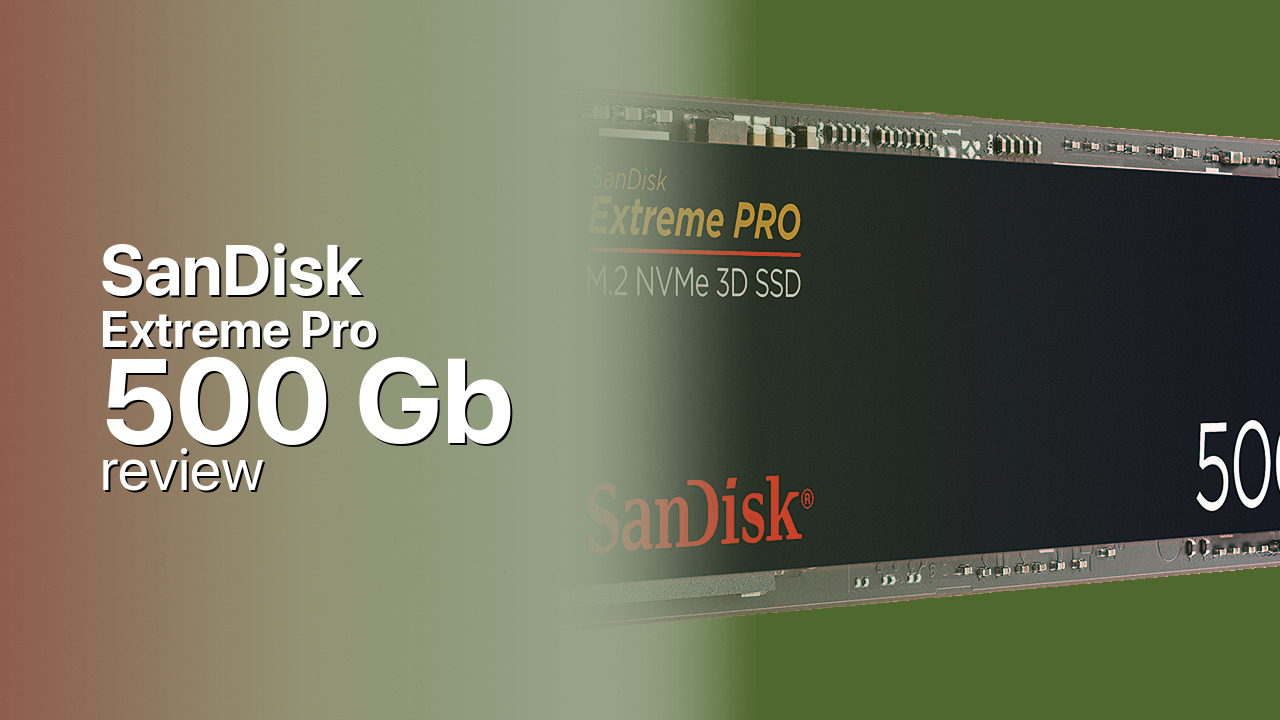
The SanDisk Extreme Pro M.2 NVMe 3D is built on the same hardware platform as the WD Black NVMe (2018 edition), reflecting the integration of SanDisk's SSD engineering into Western Digital's product stack following the acquisition. The drive uses a SanDisk in-house 8-channel controller (model 20-82-007011) paired with a DRAM cache — 512 MB of DDR3 on the 500 GB model — and SanDisk 64-layer 3D TLC NAND (BiCS3). The M.2 2280 PCB is single-sided, fitting in thin laptops and any standard M.2 slot. Available capacities span 250 GB, 500 GB, and 1 TB.
The 500 GB variant is rated at up to 3,400 MB/s sequential reads and 2,500 MB/s sequential writes, with the 1 TB model stepping up to 2,800 MB/s writes. These numbers place the Extreme Pro at the top of the PCIe 3.0 performance tier — the 3,400 MB/s read rating is near the interface's practical ceiling of roughly 3,500 MB/s for an 8-channel design. Formatted capacity is approximately 465 GB in Windows, suitable for an operating system and a solid application suite.
At launch the Extreme Pro competed against the Samsung 970 EVO and 970 PRO, and it held its own in sequential throughput while offering a more aggressive price. Today, the drive occupies an unusual position: it is a PCIe 3.0 flagship in a market that has moved to PCIe 4.0, making it a compelling value for users with PCIe 3.0 systems who want the best possible performance from that interface. The DRAM cache and 8-channel controller give it a latency and consistency advantage over modern DRAM-less PCIe 4.0 drives at similar prices, at the cost of peak throughput that caps out below even entry-level PCIe 4.0 offerings.
Storage Comparisons:
Extreme Pro Performance & Benchmarks
SanDisk rates the 500 GB Extreme Pro at up to 3,400 MB/s sequential reads and 2,500 MB/s sequential writes, with random performance of approximately 410,000 IOPS read and 330,000 IOPS write. These figures represent the upper bound of what PCIe 3.0 x4 can deliver in a consumer SSD — the 3,400 MB/s reads are within 100 MB/s of the interface ceiling, and real-world testing by multiple independent reviewers at the time of launch confirmed the drive consistently hits its rated speeds.
SanDisk Extreme Pro 500 GB vs M.2 3.0 x 4 peers
Switch between sequential throughput and random IOPS to see how this drive stacks up against other M.2 3.0 x 4 SSDs in our database. The highlighted bar is the drive on this page — click any other bar to open that drive.
- ADATA SX 8800 Pro 512 GB: 3,500 MB/s read, 2,700 MB/s write
- ADATA SX 8800 Pro 1 TB: 3,500 MB/s read, 2,700 MB/s write
- ADATA XPG Spectrix S40G RGB 256 GB: 3,500 MB/s read, 3,000 MB/s write
- ADATA XPG Spectrix S40G RGB 512 GB: 3,500 MB/s read, 3,000 MB/s write
- SanDisk Extreme Pro 500 GB (this drive): 3,400 MB/s read, 2,500 MB/s write
The 8-channel controller and dedicated DRAM cache give the Extreme Pro a meaningful advantage in sustained mixed-workload performance over DRAM-less alternatives. Where modern HMB-based PCIe 4.0 drives rely on system RAM borrowed over the PCIe bus for mapping-table lookups, the Extreme Pro's on-board DRAM handles these operations with lower latency and without consuming system resources. This translates to more consistent responsiveness under heavy multitasking and better sustained write performance after the SLC cache fills — the native TLC write speeds remain above 1,000 MB/s on the 500 GB model.
Independent benchmarking from the drive's 2018 launch window consistently ranked the Extreme Pro alongside the Samsung 970 EVO as the best consumer PCIe 3.0 drives available. The Samsung held an edge in some random I/O workloads, while the SanDisk often matched or exceeded it in sequential throughput and sustained writes. For gaming, content consumption, and general desktop use in a PCIe 3.0 system, the Extreme Pro delivers performance that modern DRAM-less PCIe 4.0 drives struggle to match in all but peak sequential throughput.
SanDisk Extreme Pro vs Competitors
See how the Extreme Pro stacks up against other M.2 3.0 x 4 drives in our database:
Compare with rival drives:
Endurance, TBW & Warranty
SanDisk backs the Extreme Pro 500 GB with a 5-year limited warranty capped at 300 TBW endurance. The 300 TBW rating works out to 600 TBW per terabyte — solid for a consumer TLC drive from this generation. At a typical daily write load of 20 to 30 GB, the drive would last 27 to 41 years before approaching the TBW ceiling. The capacity-specific endurance scaling is notable: the 250 GB model carries 200 TBW, the 500 GB model 300 TBW, and the 1 TB model 600 TBW — the 1 TB variant offers the best endurance-per-dollar ratio. SanDisk's RMA process is handled through Western Digital's warranty infrastructure, which provides a well-established global support network. The 5-year window runs from the original purchase date.
SanDisk Extreme Pro 500 GB Specifications
| Category | Value |
|---|---|
| Capacity [?] | 500 GB |
| Interface [?] | M.2 3.0 x 4 |
| Controller [?] | SanDisk Triton MP28 |
| Memory type [?] | SanDisk/Toshiba BiCS3 64L 3D TLC |
| DRAM [?] | 512MB DDR4 |
| Read speed (MB/s) [?] | 3400 |
| Write speed (MB/s) [?] | 2500 |
| Read IOPS [?] | 410000 |
| Write IOPS [?] | 330000 |
| Endurance (TBW) [?] | 300 |
| MTBF (million hours) [?] | 2000000 |
| Warranty (years) [?] | 5 |
Verdict: Is the Extreme Pro Worth It in 2026?
The SanDisk Extreme Pro 500 GB is a PCIe 3.0 flagship that has aged into a value proposition. Its 8-channel controller, dedicated DRAM cache, and mature firmware deliver better real-world consistency than modern DRAM-less PCIe 4.0 drives at similar prices, even if the peak throughput numbers on the box look lower. It is best suited for a PCIe 3.0 system that will never see a PCIe 4.0 upgrade — an older gaming desktop, a Haswell-era workstation, or a laptop with a fixed PCIe 3.0 M.2 slot. Skip it if your system supports PCIe 4.0 and you want peak sequential throughput, or if you need more than 500 GB of capacity — the 1 TB variant is the better buy for both endurance and performance. The Extreme Pro's controller architecture and DRAM cache make it a reminder that peak bandwidth numbers do not tell the whole story of how a drive feels in daily use.
+ Pros
- 3,400 MB/s reads, near the PCIe 3.0 x4 ceiling
- Dedicated DRAM cache (512 MB DDR3 on 500 GB model)
- 8-channel SanDisk in-house controller with mature firmware
- 5-year warranty with WD's global RMA infrastructure
- Single-sided M.2 2280 PCB fits thin laptops
- Strong sustained write performance for a PCIe 3.0 TLC drive
- Cons
- Limited to PCIe 3.0, cannot match PCIe 4.0 peak throughput
- 300 TBW endurance on 500 GB trails 1 TB variant's ratio
- Older 64-layer NAND generation versus modern 176-layer TLC
- No longer a current-generation product, limited retail availability
Buy this or similar SSD Storage:



Video Review
New Sandisk Extreme and Extreme Pro Portable SSD Review - NVME Upgrade!