The Team Group T-Force GC Pro 4 TB runs Innogrit's IG5666 controller (2026)
Quick answer
Buy the Team Group T-Force GC Pro 4 TB if a recent desktop platform with PCIe 5.0 is in the build and the priority is a large, fast game and project library rather than top-of-the-chart benchmark numbers.
Read: 12500 MB/s Write: 11000 MB/s Endurance: 2400 TBW Warranty: 5 years Interface: M.2 5.0
The Team Group T-Force GC Pro 4 TB delivers real PCIe 5.0 bandwidth at 12,500 MB/s reads, sitting below flagship Gen5 drives on speed but well ahead of any PCIe 4.0 rival.
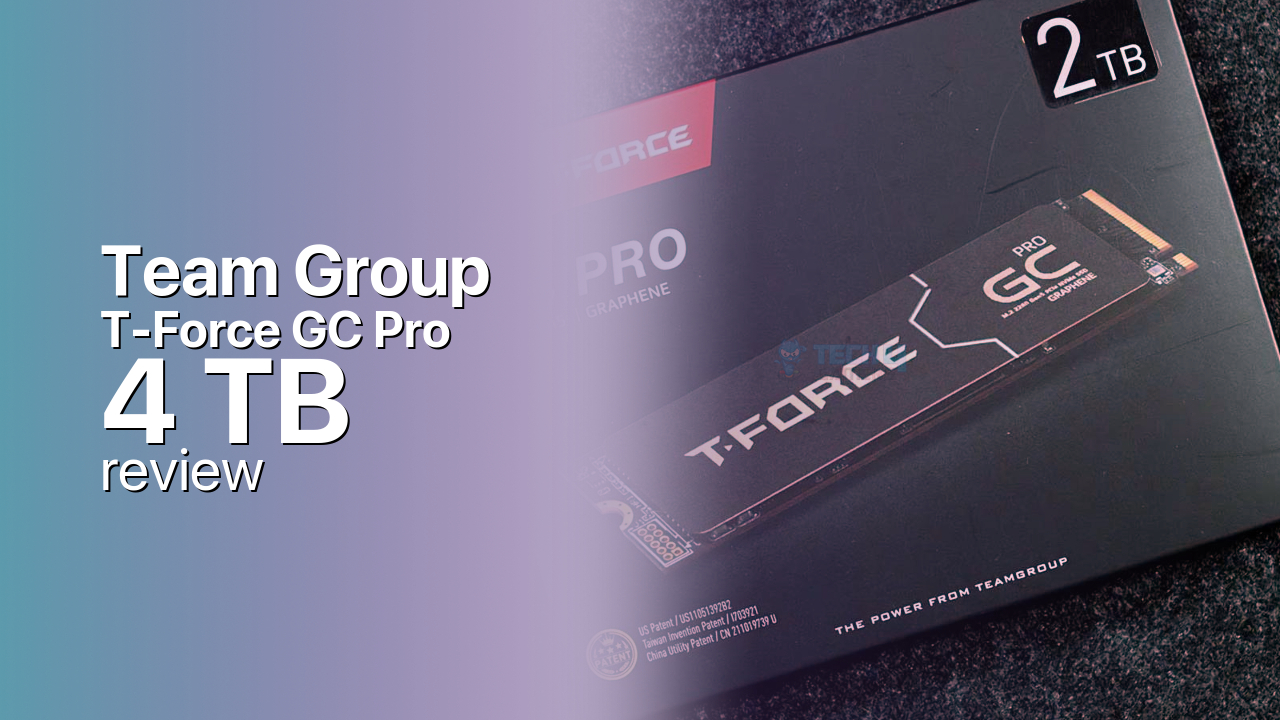
Controller & Memory
The Team Group T-Force GC Pro 4 TB is the capacity to choose for PCIe 5.0 headroom and a deep game library, not for chasing benchmark records. Team Group built it on the Innogrit IG5666 controller paired with YMTC 232-layer TLC NAND and a DRAM buffer, all on a standard M.2 2280 module keyed for PCIe 5.0 x4. That combination places the drive in the mid-tier of the Gen5 field: clearly quicker than any PCIe 4.0 part, but a step off the peak set by flagships like the Crucial T705.
The GC Pro ships only in 2 TB and 4 TB, with no 1 TB option, and both capacities share the same 12,500 MB/s read and 11,000 MB/s write ratings. Endurance scales on a 600 TBW-per-TB formula, so the 4 TB carries a 2400 TBW rating against 1200 TBW on the 2 TB. The bare drive arrives without a heatsink, and given the heat a Gen5 module generates under sustained writes, a motherboard with integrated M.2 cooling or a third-party heatsink is essential; a graphene-covered variant exists for builders who want a pre-fitted solution. Recent Intel and AMD desktop platforms take full advantage of the PCIe 5.0 link, while older boards and laptops fall back to Gen4 or Gen3. The 4 TB also works in a PS5, but the console's expansion slot is PCIe 4.0, so the drive's Gen5 speed goes largely unused there.
Against the wider field, the Crucial T705 and WD SN8100 pull ahead on peak throughput, while the Samsung 990 Pro remains the smarter pick for any board that tops out at PCIe 4.0. The 4 TB GC Pro's case is the middle ground: genuine Gen5 speed and 4 TB of fast storage in a single M.2 slot, sitting beneath the flagships on peak numbers.
Storage Comparisons:
T-Force GC Pro Performance & Benchmarks
The 4 TB GC Pro is rated for 12,500 MB/s sequential reads and 11,000 MB/s sequential writes on a PCIe 5.0 x4 link, well clear of the PCIe 4.0 band that tops out around 7,450 MB/s read. Team Group does not publish random IOPS figures for the GC Pro, so there is no official 4K number to quote; the drive's strengths sit firmly in the sequential, large-file lane rather than the random-read territory that defines OS and game-load responsiveness.
Team Group T-Force GC Pro 4 TB vs M.2 5.0 peers
Switch between sequential throughput and random IOPS to see how this drive stacks up against other M.2 5.0 SSDs in our database. The highlighted bar is the drive on this page — click any other bar to open that drive.
- Corsair MP700 Pro XT 1 TB: 14,900 MB/s read, 14,200 MB/s write
- Corsair MP700 Pro XT 2 TB: 14,900 MB/s read, 14,500 MB/s write
- Corsair MP700 Pro XT 4 TB: 14,900 MB/s read, 14,400 MB/s write
- Crucial T710 1 TB: 14,900 MB/s read, 13,800 MB/s write
- Team Group T-Force GC Pro 4 TB (this drive): 12,500 MB/s read, 11,000 MB/s write
For real workloads, that sequential headroom shows up most in direct-attached large-file transfers, video project scratch disks, and DirectStorage-enabled titles that can pull texture assets straight from the SSD. Game load times, however, are bottlenecked elsewhere in the system, so the gap between this drive and a good PCIe 4.0 model in everyday play is narrow rather than dramatic. Independent reviewers find the GC Pro lands in the practical mid-band of Gen5, reaching its rated peaks in short bursts but trailing flagship drives like the Crucial T705 once the SLC cache fills and writes settle to their sustained pace.
The SLC cache behaves as expected for a TLC drive with a DRAM buffer: writes run at full speed until the allocated cache is exhausted, then drop to the native YMTC TLC write rate, which is the pattern to plan around for sustained, multi-hundred-gigabyte transfers.
Team Group T-Force GC Pro vs Competitors
See how the T-Force GC Pro stacks up against other M.2 5.0 drives in our database:
Compare with rival drives:
Endurance, TBW & Warranty
Team Group covers the GC Pro with a five-year limited warranty, and the 4 TB carries a 2400 TBW endurance rating, whichever limit comes first. That TBW figure is enormous in practical terms: 2400 TBW is roughly 2.4 petabytes of writes, which works out to over three centuries at a steady 20 GB per day. Even a heavy creator writing 200 GB daily would need around 33 years to exhaust it, so for almost any real owner the warranty period, not the TBW, is the binding constraint.
Team Group does not publish an MTBF figure for the GC Pro, and the broader Gen5 class typically lands around 1.6 to 2 million hours; treat any such number as a population-reliability statistic computed across many units, not a guarantee that a single drive will run for two centuries. Keep the drive adequately cooled, since sustained thermal throttling on Gen5 modules is the most common real-world threat to longevity.
Team Group T-Force GC Pro 4 TB Specifications
| Category | Value |
|---|---|
| Capacity [?] | 4 TB |
| Interface [?] | M.2 5.0 |
| Controller [?] | Innogrit IG5666 |
| Memory type [?] | YMTC 232-L TLC |
| DRAM [?] | Yes |
| Read speed (MB/s) [?] | 12500 |
| Write speed (MB/s) [?] | 11000 |
| Read IOPS [?] | n/a |
| Write IOPS [?] | n/a |
| Endurance (TBW) [?] | 2400 |
| MTBF (million hours) [?] | 2000000 |
| Warranty (years) [?] | 5 |
Verdict: Is the T-Force GC Pro Worth It in 2026?
Buy the Team Group T-Force GC Pro 4 TB if a recent desktop platform with PCIe 5.0 is in the build and the priority is a large, fast game and project library rather than top-of-the-chart benchmark numbers. Skip it for a PS5, a laptop, or any board still limited to PCIe 4.0, where the Gen5 link goes unused and a PCIe 4.0 drive delivers the same real-world experience. A Samsung 990 Pro 4 TB is the natural PCIe 4.0 alternative, while the Crucial T705 4 TB is the answer for anyone who wants flagship Gen5 peak speed. We read the 4 TB GC Pro as a sensible mid-tier Gen5 bet: 4 TB of genuine PCIe 5.0 throughput and a 2400 TBW cushion, traded knowingly against the last word in raw speed.
+ Pros
- 12,500 MB/s Sequential Reads On PCIe 5.0
- 11,000 MB/s Sequential Writes On PCIe 5.0
- 2400 TBW Endurance On The 4 TB
- YMTC 232-Layer TLC NAND With DRAM Buffer
- Innogrit IG5666 PCIe 5.0 Controller
- Optional Graphene-Covered Heatsink Variant
- Cons
- No Heatsink Included With The Bare Drive
- Gen5 Speed Wasted On PCIe 4.0 Boards And PS5
- Random IOPS Unrated By Team Group
- Trails Flagship Gen5 Drives Like The T705
- No 1 TB Capacity Option Available
Buy this or similar SSD Storage:



Video Review
TEAMGROUP T-FORCE GC PRO Gen5x4 2TB - Review